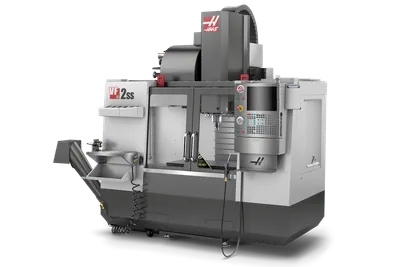
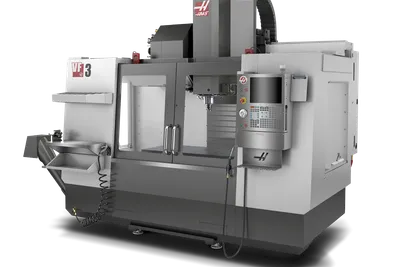
OKK HP300S
Key Specifications
X Travel
Y Travel
Z Travel
Max Spindle
Spindle Taper
Table Size
Overview
The OKK HP300S is a high-speed, high-precision vertical machining center designed for small-to-medium precision parts in the die and mold, electronics, medical device, and precision engineering sectors. The HP designation in OKK's lineup indicates a high-speed precision machine — a distinct product category from OKK's standard VMC line, emphasizing spindle speed, surface finish quality, and thermal stability over the heavy-cutting rigidity focus of the VB series. The HP300S targets applications where part complexity, surface finish requirements, and dimensional accuracy demand performance beyond what general-purpose VMCs deliver.
OKK builds the HP300S on a compact, thermally-optimized base designed to minimize thermal growth from the spindle, drives, and coolant systems during sustained high-speed operation. Spindle thermal growth in Z is a primary accuracy enemy in high-speed VMCs, where spindle motor heat increases continuously with RPM and duty cycle. OKK addresses this through hollow-shaft motor integration, spindle cooling jacket with controlled-temperature coolant flow, and active thermal compensation using sensor arrays that continuously adjust the Z-axis offset to counteract measured spindle growth — maintaining Z positioning accuracy within specification regardless of spindle speed and running time.
The HP300S spindle runs to 30,000 or 40,000 RPM on an HSK-E50 or HSK-E40 taper, enabling cutting speeds appropriate for small-diameter carbide tooling in die steel finishing, graphite electrode machining, and aluminum high-speed contouring. At 30,000–40,000 RPM, a 1 mm ball-nose end mill cuts at appropriate surface speeds (around 94–125 m/min) while maintaining chip load in the range that controls tool deflection and surface finish quality. The HP300S's high spindle speed combined with fine-resolution linear scales on all axes enables surface finish quality (Ra) figures competitive with dedicated jig boring machines for certain application types.
OKK's Fanuc 31i-B5 control on the HP300S is configured with the high-speed surface control parameters optimized for 3D contouring — block processing speed, look-ahead buffer depth, and acceleration/deceleration profiles tuned for smooth velocity transitions on complex surface programs from CAM systems. Nano-interpolation between command points produces smoother actual tool paths than standard interpolation, reducing surface roughness at the axis-reversal points that cause visible scallops in high-speed machining of sculptured surfaces.
Pricing for the OKK HP300S ranges from approximately $280,000 to $400,000 depending on spindle speed (30K vs 40K), control options, and accessories. This positions it in the high-speed precision VMC segment alongside Makino F3, Matsuura MX-330, and Yasda YMC 430 — machines where the buyer is paying specifically for speed, surface finish, and thermal accuracy performance that standard VMCs cannot deliver.
Full Specifications
| Parameter | Value |
|---|---|
| X-Axis Travel | 300 mm (11.8 in) |
| Y-Axis Travel | 300 mm (11.8 in) |
| Z-Axis Travel | 300 mm (11.8 in) |
| Table Size | 450 x 300 mm (17.7 x 11.8 in) |
| Max Workpiece Weight | 200 kg (441 lb) |
| Max Spindle Speed | 30,000 RPM (40,000 RPM option) |
| Spindle Taper | HSK-E50 (30K) / HSK-E40 (40K) |
| Spindle Motor Power | 11 kW (15 hp) |
| Rapid Traverse Rate | 60 m/min (X/Y/Z) |
| Feed Rate Max | 60,000 mm/min |
| Tool Changer Capacity | 30 tools (arm-type ATC) |
| Tool Change Time | 1.5 sec (tool-to-tool) |
| Positioning Accuracy | ±0.002 mm |
| Repeatability | ±0.001 mm |
| Resolution | 0.1 µm (linear scales, all axes) |
| Guideway Type | Linear roller guideways (X/Y/Z) |
| Spindle Thermal Compensation | Active sensor-based Z-axis compensation |
| Through Spindle Coolant | MQL standard (40 bar optional) |
| CNC Control | Fanuc 31i-B5 with high-speed surface control |
| Machine Weight | 6,000 kg (13,228 lb) approx. |
Specifications compiled from manufacturer literature and industry references. Not independently verified against a published spec sheet — confirm with the manufacturer or an authorised dealer before making a purchasing decision.
Strengths & Limitations
Strengths
- 30,000–40,000 RPM spindle enables precise cutting with 0.5–2 mm diameter carbide tools at proper surface speeds, producing surface finish quality on die steel and hardened tool steel that standard 12K–20K VMCs cannot achieve
- Active spindle thermal compensation maintains Z-axis accuracy within ±0.002 mm during sustained high-speed operation — eliminating the dimensional drift that plagues uncompensated high-speed VMCs during warm-up and temperature changes
- 0.1 µm linear scale resolution and nano-interpolation in the Fanuc 31i-B5 control produce smoother actual tool paths than standard VMCs, visibly reducing surface roughness on complex 3D cavity surfaces machined at high feed rates
- OKK's precision manufacturing heritage applied to a high-speed platform delivers better long-term geometric stability than many Taiwanese high-speed VMC competitors — accuracy that holds up after years in a demanding mold shop environment
- 60 m/min rapid traverse reduces non-cutting time on programs with frequent repositioning moves, maintaining productive spindle utilization in high-mix, short-cycle-time programs typical of precision mold insert work
Limitations
- 300 mm X/Y/Z work envelope is compact — the HP300S is a specialist machine for small precision parts; shops that occasionally need to machine parts exceeding 300 mm must maintain a separate larger VMC alongside it
- HSK-E50 / HSK-E40 tooling ecosystem is smaller than BT 40 / BT 50 — fewer readily available tool options, higher tooling cost for equivalent configurations, and more limited selection of specialty tooling assemblies
- $280K–$400K for a 300 mm travel machine is a significant price-to-envelope ratio — buyers must clearly justify the performance requirement for high-speed precision over a standard high-quality VMC at lower cost
Best For
Frequently Asked Questions
01
The OKK VP-600 is a mid-range precision VMC with a 600 mm X-travel envelope focused on structural rigidity and mid-range accuracy for die and mold work. The HP300S is a high-speed specialist machine in the 300 mm travel class, optimized specifically for the highest spindle speeds (30K–40K RPM), finest surface finish quality, and thermal accuracy stability for small-part precision work. The VP-600 is the more versatile production machine; the HP300S is the right choice when the application specifically requires 30,000+ RPM, maximum surface finish quality, or very small part precision that exceeds the VP-600's capability.
02
Yes. Graphite electrode machining for sinker EDM is one of the HP300S's primary application areas. Graphite at 30,000–40,000 RPM with HSK tooling and appropriate carbide or diamond-coated tooling produces electrode surfaces with Ra values in the 0.2–0.4 µm range directly from the machine, reducing or eliminating the grinding and polishing steps required when electrodes are machined on lower-speed equipment. Key requirements for graphite machining include dust collection (graphite dust is electrically conductive and abrasive), MQL or dry machining rather than flood coolant (graphite degrades with water), and appropriate spindle seals to prevent graphite ingress into spindle bearings.
03
For the HP300S's primary applications in die and mold, the most commonly used CAM systems are Hypermill (Open Mind), PowerMill (Autodesk), Mastercam, and NX CAM. All support the high-speed machining toolpath strategies (3D offset, scallop height-controlled parallel finishing, pencil tracing) required for complex mold cavity machining. The key CAM requirement for the HP300S is a system that can maintain consistent chip load through variable-curvature surfaces — systems with adaptive feed rate control through tight corners and cusp areas protect the small-diameter tooling and maintain surface finish quality. Fanuc post-processors for 31i-B5 are widely available from all major CAM vendors.
04
OKK installs temperature sensors at multiple points in the spindle housing, spindle motor, and machine structure. A thermal growth model — calibrated empirically for the specific machine's thermal behavior — uses real-time sensor readings to calculate the expected Z-axis displacement caused by spindle motor heat and structural temperature changes. The control continuously adjusts the Z-axis zero offset to counteract this calculated displacement, maintaining the spindle tip's Z position within specification regardless of spindle running time, speed, and load history. This is different from a simple warm-up program: compensation is active throughout the shift, not just at machine start.
05
The HP300S ATC is designed for the small-diameter, short-reach tooling appropriate for precision high-speed machining. Maximum tool diameter is typically 80 mm (adjacent pockets occupied) or 120 mm (adjacent pockets empty). Maximum tool length is 250 mm. Maximum tool weight is 3 kg. These limits reflect the machine's application focus on small-to-medium precision parts where tool sizes are primarily in the 0.5–20 mm diameter range. Large face mills and high-diameter roughing tools are not the intended application; if occasional larger-diameter roughing is required, a separate roughing machine is the standard approach in shops using the HP300S as a dedicated precision finisher.
Videos

Utkarsh Singh

Shark Home

Shark Home

Consumer Analysis

Adam's Faves
Community Discussions
Community discussion — OKK - Page 3 - CNCzone
Community discussion — OKK - CNCzone
Community discussion — OKK - Page 2 - CNCzone
Community discussion — OKK - Page 5 - CNCzone
Community discussion — Okuma...Love or Hate? : r/Machinists - Reddit
Owner experience and review — Okuma Multus B400II + B300II : r/Machinists - Reddit
Troubleshooting and problem-solving — Okuma Problem.. : r/Machinists - Reddit
Pricing and buying discussion — What are your experience with okuma machines? :
Links to community discussions. Summaries are editorial — visit the original thread for full context.