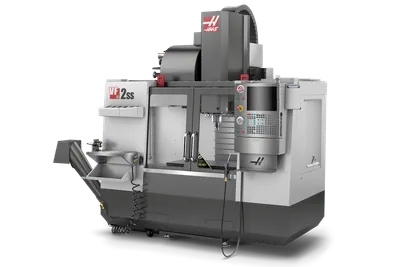
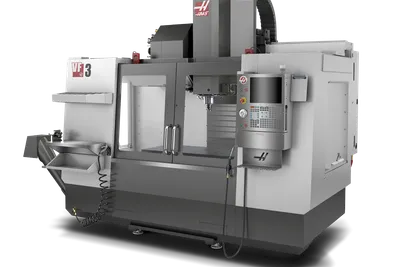
Mitsui Seiki VMC760A
Key Specifications
X Travel
Y Travel
Z Travel
Spindle Taper
Tool Capacity
Table Size
Overview
The Mitsui Seiki VMC760A is a precision vertical machining center with a 760 x 430 mm table, designed for shops that need the access and setup simplicity of a VMC with accuracy levels that most VMCs cannot approach. Where standard VMCs are built to a commercial accuracy standard of ±0.005 mm, the VMC760A is manufactured to ±0.002 mm positioning accuracy with ±0.001 mm repeatability — specifications enforced by full-closed-loop linear scale feedback on all three axes and the same thermal compensation techniques Mitsui Seiki applies to their horizontal line.
The VMC760A is built on a Meehanite cast iron column and base, with induction-hardened and precision-ground box ways on all axes. The 760 x 430 mm table accommodates workpieces up to 800 kg (1,764 lb). X/Y/Z travels are 760 x 430 x 460 mm. The inline direct-drive spindle runs to 12,000 RPM at 15 kW (20 hp) in No. 40 taper; a 20,000 RPM high-speed variant is optional for aluminum and non-ferrous work.
The VMC760A's target buyer is the precision mold maker, optical housing manufacturer, or aerospace sub-supplier who needs a VMC form factor for operator accessibility but won't accept the thermal drift and positional uncertainty of a standard knee mill or budget VMC. It competes with the Makino V56, Matsuura MX-520, and Fanuc Robodrill at the upper end, but the Mitsui Seiki's box way construction and guaranteed accuracy specification differentiate it from all three.
A 24-tool ATC is standard with an optional 40-tool magazine. The machine accepts the FANUC 31i-B5 control standard, with Siemens 840D sl as an option. Every VMC760A ships with a laser-calibrated axis accuracy certificate.
Full Specifications
| Parameter | Value |
|---|---|
| Table Size | 760 x 430 mm (29.9 x 16.9 in) |
| X-Axis Travel | 760 mm (29.9 in) |
| Y-Axis Travel | 430 mm (16.9 in) |
| Z-Axis Travel | 460 mm (18.1 in) |
| Max Table Load | 800 kg (1,764 lb) |
| Spindle Taper | No. 40 (CAT40 / BT40 / HSK-A63) |
| Spindle Speed | 12,000 RPM (standard) / 20,000 RPM (option) |
| Spindle Motor Power | 15 kW (20 hp) continuous / 18.5 kW (25 hp) 30-min |
| Spindle Nose To Table | 100–560 mm (3.9–22.0 in) |
| Rapid Traverse Rate | 30 m/min (1,181 ipm) X/Y; 24 m/min (945 ipm) Z |
| Feed Rate | 1–10,000 mm/min |
| Positioning Accuracy | ±0.002 mm (±0.00008 in) full stroke |
| Repeatability | ±0.001 mm (±0.00004 in) |
| Feedback | Full-closed loop linear scales, all axes |
| Thermal Compensation | Spindle oil cooling, ballscrew thermal compensation |
| Tool Capacity | 24 (standard) / 40 (optional) |
| Tool Change Time | 4.5 sec (chip-to-chip) |
| Way Type | Box ways, induction hardened and precision ground |
| Base Material | Meehanite cast iron |
| CNC Control | FANUC 31i-B5 |
| Machine Weight | 8,500 kg (18,739 lb) |
| Company | Mitsui Seiki (U.S.A.), Inc. |
| Releases | 20262025202420232022202120202019201820172016 |
| Sustainability | Sustainability NewsTop CommitmentSustainability ManagementMaterialityEnvironmentSocialGovernanceLibraryMitsui's ForestsSocial Contribution ActivitiesThe UK Modern Slavery Act |
| Investors | IR NewsManagement PolicyFinancial InformationIR LibraryIR MeetingsShareholder InformationFinancial CalendarIR Support |
| Careers | Recruitment Information |
| Japan | Mitsui & Co., Ltd. (Head Office) |
| Cis | Mitsui & Co. Moscow LLC |
| Oceania | Mitsui & Co. (Australia) Ltd. |
| Important Notice | Beware of scams impersonating Mitsui & Co., Ltd. and its officers or employees, and scam websites/social media accounts |
| About Us | CEO Message |
| Our Business | Business Model and Functions |
| Library | Ad Gallery |
| Address | 563 Commerce StreetFranklin Lakes, New Jersey 07417United StatesLocal Time There |
| Models | 49 Available Models |
| Phone | View Phone Number |
| Website | View Website |
Specifications sourced from machinetools.com — verified 2026-03-28
Strengths & Limitations
Strengths
- ±0.002 mm positioning accuracy with linear scale feedback far exceeds standard VMC specifications — competitive with dedicated jig borers at this travel size
- Box way construction on a VMC provides vibration damping and long-term accuracy retention not achievable with linear guide competitors
- Full thermal compensation (spindle oil cooling + ballscrew compensation) maintains accuracy across extended production shifts
- VMC form factor provides full table access and intuitive setup compared to horizontal machines — shorter learning curve for operators
- Laser-calibrated accuracy certificate shipped with every machine — useful for AS9100 and ISO 13485 quality documentation
- FANUC 31i-B5 control is universally supported with broad post-processor availability and familiar operator interface
Limitations
- Box ways add machine weight and require more maintenance than linear guide VMCs — way lube system is essential
- 30 m/min rapids are significantly slower than linear guide VMCs running 48–60 m/min — not suited for high-speed production
- Price of $350–600K is 3–5x the cost of a standard production VMC — justification requires consistent precision work
- 24-tool standard ATC limits tooling variety for complex parts; 40-tool option is recommended for mold and die work
- Mitsui Seiki VMCs are less common in the field than Fanuc Robodrill, Makino, or Matsuura — fewer experienced operators and programmers
Best For
Frequently Asked Questions
01
Traditional jig borers (like the Dixi or Moore) achieve extremely high accuracy (±0.001 mm or better) but are single-point, manual or semi-manual machines without ATC. The Mitsui Seiki VMC760A approaches jig borer accuracy (±0.002 mm positioning) with a 24–40 tool ATC and full CNC control, making it a production-capable alternative for shops that need jig borer precision but cannot sacrifice throughput.
02
The VMC760A is a 3-axis machine in its standard configuration. A 4th-axis rotary table can be mounted on the table for indexing work. For simultaneous 5-axis machining, Mitsui Seiki's GR504 5-axis machining center is the appropriate platform. The VMC760A is optimized for 3-axis precision work where table access and accuracy are the primary requirements.
03
The VMC760A includes an oil-cooled spindle to prevent thermal growth at the spindle nose, ballscrew temperature compensation via coolant circulation, and temperature sensor inputs for ambient correction in the FANUC 31i-B5 control. These systems work together to maintain ±0.002 mm accuracy during extended production shifts where ambient temperature varies.
04
Box ways provide a larger contact area between moving and fixed surfaces, which translates to better vibration damping and more resistance to cutting forces compared to linear guide rail systems. In precision mold and die work, where surface finish quality and dimensional consistency are paramount, box ways reduce chatter-induced surface variation. The tradeoff is slower rapids and higher maintenance versus linear guides.
Community Discussions
Troubleshooting and problem-solving — Need Help! "safe mode" for VMC 760 - cnczone.com
Troubleshooting and problem-solving — Problem tool change issue - CNCzone
Community discussion — Tree VMC760 w/Delta 50 will not home - CNCzone
Troubleshooting and problem-solving — VMC 760/22 toolchanger problem - cnczone.com
Pricing and buying discussion — New to me VMC recommendations : r/Machinists - Reddit
Community discussion — Recommendations for CNC VMC : r/Machinists - Reddit
Pricing and buying discussion — Does anyone have experience with Akira Seiki machines?
Pricing and buying discussion — Quiet air compressor recommendations? : r/Machinists - Reddit
Links to community discussions. Summaries are editorial — visit the original thread for full context.