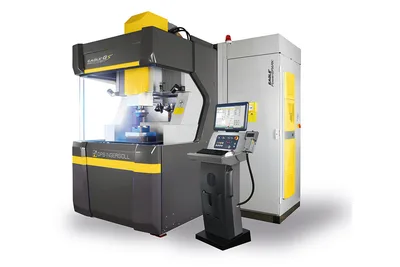
Mitsubishi Electric EA8PV Advance
Key Specifications
X Travel
Y Travel
Z Travel
Table Size
machine dimensions
machine weight
How much does the Mitsubishi Electric EA8PV Advance cost?
Estimated price range
Our best estimate for a sinker edm (ram edm) in this class — not a quote from Mitsubishi Electric. Configuration moves it a long way.
Overview
The Mitsubishi Electric EA8PV Advance is a compact sinker EDM with 300 mm (11.8 in) of X travel and 250 mm (9.8 in) each of Y and Z, a 500 x 350 mm (19.7 x 13.8 in) table and a total system weight of 2000 kg (4409 lb.). Its FP80V-A power supply delivers a maximum machining current peak of 80 A, and the control is the C31EA-2 Advance unit with a 15-inch color TFT-LCD touch screen.
Most rows of the table come in two versions, because the work tank can be ordered as an automatic elevation tank. With the standard tank the machine measures 1460 x 1900 x 2075 mm (57.5 x 74.8 x 81.7 in) and the tank's inner dimensions are 770 x 500 x 230 mm (30.3 x 19.7 x 9.1 in). The automatic elevation tank option makes the machine 1615 x 2030 x 2075 mm (63.6 x 79.9 x 81.7 in) and gives 760 x 520 x 260 mm (29.9 x 20.5 x 10.2 in) inside.
The difference that matters is height under fluid. The standard tank accepts a workpiece of 740 x 470 x 130 mm (29.1 x 18.5 x 5.1 in), with the fluid level adjustable from 90 to 180 mm (3.5 to 7.1 in) above the top of the table. The elevation tank changes that to 730 x 490 x 160 mm (28.7 x 19.3 x 6.3 in) and 85 to 210 mm (3.5 to 8.3 in). Either way this is a machine for low workpieces. The 250 mm (9.8 in) of Z is well beyond the part height the tank allows, so the stroke goes to electrode length and retraction, not to tall blocks.
Loads are modest. The table takes 550 kg (1213 lb.), the electrode limit is 25 kg (55 lb.), and the table top sits 900 mm (35.4 in) from the floor. The dielectric reservoir holds 165 L (43.6 gal.), filtered through one fine paper filter and cooled by a unit cooler. With the elevation tank the initial dielectric fluid supply is 175 L (46.2 gal.).
Full Specifications
| Parameter | Value |
|---|---|
| Machine Dimensions | 1460 x 1900 x 2075 mm (57.5 x 74.8 x 81.7 in), W x D x H (1615 x 2030 x 2075 mm (63.6 x 79.9 x 81.7 in) with automatic elevation tank opt.) |
| Machine Weight | 2000 kg (4409 lb.), total system weight |
| X-Axis Travel | 300 mm (11.8 in) |
| Y-Axis Travel | 250 mm (9.8 in) |
| Z-Axis Travel | 250 mm (9.8 in) |
| Max Electrode Weight | 25 kg (55 lb.) |
| Working Tank Inner Dimensions | 770 x 500 x 230 mm (30.3 x 19.7 x 9.1 in), W x D x H (760 x 520 x 260 mm (29.9 x 20.5 x 10.2 in) with automatic elevation tank opt.) |
| Fluid Level Adjustment Range | 90 to 180 mm (3.5 to 7.1 in), from top of table (85 to 210 mm (3.5 to 8.3 in) with automatic elevation tank opt.) |
| Table Size | 500 x 350 mm (19.7 x 13.8 in) |
| Max Workpiece Dimensions | 740 x 470 x 130 mm (29.1 x 18.5 x 5.1 in), W x D x H (730 x 490 x 160 mm (28.7 x 19.3 x 6.3 in) with automatic elevation tank opt.) |
| Floor to Table Top Distance | 900 mm (35.4 in) |
| Max Table Load | 550 kg (1213 lb.) |
| T Slot | Two slots at 13-120mm pitch |
| Dielectric Reservoir Capacity | 165 L (43.6 gal.) (with automatic elevation tank opt.: 165 L (43.6 gal.), initial dielectric fluid supply amount 175 L (46.2 gal.)) |
| Filtering Method | One fine paper filter |
| Dielectric Fluid Chiller Unit | Unit cooler |
| Power Supply | FP80V-A, maximum machining current peak 80 A |
| CNC Control | C31EA-2 (Advance control unit), 15-inch color TFT-LCD touch screen |
Specifications sourced from dl.mitsubishielectric.com — verified 2026-10-03
Strengths & Limitations
Strengths
- FP80V-A power supply with a maximum machining current peak of 80 A on a machine of 2000 kg (4409 lb.) total system weight
- Small footprint: 1460 x 1900 mm (57.5 x 74.8 in) wide and deep with the standard tank
- C31EA-2 Advance control with a 15-inch color TFT-LCD touch screen, the same control listed on the EA28V Advance
- The automatic elevation tank option raises maximum workpiece height from 130 mm (5.1 in) to 160 mm (6.3 in)
- A unit cooler for the dielectric fluid is listed with the machine
Limitations
- Maximum workpiece height is 130 mm (5.1 in) with the standard tank and 160 mm (6.3 in) with the elevation tank option
- Table load is 550 kg (1213 lb.) and electrode weight 25 kg (55 lb.)
- X travel of 300 mm (11.8 in) is less than half the 650 mm (25.6 in) of the EA28V Advance
- The automatic elevation tank is an option and enlarges the machine to 1615 x 2030 mm (63.6 x 79.9 in) in width and depth
- Filtration is a single fine paper filter
Best For
Frequently Asked Questions
01
It changes the tank, the workpiece envelope and the footprint. Maximum workpiece goes from 740 x 470 x 130 mm (29.1 x 18.5 x 5.1 in) to 730 x 490 x 160 mm (28.7 x 19.3 x 6.3 in), and the fluid level range from 90 to 180 mm (3.5 to 7.1 in) to 85 to 210 mm (3.5 to 8.3 in). The machine grows from 1460 x 1900 x 2075 mm (57.5 x 74.8 x 81.7 in) to 1615 x 2030 x 2075 mm (63.6 x 79.9 x 81.7 in).
02
Travels are 300 mm (11.8 in) in X, 250 mm (9.8 in) in Y and 250 mm (9.8 in) in Z. The table is 500 x 350 mm (19.7 x 13.8 in), carries up to 550 kg (1213 lb.) and stands 900 mm (35.4 in) above the floor.
03
With the standard tank, 740 x 470 x 130 mm (29.1 x 18.5 x 5.1 in) inside a tank that measures 770 x 500 x 230 mm (30.3 x 19.7 x 9.1 in). With the automatic elevation tank option, 730 x 490 x 160 mm (28.7 x 19.3 x 6.3 in). Table load is 550 kg (1213 lb.) in both cases.
04
The power supply is the FP80V-A, with a maximum machining current peak of 80 A. The control is the C31EA-2 Advance control unit with a 15-inch color TFT-LCD touch screen. Maximum electrode weight is 25 kg (55 lb.).
05
Both use the C31EA-2 control. The EA28V Advance is far larger, with travels of 650 mm (25.6 in), 450 mm (17.7 in) and 350 mm (13.8 in), an 850 x 600 mm (33.5 x 23.6 in) table, a 2000 kg (4409 lb.) table load and a total system weight of 5400 kg (11905 lb.). The EA8PV Advance has travels of 300 mm (11.8 in), 250 mm (9.8 in) and 250 mm (9.8 in) and a 550 kg (1213 lb.) table load.
Videos

HitechMachinery

KD Machinery

HitechMachinery

HitechMachinery
More from Mitsubishi Electric
Mitsubishi Electric EA12PS
Mitsubishi Electric EA12 Advance
Mitsubishi Electric SV12P
Mitsubishi Electric EA12V
Mitsubishi Electric EA8 Advance
Mitsubishi Electric SG70
Other Sinker EDM (Ram EDM)
Makino EDNC-17
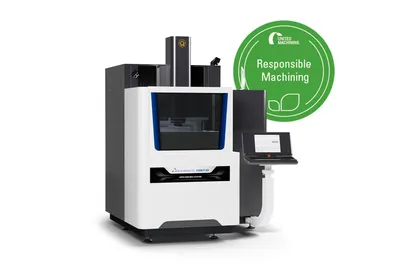
GF Machining AgieCharmilles FORM P 600
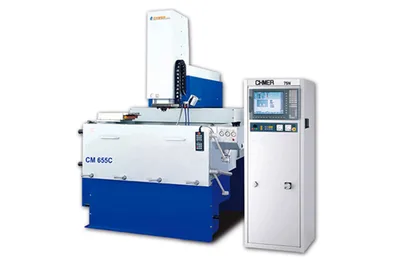
CHMER CM655C
GF AgieCharmilles FORM 20
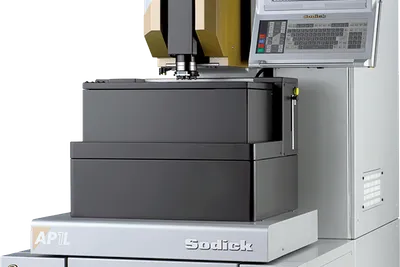
Sodick AP1L