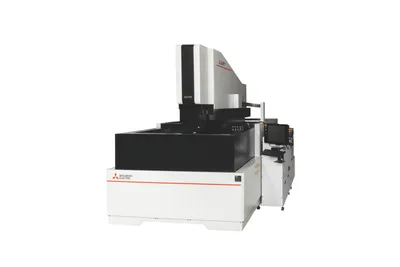
Mitsubishi Electric EA8 Advance
This model was not found in Mitsubishi Electric's current lineup when we checked on 2026-10-03 (lineup page). It may be a superseded or older model; the specifications below are as we last recorded them.
Key Specifications
X Travel
Y Travel
Z Travel
work table size
work tank inner
max workpiece weight
How much does the Mitsubishi Electric EA8 Advance cost?
Estimated price range
Our best estimate for a sinker edm (ram edm) in this class — not a quote from Mitsubishi Electric. Configuration moves it a long way.
Overview
The Mitsubishi Electric EA8 Advance is a small CNC sinker EDM. The listed figures give it 400 mm (15.75 in) of X travel, 300 mm (11.81 in) of Y and 250 mm (9.84 in) of Z, with a maximum workpiece weight of 400 kg (882 lb). Mitsubishi Electric's current lineup does not include a model under this name, so the page is most useful to someone assessing a used machine, and each figure should be confirmed against that machine's own documentation.
The generator is listed as the FP80 AI pulse generator with Miracle Circuit, the control as a Mitsubishi M800S CNC, and the axes as ball screws with linear scales. Finish is given as VDI 3 / Ra 0.08 µm achievable and electrode wear as near-zero on graphite with the Miracle Circuit. Both are best-case statements, not results for a particular electrode and steel, so ask for a test burn on your own geometry before quoting to them.
Electrode-to-table clearance runs from 100 to 350 mm (3.9 to 13.8 in). That range, more than the Z stroke alone, decides whether a long electrode on its holder still clears a tall block, so add up the stack before taking on a deep rib. The machine is listed at 1,600 x 2,200 x 2,300 mm (63.0 x 86.6 x 90.6 in) and 4,200 kg (9,259 lb).
Two neighbours frame it. The EA8PV Advance has 300 mm (11.8 in) of X and 250 mm (9.8 in) of Y, shorter than the strokes listed here, while the EA12 Advance steps up to 600 mm (23.6 in) of X and 400 mm (15.75 in) of Y.
Full Specifications
| Parameter | Value |
|---|---|
| X-Axis Travel | 400 mm (15.75 in) |
| Y-Axis Travel | 300 mm (11.81 in) |
| Z-Axis Travel | 250 mm (9.84 in) |
| Work Table Size | 800 x 550 mm (31.5 x 21.7 in) |
| Work Tank Inner | 650 x 500 x 350 mm (25.6 x 19.7 x 13.8 in) |
| Max Workpiece Weight | 400 kg (882 lb) |
| Electrode to Table Clearance | 100 - 350 mm (3.9 - 13.8 in) |
| Drive System | High-precision ball screws with linear scales |
| Generator | FP80 AI pulse generator with Miracle Circuit |
| Surface Finish | VDI 3 / Ra 0.08 um achievable |
| Electrode Wear | Near-zero on graphite with Miracle Circuit |
| CNC Control | Mitsubishi M800S CNC |
| Machine Dimensions | 1,600 x 2,200 x 2,300 mm (63.0 x 86.6 x 90.6 in) |
| Machine Weight | 4,200 kg (9,259 lb) |
| Connectivity | Ethernet, remote monitoring |
Specifications compiled from manufacturer literature and industry references. Not independently verified against a published spec sheet — confirm with the manufacturer or an authorised dealer before making a purchasing decision.
Strengths & Limitations
Strengths
- Listed travels of 400 x 300 x 250 mm (15.75 x 11.81 x 9.84 in), longer in X and Y than the 300 x 250 mm of the EA8PV Advance
- FP80 AI pulse generator with Miracle Circuit, with electrode wear listed as near-zero on graphite
- Finish listed as VDI 3 / Ra 0.08 µm achievable, fine enough to cut down hand polishing on cavity surfaces
- Ball screw axes with linear scales, so position is read at the axis itself
- Ethernet and remote monitoring appear in the listed connectivity
Limitations
- Maximum workpiece weight is 400 kg (882 lb), which rules out heavier mold bases
- Electrode-to-table clearance tops out at 350 mm (13.8 in), so a tall block leaves little room for the electrode and its holder
- The listed figures give no electrode weight limit, tool changer or dielectric capacity; those have to be read off the machine itself
Best For
Frequently Asked Questions
01
The listed figures are 400 mm (15.75 in) in X, 300 mm (11.81 in) in Y and 250 mm (9.84 in) in Z. Electrode-to-table clearance is listed separately as 100 to 350 mm (3.9 to 13.8 in), and that is the figure to check when a tall workpiece and a long electrode have to fit together.
02
The listed maximum workpiece weight is 400 kg (882 lb). Count the fixture, any magnetic chuck or pallet and the block together against that figure. The machine itself is listed at 4,200 kg (9,259 lb).
03
The table gives VDI 3 / Ra 0.08 µm as achievable and electrode wear as near-zero on graphite with the Miracle Circuit of the FP80 AI pulse generator. Treat both as best-case values. Real results depend on electrode material, area and flushing, so a test burn is the only reliable check.
04
The EA8PV Advance has 300 mm (11.8 in) of X, 250 mm (9.8 in) of Y and 250 mm (9.8 in) of Z with a 500 x 350 mm (19.7 x 13.8 in) table and a 550 kg (1213 lb) table load. The figures listed for the EA8 Advance are 400 mm (15.75 in) of X and 300 mm (11.81 in) of Y on the same 250 mm of Z, with a 400 kg (882 lb) workpiece limit.
Videos

HK Ltd

EX-FACTORY INC.

HitechMachinery

HitechMachinery
Community Discussions
Maintenance and service
Links to community discussions. Summaries are editorial — visit the original thread for full context.
More from Mitsubishi Electric