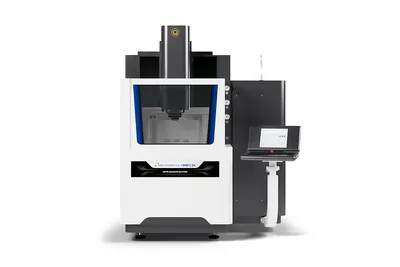
Mitsubishi Electric EA12V
This model was not found in Mitsubishi Electric's current lineup when we checked on 2026-10-03 . It may be a superseded or older model; the specifications below are as we last recorded them.
Key Specifications
x y travel
z travel
max workpiece dimensions
max workpiece weight
max electrode weight
drive system
How much does the Mitsubishi Electric EA12V cost?
Estimated price range
Our best estimate for a sinker edm (ram edm) in this class — not a quote from Mitsubishi Electric. Configuration moves it a long way.
Overview
The Mitsubishi Electric EA12V is a ballscrew-driven sinker EDM listed with 350 x 250 mm (13.8 x 9.8 in) of X-Y travel, 250 mm (9.8 in) of Z and a 300 kg (661 lb) workpiece limit. Mitsubishi Electric's current lineup no longer includes it. Figures quoted for the EA12V also vary, with another listing giving 400 mm (15.7 in) of X travel, so use the listed figures here as a guide and confirm them on the machine.
The tank takes a workpiece up to 650 x 450 x 250 mm, noticeably wider than the travel, so a mold base can sit in the tank even when only part of it lies within reach of the electrode. Electrode weight is limited to 30 kg. The orbit function covers circular, square and planetary cycles, which is how a sinker opens a cavity to final size with an undersized electrode and evens out the finish on the walls.
On the electrical side the table names Mitsubishi VS adaptive discharge control and a Mitsubishi V400 CNC with a condition database, with Ra 0.2 µm given for finishing conditions on steel. Oil dielectric is standard. The electrode changer is an option, a 6-position AEC, so a machine without it needs an operator at every electrode change. Supply is 200V three-phase at 50/60 Hz.
Full Specifications
| Parameter | Value |
|---|---|
| X Y Travel | 350 x 250 mm (13.8 x 9.8 in) |
| Z Travel | 250 mm (9.8 in) |
| Max Workpiece Dimensions | 650 x 450 x 250 mm |
| Max Workpiece Weight | 300 kg (661 lb) |
| Max Electrode Weight | 30 kg |
| Drive System | Precision ballscrew, anti-backlash preloaded |
| Generator | Mitsubishi VS adaptive discharge control |
| Surface Finish | Ra 0.2 µm (finishing conditions on steel) |
| Electrode Changer | Optional 6-position AEC |
| Orbit Function | Yes — circular, square, and planetary orbit cycles |
| Dielectric | Oil dielectric (hydrocarbon) standard |
| CNC Control | Mitsubishi V400 CNC with condition database |
| Electrode Materials | Graphite, copper, copper-tungsten |
| Power Supply | 200V, 3-phase, 50/60 Hz |
Specifications compiled from manufacturer literature and industry references. Not independently verified against a published spec sheet — confirm with the manufacturer or an authorised dealer before making a purchasing decision.
Strengths & Limitations
Strengths
- Orbit function with circular, square and planetary cycles is listed
- Ra 0.2 µm listed for finishing conditions on steel
- Maximum workpiece of 650 x 450 x 250 mm on 350 x 250 mm (13.8 x 9.8 in) of X-Y travel
- Runs graphite, copper and copper-tungsten electrodes up to 30 kg
- The V400 CNC includes a condition database
Limitations
- Workpiece weight is limited to 300 kg (661 lb)
- The 6-position AEC is optional, and six positions is a small magazine for multi-electrode jobs
- Z travel is 250 mm (9.8 in), the same figure as the maximum workpiece height, so tall workpieces leave little room for electrode and holder
Best For
Frequently Asked Questions
01
The listed figures are 350 x 250 mm (13.8 x 9.8 in) in X and Y and 250 mm (9.8 in) in Z, on precision ballscrews with anti-backlash preload. The maximum workpiece is 650 x 450 x 250 mm.
02
The workpiece limit is 300 kg (661 lb) and the electrode limit is 30 kg. A block that fills the 650 x 450 x 250 mm maximum workpiece size in steel would be well over that weight, so check the mass of the part and its fixturing, not only its dimensions.
03
Only as an option. The listed figures show an optional 6-position AEC, so do not assume a given machine has one. Without it, each electrode in a rough-and-finish sequence is changed by hand.
04
Ra 0.2 µm under finishing conditions on steel. Graphite, copper and copper-tungsten are the listed electrode materials, and the generator is described as Mitsubishi VS adaptive discharge control. Oil dielectric is standard.
Videos

MTDCNC

HitechMachinery

KD Machinery

HK Ltd
Community Discussions
Pricing and buying discussion
Links to community discussions. Summaries are editorial — visit the original thread for full context.
More from Mitsubishi Electric
Mitsubishi Electric EA8 Advance
Mitsubishi Electric SG70
Mitsubishi Electric EA28V-ADV
Mitsubishi EA28V CNC Sinker EDM
Mitsubishi Electric EA28V
Mitsubishi Electric EA28V Advance
Other Sinker EDM (Ram EDM)
GF AgieCharmilles FORM P 350
Makino EDNC-6
FORM E
Oscar EDM EX 1510
Makino EDAF3