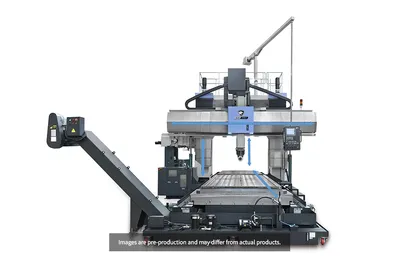
Mazak FJW-100/160
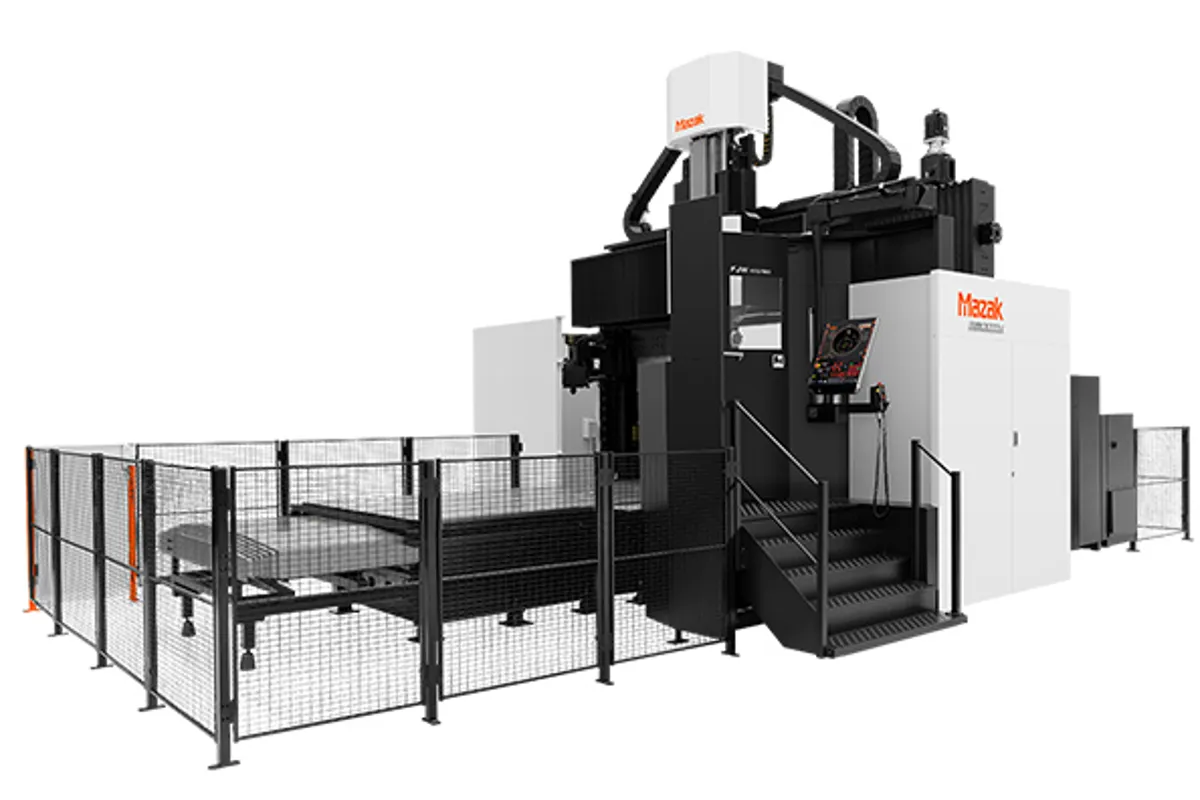
Image: mazak.com, Yamazaki Mazak
Key Specifications
X Travel
Y Travel
Z Travel
Max Spindle
Spindle Taper
Tool Capacity
How much does the Mazak FJW-100/160 cost?
Estimated price range
Our best estimate for a vertical machining centers (vmc) in this class — not a quote from Yamazaki Mazak. Configuration moves it a long way.
Overview
The Mazak FJW-100/160 is a double-column, 5-surface machining center built around a 157.48 in (4,000 mm) × 78.74 in (2,000 mm) table that carries 48,501 lb (22,000 kg). Travels are 167.32 in (4,250 mm) in X, 125.98 in (3,200 mm) in Y and 31.5 in (800 mm) in Z, and the CAT No.50 spindle tops out at 6,000 rpm. The figures describe a machine for large steel and cast-iron parts: low speed, high torque and a work envelope several metres long.
Height capacity comes from two axes working together. The ram gives 31.5 in (800 mm) of Z, and the cross rail moves on a W axis with 39.37 in (1,000 mm) of travel, so the spindle end can sit anywhere from 0 in (0 mm) to 66.18 in (1,681 mm) above the table top. Column height is 64.96 in (1,650 mm), and the columns stand 104.33 in (2,650 mm) apart, which is the real limit on part width, not the 78.74 in (2,000 mm) table. The cross rail is slow next to the ram: W rapid is 118 ipm (3 m/min) against 787 ipm (20 m/min) for Z, so it makes sense to set rail height for an operation and let Z do the work.
The spindle is rated 470 ft-lb (637 Nm) and 22 kW (30 HP) continuous, rising to 611 ft-lb (828 Nm) and 26 kW (35 HP) at 40% ED. The FJV-60/120 is listed at 176 ft-lb (239 Nm) and 30 kW (40 HP) continuous with a 10,000 rpm top speed, so the FJW-100/160 gives up spindle speed and some power for more than twice the continuous torque. That suits large face mills and boring bars in steel. It also limits small-tool work, where 6,000 rpm caps the cutting speed.
Mazak describes the FJW series as a 5-surface machine with an angle head attachment as standard equipment. The head is attached to and detached from the spindle automatically, changes its own tools, and indexes to 72 positions every 5°, so the top and the sides of a part can be cut in one setup. Y travel of 125.98 in (3,200 mm) is far more than the 78.74 in (2,000 mm) table width, which leaves the head room to work down the side faces.
Installation is a project in itself. The machine weighs 94,797 lb (42,999 kg), covers 246.06 in (6,250 mm) × 417.72 in (10,610 mm) of floor with the MAZATROL SmoothG control and stands 204.37 in (5,191 mm) high, so foundation, crane height and door openings come first.
Full Specifications
| Parameter | Value |
|---|---|
| Table Size | 157.48 in (4,000 mm) × 78.74 in (2,000 mm) |
| Table Column Height | 64.96 in (1,650 mm) |
| Table Distance Between Columns | 104.33 in (2,650 mm) |
| Max Table Load | 48,501 lb (22,000 kg) |
| Spindle Taper | CAT No.50 |
| Max Spindle Speed | 6,000 rpm |
| Spindle Torque Intermittent | 611 ft-lb (828 Nm) (40% ED) |
| Spindle Torque | 470 ft-lb (637 Nm) continuous |
| Spindle Power Intermittent | 26 kW (35 HP) (40% ED) |
| Spindle Motor Power | 22 kW (30 HP) continuous |
| Tool Capacity | 50 tools |
| Max Tool Diameter (full magazine) | Ø4.92 in (125 mm) |
| Max Tool Diameter (adjacent pockets empty) | Ø9.84 in (250 mm) |
| Max Tool Length | 15.75 in (400 mm) |
| Max Tool Weight | 55 lb (25 kg) |
| X-Axis Travel | 167.32 in (4,250 mm) |
| Y-Axis Travel | 125.98 in (3,200 mm) |
| Z-Axis Travel | 31.5 in (800 mm) |
| W Axis Travel | 39.37 in (1,000 mm) |
| Distance From Table Top Face to Spindle End | 0 in (0 mm) to 66.18 in (1,681 mm) |
| Rapid Traverse X | 1,181 ipm (30 m/min) |
| Rapid Traverse Y | 1,260 ipm (32 m/min) |
| Rapid Traverse Z | 787 ipm (20 m/min) |
| Rapid Traverse W Axis | 118 ipm (3 m/min) |
| Floor Space Required | 246.06 in (6,250 mm) × 417.72 in (10,610 mm) (W × L, MAZATROL SmoothG) |
| Machine Height | 204.37 in (5,191 mm) |
| Machine Weight | 94,797 lb (42,999 kg) |
Specifications sourced from mazak.com — verified 2026-10-02
Strengths & Limitations
Strengths
- 470 ft-lb (637 Nm) of continuous spindle torque, 611 ft-lb (828 Nm) at 40% ED, on a CAT No.50 taper
- Table of 157.48 in (4,000 mm) × 78.74 in (2,000 mm) rated for 48,501 lb (22,000 kg)
- W-axis cross rail with 39.37 in (1,000 mm) of travel places the spindle end from 0 in (0 mm) to 66.18 in (1,681 mm) above the table
- Mazak lists an angle head attachment as standard equipment for the FJW series, indexing to 72 positions every 5° for side-face machining
- 50 tools in the magazine, with tools up to Ø9.84 in (250 mm) when adjacent pockets are left empty
Limitations
- Maximum spindle speed of 6,000 rpm limits small-diameter tools and high-speed finishing in aluminium
- W-axis rapid is 118 ipm (3 m/min), far slower than the 787 ipm (20 m/min) of Z, so cross-rail moves add time on parts with large height changes
- Needs 246.06 in (6,250 mm) × 417.72 in (10,610 mm) of floor, 204.37 in (5,191 mm) of height and a foundation for 94,797 lb (42,999 kg)
- Continuous power is 22 kW (30 HP), below the 30 kW (40 HP) continuous of the FJV-60/120
- The angle head indexes in 5° steps, so side features at other angles need a different method
Best For
Frequently Asked Questions
01
The table is 157.48 in (4,000 mm) × 78.74 in (2,000 mm) and is rated for 48,501 lb (22,000 kg). Width is limited by the 104.33 in (2,650 mm) between the columns, and height by the distance from the table top to the spindle end, which ranges from 0 in (0 mm) to 66.18 in (1,681 mm). X travel is 167.32 in (4,250 mm).
02
The W axis raises and lowers the cross rail that carries the spindle head. It has 39.37 in (1,000 mm) of travel at a rapid of 118 ipm (3 m/min) and works together with the 31.5 in (800 mm) Z-axis ram. Mazak gives a column height of 64.96 in (1,650 mm) from the combined movement of ram and cross rail, for machining tall workpieces.
03
470 ft-lb (637 Nm) and 22 kW (30 HP) continuous, or 611 ft-lb (828 Nm) and 26 kW (35 HP) at 40% ED. Maximum speed is 6,000 rpm on a CAT No.50 taper. Mazak describes it as a high torque spindle for rough machining of steel and cast iron.
04
With an angle head attachment, which Mazak lists as standard equipment for the FJW series. It is attached to and detached from the spindle automatically, can change its own tools, and indexes to 72 positions every 5°. Mazak states that programs for 5-face machining can be written in MAZATROL conversational form or in G code (EIA/ISO).
05
The magazine holds 50 tools. A tool can be up to Ø4.92 in (125 mm) in diameter with every pocket full, or Ø9.84 in (250 mm) with the adjacent pockets empty, up to 15.75 in (400 mm) long and up to 55 lb (25 kg).
06
The FJV-60/120 has a 118.11 in (3,000 mm) × 49.21 in (1,250 mm) table rated for 11,023 lb (5,000 kg), with 125.98 in (3,200 mm) of X and 55.12 in (1,400 mm) of Y. The FJW-100/160 table is 157.48 in (4,000 mm) × 78.74 in (2,000 mm) and takes 48,501 lb (22,000 kg). The FJV-60/120 spindle runs to 10,000 rpm with 176 ft-lb (239 Nm) continuous, against 6,000 rpm and 470 ft-lb (637 Nm) continuous on the FJW-100/160.
Videos

Yamazaki Mazak Corporation

John Hart
Comparisons
More from Yamazaki Mazak
Other Vertical Machining Centers (VMC)
Vision Wide VB-4020
GF Machining Solutions Mikron MILL S 500 Graphite
Pinnacle DW1422
Fehlmann VERSA 643 linear
Hartford HSA-536