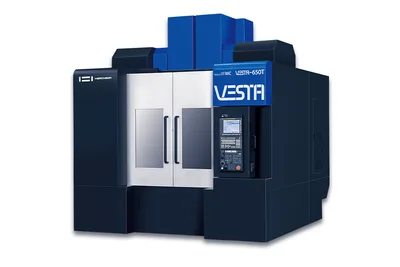
Mazak FJV BT40
Key Specifications
X Travel
Y Travel
Z Travel
Max Spindle
Spindle Taper
Tool Capacity
How much does the Mazak FJV BT40 cost?
Estimated price range
Our best estimate for a vertical machining centers (vmc) in this class — not a quote from Yamazaki Mazak. Configuration moves it a long way.
Overview
The Mazak FJV BT40 page covers the series Mazak lists as FJV (CAT No.40): two double-column vertical machining centers, the FJV-200 and the FJV-250, built around a BT40 spindle that runs to 12,000 rpm. Both carry 30 tools and move at 2,047 ipm (52 m/min) on X, Y and Z.
With two models, each range in the table is simply a small machine and a large one. The FJV-250 is the large one, with 40.16 in (1,020 mm) of X, 20.08 in (510 mm) of Y and 18.11 in (460 mm) of Z, and a 47.24 in (1,200 mm) × 21.65 in (550 mm) table rated for 2,645 lb (1,200 kg). That leaves the FJV-200 with the lower figure in each row: 22.05 in (560 mm) of X, 16.14 in (410 mm) of Y and of Z, and a table load of 771.62 lb (350 kg). The gap in table load is more than three to one, so the two are not interchangeable for fixture-heavy work even where the part itself would fit.
The standard spindle is rated 15 kW (20 HP) continuous and 22 kW (30 HP) at 40% ED, with 38.7 ft-lb (52 Nm) continuous and 52.8 ft-lb (72 Nm) at 40% ED. Mazak offers three alternatives, all options: a 12,000 rpm high-torque spindle for rough machining of steel and cast iron, an 18,000 rpm spindle for aluminum and copper, and a 25,000 rpm spindle for die work with small diameter end mills.
The double-column frame carries a symmetrical headstock with an integral spindle motor. Linear roller guides are used on all axes, temperature-controlled oil circulates through the ball screw cores, and the spindle is temperature controlled. The CNC is a choice between MAZATROL SmoothG and MAZATROL SmoothC, and the choice has consequences: Mazak states that Ai Thermal Shield is available with the MAZATROL SmoothG.
For work beyond this envelope the next step is the FJV-35/60, a CAT No.50 machine with 59.06 in (1,500 mm) of X, 10,000 rpm and 176 ft-lb (239 Nm) continuous.
Full Specifications
| Parameter | Value |
|---|---|
| Models in Series | 2 models: FJV-200, FJV-250 |
| Table Distance Between Columns | 37.6 in (955 mm) to 54.33 in (1,380 mm) |
| Max Table Load | 771.62 lb (350 kg) to 2,645 lb (1,200 kg) |
| Spindle Taper | BT40 |
| Max Spindle Speed | 12,000 rpm |
| Spindle Torque Intermittent | 52.8 ft-lb (72 Nm) (40% ED) |
| Spindle Torque | 38.7 ft-lb (52 Nm) continuous |
| Spindle Power Intermittent | 22 kW (30 HP) (40% ED) |
| Spindle Motor Power | 15 kW (20 HP) continuous |
| Tool Capacity | 30 tools |
| Max Tool Diameter (full magazine) | Ø3.15 in (80 mm) |
| Max Tool Diameter (adjacent pockets empty) | Ø4.92 in (125 mm) |
| Max Tool Length | 11.81 in (300 mm) |
| Max Tool Weight | 17.64 lb (8 kg) |
| X-Axis Travel | 22.05 in (560 mm) to 40.16 in (1,020 mm) |
| Y-Axis Travel | 16.14 in (410 mm) to 20.08 in (510 mm) |
| Z-Axis Travel | 16.14 in (410 mm) to 18.11 in (460 mm) |
| Rapid Traverse X | 2,047 ipm (52 m/min) |
| Rapid Traverse Y | 2,047 ipm (52 m/min) |
| Rapid Traverse Z | 2,047 ipm (52 m/min) |
| Machine Height | 111.26 in (2,826 mm) to 115.2 in (2,926 mm) |
| Machine Weight | 14,109 lb (6,400 kg) to 18,739 lb (8,500 kg) |
Specifications sourced from mazak.com — verified 2026-10-02
Strengths & Limitations
Strengths
- BT40 spindle at 12,000 rpm with 15 kW (20 HP) continuous and 22 kW (30 HP) at 40% ED on both models
- Rapid traverse of 2,047 ipm (52 m/min) on X, Y and Z
- Optional 18,000 rpm and 25,000 rpm high-speed spindles for aluminum, copper and small-tool die machining
- Double-column frame with ball screw core cooling, spindle temperature control and linear roller guides on all axes
- The FJV-250 carries 2,645 lb (1,200 kg) on a 47.24 in (1,200 mm) × 21.65 in (550 mm) table
Limitations
- Standard spindle torque is 38.7 ft-lb (52 Nm) continuous; the 12,000 rpm high-torque spindle is an option
- Only two sizes, and the lower table load in the series is 771.62 lb (350 kg)
- Z travel is 16.14 in (410 mm) to 18.11 in (460 mm), which limits tall parts and long tools together
- Tools are limited to Ø3.15 in (80 mm) with a full magazine, 11.81 in (300 mm) in length and 17.64 lb (8 kg)
- Ai Thermal Shield is listed as available with the MAZATROL SmoothG, so the control choice affects thermal compensation
Best For
Frequently Asked Questions
01
Size. The FJV-250 has 40.16 in (1,020 mm) of X, 20.08 in (510 mm) of Y and 18.11 in (460 mm) of Z, a table load of 2,645 lb (1,200 kg) and a weight of 18,739 lb (8,500 kg). The other end of each range, which with two models is the FJV-200, is 22.05 in (560 mm), 16.14 in (410 mm) and 16.14 in (410 mm) of travel, 771.62 lb (350 kg) of table load and 14,109 lb (6,400 kg). Spindle, tool capacity and rapids are the same on both.
02
The standard spindle is BT40 at 12,000 rpm with 15 kW (20 HP) continuous, 22 kW (30 HP) at 40% ED and 38.7 ft-lb (52 Nm) continuous. Options are a 12,000 rpm high-torque spindle for heavy rough machining of steel and cast iron, an 18,000 rpm high-speed spindle for aluminum, copper and similar materials, and a 25,000 rpm high-speed spindle for die machining with small diameter end mills.
03
Mazak lets the buyer select between MAZATROL SmoothG and MAZATROL SmoothC. The Ai Thermal Shield function, which adjusts for spindle speed and machine temperature to hold the cutting edge position, is stated as available with the MAZATROL SmoothG. Mazak also notes that its high-accuracy contouring at high feedrate requires the optional coolant temperature control system and scale feedback on X, Y and Z.
04
The magazine holds 30 tools on both models. Maximum tool diameter is Ø3.15 in (80 mm), or Ø4.92 in (125 mm) with the adjacent pockets empty. Maximum tool length is 11.81 in (300 mm) and maximum tool weight is 17.64 lb (8 kg). With 16.14 in (410 mm) to 18.11 in (460 mm) of Z travel, a long tool takes a large share of the available height.
05
When the part outgrows the envelope or the cut outgrows the spindle. The FJV-35/60 has 59.06 in (1,500 mm) of X, 31.5 in (800 mm) of Y and 25.98 in (660 mm) of Z with a 5,512 lb (2,500 kg) table load. Its CAT No.50 spindle gives 30 kW (40 HP) continuous and 176 ft-lb (239 Nm) continuous at 10,000 rpm, and the FJV-35/60 weighs 38,800 lb (17,599 kg) against 18,739 lb (8,500 kg) for the FJV-250.
Videos

Yamazaki Mazak Corporation [English]

Yamazaki Mazak Corporation [English]

MAZAK SINGAPORE
Comparisons
More from Yamazaki Mazak
Other Vertical Machining Centers (VMC)
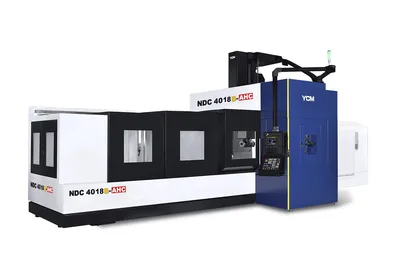
YCM NDC4018B-AHC
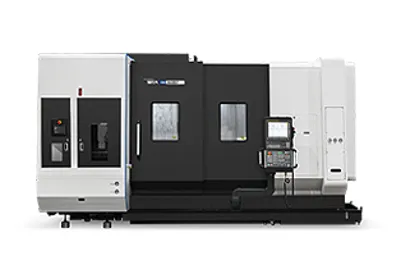
Hyundai WIA XM3100 Series
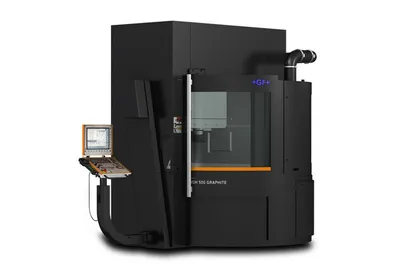
GF Machining MIKRON HSM 500 Graphite
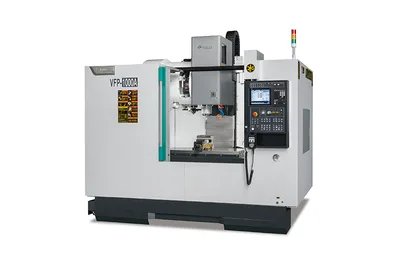
Feeler VFP-1000
Hurco VM10i