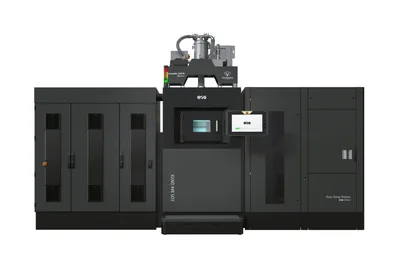
Markforged X3
Key Specifications
variant
process
build volume
machine weight
footprint
print bed
How much does the Markforged X3 cost?
Estimated price range
Our best estimate for a metal additive manufacturing in this class — not a quote from Markforged. Configuration moves it a long way.
Overview
The Markforged X3, listed as the X3 (Gen 2), is a fused filament fabrication printer for Onyx and Onyx FR with a 330 x 270 x 200 mm (13 x 10.6 x 7.9 in) build volume. It has no continuous fiber: the fibers row reads None. Think of it as a large-cabinet plastics printer with in-process measurement, not as a composite machine.
That measurement is the laser row. The table lists a laser for bed leveling and active print calibration, and the print bed, located by a kinematic coupling, is flat to within 80 μm. A bed that returns to the same position each time it is refitted, checked by a laser, is what allows the 50 μm minimum layer height to be used with confidence. The default is 100 μm and the maximum 200 μm.
The second plastic is the other reason to pick it. Onyx FR joins Onyx on the list, which matters where a flame-retardant grade is specified for a part. The strength figures in the table are Onyx data: 36 MPa tensile strength (1.2x ABS) and 3.6 GPa flex modulus (1.7x ABS). With no fiber to add, those figures are the ceiling, and loaded parts have to be designed as plastic parts.
Physically it is a tall cabinet: 584 x 483 x 914 mm (23 x 19 x 36 in) and 46 kg (102 lbs), close to the 48 kg (106 lbs) of the Markforged X7. It needs a stand or bench rated for that weight and clear headroom above it.
Power is 100–240 VAC at 150 W (2 A peak). Connection is by 2.4 GHz Wi-Fi to 802.11 b/g/n. The extruder is the second-generation type with out-of-plastic detection, infill is closed cell with multiple geometries, and Eiger Cloud is the supplied software, with other options at cost.
Full Specifications
| Parameter | Value |
|---|---|
| Variant | X3 (Gen 2) |
| Process | Fused filament fabrication |
| Build Volume | 330 x 270 x 200 mm (13 x 10.6 x 7.9 in) |
| Machine Weight | 46 kg (102 lbs) |
| Floor Space Required | 584 x 483 x 914 mm (23 x 19 x 36 in) |
| Print Bed | Kinematic coupling — flat to within 80 μm |
| Laser | Bed leveling, active print calibration |
| Extrusion System | Second-generation extruder, out-of-plastic detection |
| Power | 100–240 VAC, 150 W (2 A peak) |
| Rf Module | Operating Band 2.4 GHz Wi-Fi Standards 802.11 b/g/n |
| Plastics Available | Onyx, Onyx FR |
| Fibers Available | None |
| Tensile Strength | 36 MPa (1.2x ABS) (Onyx data) |
| Flex Modulus | 3.6 GPa (1.7x ABS) (Onyx data) |
| Layer Height | 100 μm default, 50 μm minimum, 200 μm maximum |
| Infill | Closed cell infill: multiple geometries available |
| Supplied Software | Eiger Cloud (Other options available at cost) |
| Security | Two-factor authentication, org admin access, single sign-on |
Specifications sourced from www-objects.markforged.com — verified 2026-10-03
Strengths & Limitations
Strengths
- Laser for bed leveling and active print calibration
- Print bed flat to within 80 μm on a kinematic coupling
- Layer height down to 50 μm, with 100 μm default and 200 μm maximum
- Prints Onyx FR as well as Onyx
- 330 x 270 x 200 mm (13 x 10.6 x 7.9 in) build volume for parts of real size
- Draws only 150 W (2 A peak) from a 100–240 VAC supply
Limitations
- Fibers available: None, so parts cannot be reinforced with continuous fiber
- Only two plastics are listed, Onyx and Onyx FR
- Onyx data of 36 MPa tensile strength and 3.6 GPa flex modulus limits it to plastic-level loads
- At 46 kg (102 lbs) and 914 mm (36 in) tall it is a cabinet machine that needs its own stand, not a printer for a desk
Best For
Frequently Asked Questions
01
No. The table lists fibers available as None. The plastics available are Onyx and Onyx FR, and the process is fused filament fabrication.
02
The table lists it for bed leveling and active print calibration. Together with a kinematic-coupling print bed that is flat to within 80 μm, it supports layer heights from the 50 μm minimum to the 200 μm maximum, with 100 μm as the default.
03
The plastics available are Onyx and Onyx FR. The strength figures in the table are Onyx data: 36 MPa tensile strength (1.2x ABS) and 3.6 GPa flex modulus (1.7x ABS). No fibers are available, so those figures are the limit for a printed part.
04
The footprint row gives 584 x 483 x 914 mm (23 x 19 x 36 in), and the machine weight is 46 kg (102 lbs). The Markforged X7 is listed at 48 kg (106 lbs).
05
Eiger Cloud is the supplied software, and other options are available at cost. Security is listed as two-factor authentication, org admin access and single sign-on. The RF module operates in the 2.4 GHz band to Wi-Fi standards 802.11 b/g/n.
More from Markforged
Markforged FX20
Markforged Metal X Gen 2
Markforged Metal X Gen 2 Metal 3D Printer
Markforged X7
Markforged Metal X
Markforged Metal X System
Other Metal Additive Manufacturing
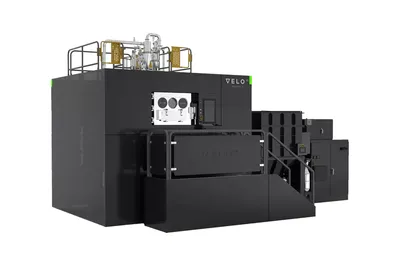
Velo3D Sapphire 1MZ
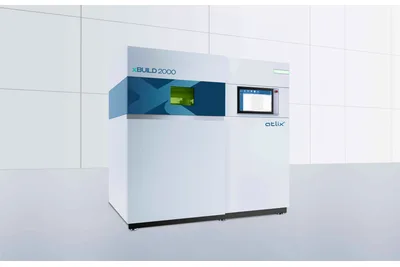
ATLIX xBUILD 2000
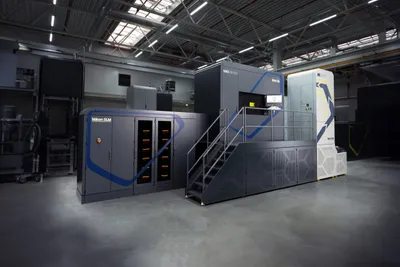
SLM Solutions NXG XII 600
GE Additive Arcam Spectra H
DN Solutions DLX 420