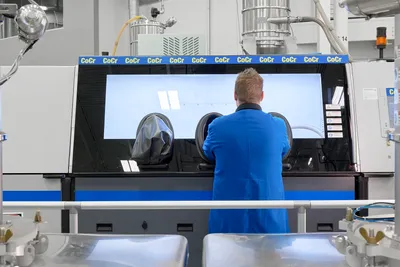
Markforged Metal X Gen 2 Metal 3D Printer
Key Specifications
physical dimensions width
physical dimensions depth
physical dimensions height
machine weight
build volume width
build volume depth
How much does the Markforged Metal X Gen 2 Metal 3D Printer cost?
Estimated price range
Our best estimate for a metal additive manufacturing in this class — not a quote from Markforged. Configuration moves it a long way.
Overview
The Markforged Metal X Gen 2 Metal 3D Printer is best judged by its material list and its lead time. It runs six alloys as bound powder metal filament: 17-4PH Stainless Steel, Copper, H13 Tool Steel, Inconel 625, and A2 and D2 Tool Steel.
Half of that list is tool steel. H13, A2 and D2 on one printer points at the toolroom: inserts, punches, forming details and fixtures that would otherwise wait for machine time. Copper is the unusual entry, since it gives a route to conductive parts from a spool of filament. 17-4PH Stainless Steel and Inconel 625 cover general hardware and hot or corrosive service. Switching alloy means changing media spools, and the table does not describe any cleaning step between them, so ask how changeovers are handled.
Lead time is set less by the printer than by what follows it. The washing time in the Wash-1 is listed as 12-72 hrs typical, a sixfold spread, and the table gives no rule for where a given part falls in it. After the wash comes the Sinter-2, with a peak internal temperature of 1,300° C (2,372° F); no cycle time is listed for the furnace. A shop quoting delivery on printed metal should plan around the wash and sinter queue, not the print.
Part size is capped by the build volume: 300 mm in width, 220 mm in depth, 180 mm in height. Within that, parts are printed solid or with triangular closed cell infill, at a Z layer resolution of 85 μm - 170 μm post-sinter, on a heated, auto leveling bed.
The printer weighs 75 kg (165 lbs). The Wash-1 at 136 kg (300 lbs) and the Sinter-2 at 350 kg (772 lbs) are the heavier pieces of the line.
Full Specifications
| Parameter | Value |
|---|---|
| Physical Dimensions Width | 575 mm |
| Physical Dimensions Depth | 467 mm |
| Physical Dimensions Height | 1120 mm |
| Machine Weight | 75 kg (165 lbs) |
| Build Volume Width | 300 mm |
| Build Volume Depth | 220 mm |
| Build Volume Height | 180 mm |
| Z Layer Resolution | 85 μm - 170 μm (Post-Sinter) |
| Printing Media | Bound Powder Filament |
| Internal Part Geometry | Closed Cell Infill (Triangular) or Solid Parts |
| Print Bed | Heated, Auto Leveling, Replaceable Print Sheets |
| Printing Process | Metal FFF |
| Wash 1 External Dimensions | 609 x 685 x 1,067 mm |
| Wash 1 Weight | 136 kg (300 lbs) |
| Wash 1 Washing Time | 12-72 hrs typical |
| Wash 1 Solvent | Opteon SF-79 |
| Sinter 2 External Dimensions | 1,200 x 700 x 1,500 mm |
| Sinter 2 Weight | 350 kg (772 lbs) |
| Sinter 2 Peak Internal Temp | 1,300° C (2,372° F) |
| Compatible Materials | 17-4PH Stainless Steel, Copper, H13 Tool Steel, Inconel 625, A2 and D2 Tool Steel |
| Release Material | Ceramic — Becomes Powder During Sintering Process |
| Media Spools | Bound Powder Metal Filament |
Specifications sourced from markforged.com — verified 2026-10-03
Strengths & Limitations
Strengths
- Three tool steels on one printer: H13, A2 and D2 Tool Steel
- Copper is a listed material, printed from bound powder metal filament
- Inconel 625 and 17-4PH Stainless Steel are also on the compatible list
- Alloys are loaded as media spools of filament
- Sinter-2 furnace reaches a peak internal temperature of 1,300° C (2,372° F)
Limitations
- Washing time is 12-72 hrs typical, so the wait after printing can be far longer than the print
- No aluminium or titanium alloy appears on the compatible-materials list
- The table gives no sintering cycle time, so total lead time cannot be worked out from it
- Parts are capped at 300 mm in width, 220 mm in depth and 180 mm in height
Best For
Frequently Asked Questions
01
The compatible materials are 17-4PH Stainless Steel, Copper, H13 Tool Steel, Inconel 625, and A2 and D2 Tool Steel. They come as bound powder metal filament on media spools. No aluminium or titanium alloy is on the list.
02
The table gives one time figure: washing in the Wash-1 takes 12-72 hrs typical. Print time and the Sinter-2 cycle are not listed. Since the wash alone can run to 72 hrs, plan lead time around the post-processing steps and ask for typical print and sinter times for the part in question.
03
Yes. H13 Tool Steel, A2 Tool Steel and D2 Tool Steel are all on the compatible-materials list. The table does not give hardness or heat-treatment data for the sintered material, so request the material data sheets before specifying a printed insert or punch.
04
The Sinter-2 is listed with a peak internal temperature of 1,300° C (2,372° F). It measures 1,200 x 700 x 1,500 mm and weighs 350 kg (772 lbs). The table does not state its gas, power or exhaust requirements.
05
The Wash-1 is listed with Opteon SF-79 solvent. The unit measures 609 x 685 x 1,067 mm and weighs 136 kg (300 lbs). Check local rules for storing and disposing of the solvent before installing it.
More from Markforged
Other Metal Additive Manufacturing
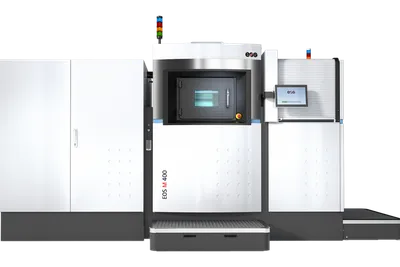
EOS M 400-4
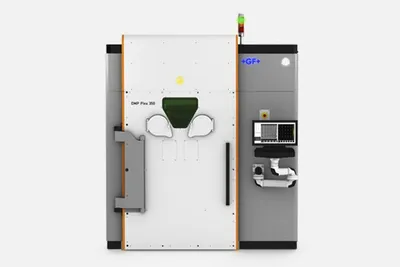
GF Machining DMP Factory 350 Dual
3D Systems DMP Factory 350 Metal 3D Printer
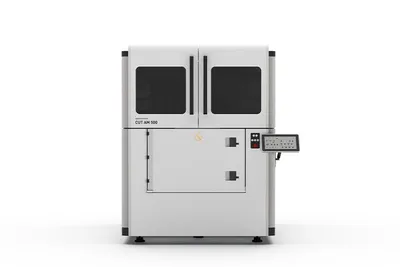
GF CUT AM 500