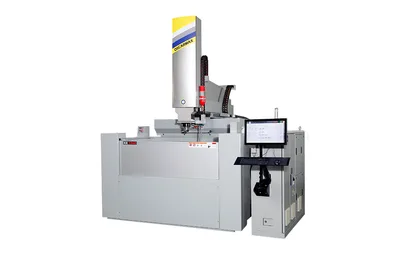
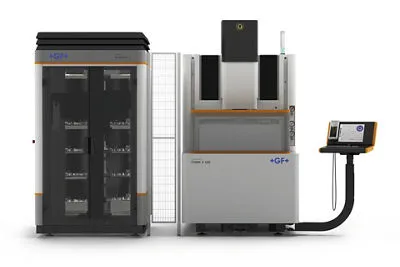
Makino EDBV3
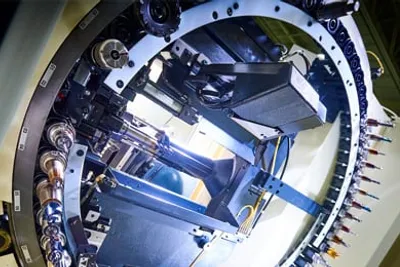
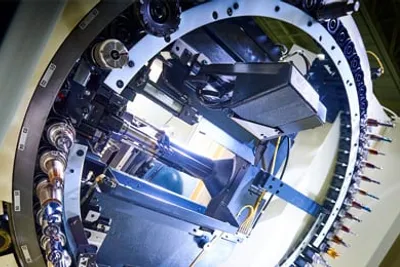
Image: makino.com, Makino
Key Specifications
X Travel
Y Travel
Z Travel
Tool Capacity
Table Size
Rapid Traverse
How much does the Makino EDBV3 cost?
Estimated price range
Our best estimate for a sinker edm (ram edm) in this class — not a quote from Makino. Configuration moves it a long way.
Overview
The Makino EDBV3 (Electrical Discharge Blade and Vane) is an EDM drilling machine for the cooling film holes and diffusors in blades and vanes for aerospace and power generation. It has 370 mm (14.6 in) of X, 270 mm (10.6 in) of Y and 500 mm (19.7 in) of Z, an integrated 2-axis rotary table with A: 360° and B: -110/+30°, a 24 tool changer and a 790 x 611 mm (31.1 in x 24.1 in) work tank.
The central problem in drilling a cooled blade is back-striking: once the electrode breaks into the hollow cavity, it must stop before it damages the opposite wall. The EDBV3 has a break-thru detection circuit as standard, and Makino states that detection occurs within 1 second or 0.040" (1.0mm) of depth. All machining is done fully submerged in de-ionized water, which Makino says gives the fastest cycle times and the most stable break-thru, and which also cuts over-spray, so the splash guards of older drilling machines are not needed. A Middle Guide supports long electrodes so they do not whip or bend.
Setup time is attacked on two fronts. The rotary table positions the part so several sides can be drilled in one setup, and the Die Guide and electrode are loaded and exchanged together as one assembly, which keeps a combined ATC and AGC exchange within 30 seconds. The Hyper-i control adds pre-programmed cycles for diffuser shapes, electrode length management and graphical pick-up cycles.
The workpiece limit is low: 5 kg (11 lb) on the rotary table as standard, or 15 kg (33 lb) with the option. That is enough for a turbine blade or vane, but rules out larger components. Rapid traverse is 5 m/min (197 in/min). The BX3 shares its X and Y travels but has 10 m/min (394 in/min) rapids and 750 mm (29.5 in) of Z, while the EDBV8 keeps the same rotary table and 24 tools but extends X to 800 mm (31.5 in) and Y to 600 mm (23.6 in) for larger parts.
Full Specifications
| Parameter | Value |
|---|---|
| Table Size | Rotary Table - A: 360° / B: -110/+30° |
| X-Axis Travel | 370 mm (14.6 in) |
| Y-Axis Travel | 270 mm (10.6 in) |
| Z-Axis Travel | 500 mm (19.7 in) |
| Rapid Traverse Rate | 5 m/min (197 in/min) |
| Max Workpiece Weight | 5 kg (15 kg optional) Rotary Table (11 lb (33 lb optional) Rotary Table) |
| Tool Capacity | 24 |
| Work Tank Size | 790 x 611 mm (31.1 in x 24.1 in) |
Specifications sourced from makino.com — verified 2026-10-02
Strengths & Limitations
Strengths
- Standard break-thru detection within 1 second or 0.040" (1.0mm) of depth to prevent back-striking
- Fully submerged drilling in de-ionized water, with no splash guards needed
- Die Guide and electrode exchanged together, keeping ATC and AGC exchange within 30 seconds
- Integrated 2-axis rotary table (A: 360°, B: -110/+30°) for multi-side drilling in one setup
- Hyper-i cycles for diffuser shapes, electrode length management and graphical pick-up
- 3-sided programmable Rise and Fall work tank for loading and automation
Limitations
- Rotary table load is 5 kg (11 lb) as standard; 15 kg (33 lb) is an option
- Rapid traverse of 5 m/min (197 in/min) is half the 10 m/min (394 in/min) of the BX3
- B-axis tilt is asymmetric at -110/+30°, against ±140º on the BX3
- Built for blade and vane drilling; X and Y of 370 mm (14.6 in) and 270 mm (10.6 in) leave little room for other parts
Best For
Frequently Asked Questions
01
A break-thru detection circuit is standard. Makino states it detects break-through within 1 second or 0.040" (1.0mm) of depth, so the electrode stops before it strikes the far wall of a hollow cavity. Submerged machining in de-ionized water also gives a more stable break-thru.
02
The rotary table takes 5 kg (11 lb) as standard and 15 kg (33 lb) as an option. Travels are 370 mm (14.6 in) in X, 270 mm (10.6 in) in Y and 500 mm (19.7 in) in Z, so the machine is sized for individual blades and vanes.
03
Both have 370 mm (14.6 in) of X and 270 mm (10.6 in) of Y. The BX3 rapids at 10 m/min (394 in/min) against 5 m/min (197 in/min), has 750 mm (29.5 in) of Z against 500 mm (19.7 in), and a B-axis of ±140º against the EDBV3's -110/+30°.
04
The Die Guide and the electrode tooling are loaded and exchanged together as an assembled unit, which keeps the combined ATC and AGC (Automatic Guide Change) exchange within 30 seconds. The tool changer holds 24 tools.
05
No. All machining is done fully submerged in de-ionized water in a programmable 3-sided Rise and Fall tank of 790 x 611 mm (31.1 in x 24.1 in), which minimizes water over-spray. Water quality is kept by an on-board chiller and filtration and de-ionization systems.
Comparisons
More from Makino
Other Sinker EDM (Ram EDM)
Sodick K1C
Sodick AG600
Sodick AG60L CNC Sinker EDM
CHMER CM1475C
GF AgieCharmilles FORM X