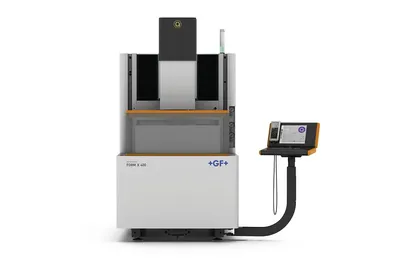
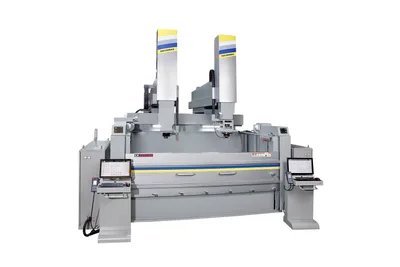
Makino EDAF3 Sinker EDM
Key Specifications
X Travel
Y Travel
Z Travel
Table Size
Weight
Rapid Traverse
How much does the Makino EDAF3 Sinker EDM cost?
Estimated price range
Our best estimate for a sinker edm (ram edm) in this class — not a quote from Makino. Configuration moves it a long way.
Overview
The Makino EDAF3 is the larger of the two EDAF sinker EDMs, with 450 mm (17.7 in) of X and 351 mm (13.8 in) of both Y and Z over a 700 x 500 mm (27.5 in x 19.7 in) table. It carries workpieces up to 800 kg (1,764 lb) in an 850 x 650 x 400 mm (33.46 in x 25.6 in x 15.75 in) work tank, and electrodes up to 165 lbs.
The obvious comparison is the EDAF2, which has 350 mm (13.78 in) of X and 250 mm (9.8 in) of Y and Z on a 550 × 350 mm (21.65 in x 13.78 in) table, so the EDAF3 is larger on every axis and also has the deeper tank. The extra Z is what lets a deep cavity and a long electrode fit at the same time, and the 400 mm tank depth covers taller mould plates.
The generator is an MGH6 rated at 40A peak, the figure that sets how fast large electrodes can rough out a cavity. Rapid traverse is 5,000 mm/min (197 ipm). A 16 position ATC is listed, along with an MA head with C-axis rotation to 1,000 RPM; the table does not say whether the MA head is standard or optional on this model, so confirm it in the quotation. The control is Makino's Hyper-i touchscreen.
The dielectric system holds 450 liters (119 gal) of fluid. Plan the installation around a footprint of 1,500 x 2,610 x 2,600 mm (59.1 x 102.8 x 102.4 in) and a machine weight of 5,400 kg (11,900 lb). The 2,600 mm height in particular needs checking against crane hooks and ceiling clearance.
The EDGE3i, with the same 450 mm (17.7 in) of X but 300 mm (11.8 in) of Y, 320 mm (12.6 in) of Z and a 600 x 450 mm (23.6 in x 17.7 in) table, is the alternative when the EDAF3's envelope is more than the work needs.
Full Specifications
| Parameter | Value |
|---|---|
| X-Axis Travel | 450 mm (17.7 in) |
| Y-Axis Travel | 351 mm (13.8 in) |
| Z-Axis Travel | 351 mm (13.8 in) |
| Table Size | 700×500 (27.5 in x 19.7 in) |
| Max Workpiece Weight | 800 kg (1,764 lb) |
| Max Electrode Weight | 165 lbs |
| Dielectric Fluid Volume | 450 liters (119 gal) |
| NC Power Supply | MGH6 (40A peak) |
| Rapid Traverse Rate | 5,000 mm/min (197 ipm) |
| ATC Capacity | 16 positions |
| C Axis Speed | 1,000 RPM (MA Head) |
| Machine Dimensions | 1,500 x 2,610 x 2,600 mm (59.1 x 102.8 x 102.4 in) |
| Machine Weight | 5,400 kg (11,900 lb) |
| CNC Control | Makino Hyper-i (touchscreen) |
| Maximum Workpiece Weight | 1,760 lbs |
| Work Tank Size | 850×650×400 (33.46 in x 25.6 in x 15.75 in) |
Specifications sourced from makino.com — verified 2026-09-24
Strengths & Limitations
Strengths
- Workpieces up to 800 kg (1,764 lb) on a 700 x 500 mm (27.5 in x 19.7 in) table
- 850 x 650 x 400 mm (33.46 in x 25.6 in x 15.75 in) work tank for tall mould plates
- MGH6 generator rated at 40A peak
- 16 position ATC and a 1,000 RPM MA head listed
- 450 mm (17.7 in) of X and 351 mm (13.8 in) of Y and Z, against 350 mm and 250 mm on the EDAF2
Limitations
- Machine weight of 5,400 kg (11,900 lb) and a height of 2,600 mm need planning before installation
- Needs a floor area of 1,500 x 2,610 mm (59.1 x 102.8 in) before access space is added
- 450 liters (119 gal) of dielectric to fill, filter and maintain
- Makino's table does not say whether the MA head is standard or optional
Best For
Frequently Asked Questions
01
The EDAF3 has 450 mm (17.7 in) of X and 351 mm (13.8 in) of Y and Z on a 700 x 500 mm (27.5 in x 19.7 in) table. The EDAF2 has 350 mm (13.78 in) of X and 250 mm (9.8 in) of Y and Z on a 550 × 350 mm (21.65 in x 13.78 in) table. The EDAF3 takes workpieces up to 800 kg (1,764 lb) in an 850 x 650 x 400 mm (33.46 in x 25.6 in x 15.75 in) tank.
02
The NC power supply is an MGH6 rated at 40A peak. The control is Makino's Hyper-i touchscreen, and rapid traverse is 5,000 mm/min (197 ipm). A 16 position ATC and an MA head with C-axis rotation to 1,000 RPM are listed.
03
The machine measures 1,500 x 2,610 x 2,600 mm (59.1 x 102.8 x 102.4 in) and weighs 5,400 kg (11,900 lb). The dielectric system holds 450 liters (119 gal). Check door widths, floor loading and overhead clearance for the 2,600 mm height.
04
The work tank is 850 x 650 x 400 mm (33.46 in x 25.6 in x 15.75 in) over a 700 x 500 mm (27.5 in x 19.7 in) table. Workpieces can weigh up to 800 kg (1,764 lb) and electrodes up to 165 lbs.
Videos

Makino Inc.

MTDCNC

EdgeMT

Bob Wescott
More from Makino
Other Sinker EDM (Ram EDM)
CHMER CM A64C
Mitsubishi Electric EA28V
GF AgieCharmilles FORM S 350
GF AgieCharmilles FORM P
Oscar EDM EX 2210-2H