HP Metal Jet S100+
Key Specifications
build volume
layer thickness
build rate
sintering shrinkage
final part density
supported materials
How much does the HP Metal Jet S100+ cost?
Estimated price range
Our best estimate for a metal additive manufacturing in this class — not a quote from HP Inc.. Configuration moves it a long way.
Overview
The HP Metal Jet S100 is a metal additive manufacturing printer that builds parts with HP thermal inkjet printheads and finishes them by debinding and sintering. The listed figures give a build volume of 430 × 320 × 200 mm (16.9 × 12.6 × 7.9 in), a layer thickness of 50 – 140 µm and a printer weight of approximately 3,200 kg, with the sintering furnace sold separately.
What comes off the printer is a green part, and the sintering rows are the ones a designer has to work with. Shrinkage is listed at approximately 20% and uniform in X, Y and Z, so every dimension is printed oversize and comes down in the furnace. Final part density is listed at 93–99% depending on the process. Accuracy is ±0.3% or ±0.2 mm, whichever is greater, after sintering: on a small feature the ±0.2 mm term governs, and on a long dimension the percentage does.
Surface finish is listed at Ra 4–8 µm as-sintered and up to Ra 0.8 µm with post-processing, so sealing faces and bearing fits will need a finishing operation. Supported materials are 316L stainless steel and 17-4PH stainless steel, with additional alloys described as in qualification. The post-processing row calls the debinding and sintering route MIM-compatible.
Two pairs of rows do not agree with each other, and both should be settled with the supplier before planning capacity. The build envelope appears as 430 × 320 × 200 mm (16.9 × 12.6 × 7.9 in) and also as a 430 × 309 mm build area with a build height of up to 140 mm. The build rate appears as up to 2,800 cm³/hr of green part volume and also as up to 55 cm³/hour.
Full Specifications
| Parameter | Value |
|---|---|
| Build Volume | 430 × 320 × 200 mm (16.9 × 12.6 × 7.9 in) |
| Layer Thickness | 50 – 140 µm |
| Build Rate | Up to 2,800 cm³/hr (green part volume) |
| Sintering Shrinkage | Approx. 20% uniform (X, Y, Z) |
| Final Part Density | 93–99% (process dependent) |
| Supported Materials | 316L stainless steel, 17-4PH stainless steel (additional alloys in qualification) |
| Accuracy | ±0.3% or ±0.2 mm (whichever is greater, post-sinter) |
| Surface Finish | Ra 4–8 µm as-sintered (up to Ra 0.8 µm with post-processing) |
| Printhead Technology | HP thermal inkjet, 630 nozzles per inch |
| Software | HP Metal Jet Software Suite |
| Machine Weight | Approx. 3,200 kg printer; sintering furnace sold separately |
| Build Area | 430 × 309 mm |
| Build Height | Up to 140 mm |
| Volumetric Build Rate | Up to 55 cm³/hour |
| Materials | Stainless steel 316L, 17-4 PH |
| Post Processing | Debinding + sintering (MIM-compatible) |
| Control System | HP Digital Front End |
Specifications compiled from manufacturer literature and industry references. Not independently verified against a published spec sheet — confirm with the manufacturer or an authorised dealer before making a purchasing decision.
Strengths & Limitations
Strengths
- Build volume is listed at 430 × 320 × 200 mm (16.9 × 12.6 × 7.9 in)
- Sintering shrinkage is listed as approximately 20% and uniform in X, Y and Z, which keeps scaling predictable
- Post-sinter accuracy is listed at ±0.3% or ±0.2 mm, whichever is greater
- Layer thickness can be set across 50 – 140 µm
- The debinding and sintering route is listed as MIM-compatible
Limitations
- The sintering furnace is sold separately from the approximately 3,200 kg printer
- As-sintered surface finish is Ra 4–8 µm; reaching Ra 0.8 µm requires post-processing
- Supported materials are 316L stainless steel and 17-4PH stainless steel, with other alloys still in qualification
- Final part density is listed as 93–99% and process dependent, so the low end has to be ruled out by process qualification
- The listed figures are unconfirmed and disagree on build rate (2,800 cm³/hr against 55 cm³/hour) and on build height (200 mm against 140 mm)
Best For
Frequently Asked Questions
01
The build volume row gives 430 × 320 × 200 mm (16.9 × 12.6 × 7.9 in). Two other rows give a build area of 430 × 309 mm and a build height of up to 140 mm. The rows do not agree, so confirm the usable envelope with the supplier before sizing parts to the larger figure.
02
Sintering shrinkage is listed at approximately 20%, uniform in X, Y and Z. Parts are printed oversize to allow for it. Because the shrinkage is described as uniform, one scale factor applies in all three directions.
03
Accuracy is listed at ±0.3% or ±0.2 mm, whichever is greater, measured after sintering. Surface finish is Ra 4–8 µm as-sintered, and up to Ra 0.8 µm with post-processing.
04
The supported materials row lists 316L stainless steel and 17-4PH stainless steel, and notes additional alloys in qualification. Final part density is listed at 93–99%, depending on the process.
05
No. The weight row gives approximately 3,200 kg for the printer and states that the sintering furnace is sold separately. The post-processing row lists debinding and sintering, described as MIM-compatible, so furnace capacity has to be arranged alongside the printer.
Videos

HP

HP

Manufacturing Technology Centre
More from HP Inc.
Other Metal Additive Manufacturing
SLM Solutions SLM 125
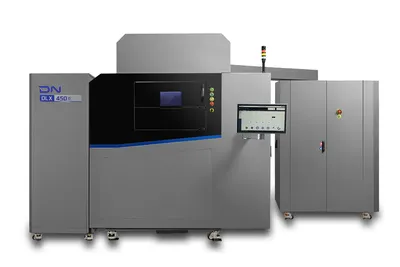
DN Solutions DLX 450
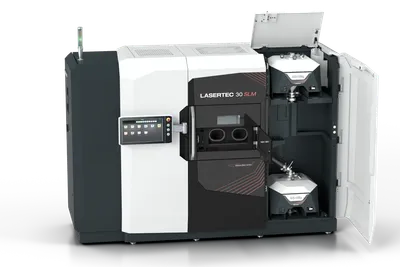
DMG Mori LASERTEC 30 SLM