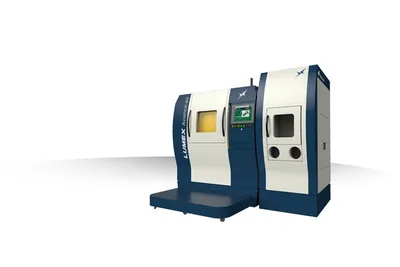
Hermle MPA 42
Key Specifications
Spindle Taper
Accuracy
Repeatability
x axis travel
y axis travel
z axis travel
How much does the Hermle MPA 42 cost?
Estimated price range
Our best estimate for a metal additive manufacturing in this class — not a quote from Hermle. Configuration moves it a long way.
Overview
The Hermle MPA 42 puts metal build-up and 5-axis milling in one machine. The additive process is listed as Metal Powder Application (MPA), a thermal spray deposition, and the cutting side is a 5-axis machining centre with 800 mm (31.5 in) of X and Y travel and 550 mm (21.7 in) of Z. Treat the listed figures as unconfirmed and check them with Hermle before relying on any of them.
The listed deposition rate is up to 200 cm³/hr depending on material, and the materials named are copper, steel, stainless steel, titanium and multi-material combinations. The tool magazine is given as 42 positions plus the MPA spray head, so material can be applied and then milled without moving the part to another machine. Milling is done by an 18,000 rpm HSK-A63 spindle with a 29 kW (39 hp) motor.
The part sits on a table of 800 mm (31.5 in) diameter rated for 1,400 kg (3,086 lb). The A-axis swivels +/- 115 degrees (230 degrees total) and the C-axis is 360 degrees continuous. Positioning accuracy is listed as +/- 0.005 mm (0.0002 in) and repeatability as +/- 0.003 mm (0.00012 in). The base is mineral cast, the control a Heidenhain TNC 640, the machine weight 14,000 kg (30,864 lb) and the power supply 400V, 3-phase, 50/60 Hz.
Full Specifications
| Parameter | Value |
|---|---|
| X Axis Travel | 800 mm (31.5 in) |
| Y Axis Travel | 800 mm (31.5 in) |
| Z Axis Travel | 550 mm (21.7 in) |
| A Axis Swivel | +/- 115 degrees (230 degrees total) |
| C Axis | 360 degrees continuous |
| Table Diameter | 800 mm (31.5 in) |
| Table Load Capacity | 1,400 kg (3,086 lb) |
| Spindle Speed | 18,000 rpm |
| Spindle Motor | 29 kW (39 hp) |
| Spindle Taper | HSK-A63 |
| Tool Magazine | 42 positions (plus MPA spray head) |
| Additive Process | Metal Powder Application (MPA) — thermal spray deposition |
| Additive Materials | Copper, steel, stainless steel, titanium, multi-material combinations |
| Deposition Rate | Up to 200 cm³/hr depending on material |
| Positioning Accuracy | +/- 0.005 mm (0.0002 in) |
| Repeatability | +/- 0.003 mm (0.00012 in) |
| Machine Base | Mineral cast |
| CNC Control | Heidenhain TNC 640 |
| Machine Weight | 14,000 kg (30,864 lb) |
| Power Supply | 400V, 3-phase, 50/60 Hz |
Specifications compiled from manufacturer literature and industry references. Not independently verified against a published spec sheet — confirm with the manufacturer or an authorised dealer before making a purchasing decision.
Strengths & Limitations
Strengths
- Metal Powder Application (MPA) deposition and 5-axis milling in one machine, with the spray head listed alongside 42 tool positions
- Named materials include copper, steel, stainless steel, titanium and multi-material combinations
- 18,000 rpm HSK-A63 spindle with a 29 kW (39 hp) motor for machining the applied material
- Table of 800 mm (31.5 in) diameter rated for 1,400 kg (3,086 lb), with +/- 115 degrees of A-axis swivel
- Listed positioning accuracy of +/- 0.005 mm (0.0002 in) and repeatability of +/- 0.003 mm (0.00012 in)
Limitations
- Deposition is listed at up to 200 cm³/hr depending on material, so large solid volumes mean long build times
- No powder, gas or energy consumption is listed for the spray process, which a buyer needs in order to plan the additive side
- No spindle torque is listed, only the 29 kW (39 hp) motor rating
- At 14,000 kg (30,864 lb), foundation and rigging need checking before installation
Best For
Frequently Asked Questions
01
The listed process is Metal Powder Application (MPA), described as thermal spray deposition. The deposition rate is given as up to 200 cm³/hr depending on material. The MPA spray head is listed next to the 42 tool positions, so applying and milling happen in one machine.
02
The listed additive materials are copper, steel, stainless steel and titanium, plus multi-material combinations. The figures do not say which combinations have been qualified or what powder specification each needs, so raise that with Hermle for the specific pairing you have in mind.
03
Travels are 800 mm (31.5 in) in X and Y and 550 mm (21.7 in) in Z. The spindle is HSK-A63 at 18,000 rpm with a 29 kW (39 hp) motor. The A-axis swivels +/- 115 degrees and the C-axis is 360 degrees continuous. Positioning accuracy is listed as +/- 0.005 mm (0.0002 in).
04
The table has a diameter of 800 mm (31.5 in) and a load capacity of 1,400 kg (3,086 lb). The figures give no maximum workpiece diameter or height, so the limit for a tilted part has to be confirmed. Remember that applied material adds to the weight on the table as the build grows.
05
The listed power supply is 400V, 3-phase, 50/60 Hz and the machine weight is 14,000 kg (30,864 lb). Nothing is listed for the powder handling, gas supply or extraction that a spray process requires, so get those requirements in writing before preparing the site.
Videos

Maschinenfabrik Berthold HERMLE AG

Kingsbury UK
More from Hermle
Other Metal Additive Manufacturing
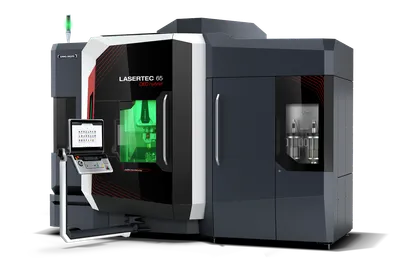
DMG Mori LASERTEC 65 DED hybrid 2nd Generation
HP Metal Jet S100 Metal 3D Printer
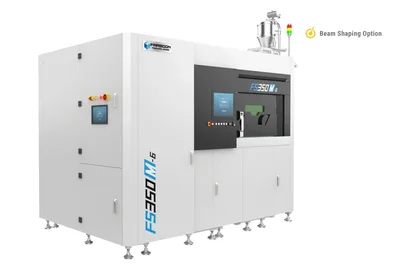
Farsoon FS350M
Velo3D Sapphire
ATLIX xBUILD 5000