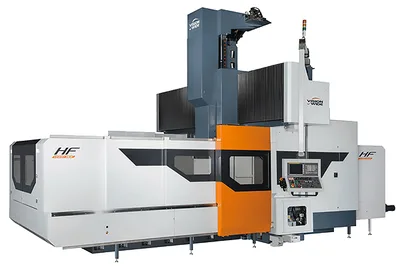
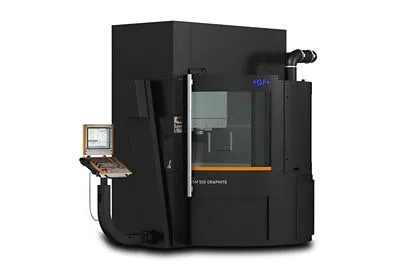
GF Machining Solutions Mikron MILL S 400 Graphite
This model was not found in GF Machining Solutions's current lineup when we checked on 2026-10-02 (lineup page). It may be a superseded or older model; the specifications below are as we last recorded them.
Key Specifications
X Travel
Y Travel
Z Travel
Max Spindle
Spindle Taper
Tool Capacity
How much does the GF Machining Solutions Mikron MILL S 400 Graphite cost?
Estimated price range
Our best estimate for a vertical machining centers (vmc) in this class — not a quote from GF Machining Solutions. Configuration moves it a long way.
Overview
The Mikron MILL S 400 Graphite is a dry-cutting graphite milling machine listed with 400 x 350 x 400 mm of travel, a 500 x 400 mm table rated for 250 kg and a 42,000 RPM Step-Tec spindle with an HSK-E32 interface at 13 kW. It is not in GF Machining Solutions' current lineup, and the table has not been matched to a GF page, so these are listed figures only.
Everything in the listed table is aimed at graphite electrodes. It machines dry with no coolant, an integrated HEPA-grade closed-loop system extracts the dust, and the linear guides, ballscrews, drives and electrical cabinet are listed as fully sealed. The HSK-E32 interface is smaller than the HSK-E40 of the current Mikron HSM 500 GRAPHITE, which keeps the tools small and suits fine electrode ribs and detail.
Other listed figures are a 60 m/min rapid traverse, positioning accuracy of 0.003 mm, 20 tools expandable to 40, a Heidenhain TNC 640 control and a machine weight of 7,500 kg. The Z travel of 400 mm is generous for the size, which helps with tall electrode blanks.
For a current alternative, the Mikron HSM 500 GRAPHITE offers 500 x 450 x 350 mm of travel, a 550 x 450 mm table for 200 kg and a 42,000 rpm HSK-E40 spindle with dedicated dust extraction.
Full Specifications
| Parameter | Value |
|---|---|
| X-Axis Travel | 400 mm (15.7 in) |
| Y-Axis Travel | 350 mm (13.8 in) |
| Z-Axis Travel | 400 mm (15.7 in) |
| Table Size | 500 x 400 mm (19.7 x 15.7 in) |
| Table Load Capacity | 250 kg (551 lb) |
| Max Spindle Speed | 42,000 RPM |
| Spindle Taper | HSK-E32 |
| Spindle Motor Power | 13 kW (17 hp) |
| Spindle Technology | Step-Tec precision spindle |
| Machining Type | Dry (graphite) — no coolant |
| Dust Extraction | Integrated HEPA-grade closed-loop system |
| Sealed System | Linear guides, ballscrews, drives, and electrical cabinet fully sealed |
| Tool Capacity | 20 (expandable to 40) |
| Rapid Traverse Rate | 60 m/min (2,362 ipm) |
| Positioning Accuracy | 0.003 mm (3 µm) |
| Machine Weight | 7,500 kg (16,535 lb) |
| CNC Control | Heidenhain TNC 640 |
Specifications compiled from manufacturer literature and industry references. Not independently verified against a published spec sheet — confirm with the manufacturer or an authorised dealer before making a purchasing decision.
Strengths & Limitations
Strengths
- Dry machining with an integrated HEPA-grade closed-loop dust extraction system
- Linear guides, ballscrews, drives and electrical cabinet listed as fully sealed
- 42,000 RPM Step-Tec spindle with HSK-E32 interface for small electrode cutters
- Listed positioning accuracy of 0.003 mm
- 400 mm of Z travel for tall electrode blanks
Limitations
- 13 kW spindle on an HSK-E32 interface is limited to small tools and light cuts
- X travel of 400 mm and Y travel of 350 mm limit multi-electrode setups
- Built for dry graphite work only, with no coolant system listed
Best For
Frequently Asked Questions
01
It does not appear in GF Machining Solutions' current lineup. The current graphite machine is the Mikron HSM 500 GRAPHITE, with 500 x 450 x 350 mm of travel and a 42,000 rpm HSK-E40 spindle.
02
The table lists it as a dry graphite machine with no coolant, using an integrated HEPA-grade closed-loop dust extraction system. It is not set up for wet cutting of steel or copper.
03
The spindle is listed with an HSK-E32 interface at 42,000 RPM and 13 kW, and the magazine holds 20 tools, expandable to 40. Check which magazine a used machine has and budget for HSK-E32 holders.
04
The condition of the seals on the guides and ballscrews, the dust extraction filters and the spindle, since graphite dust is abrasive. The listed machine weight is 7,500 kg, and control is a Heidenhain TNC 640.
Videos

United Machining (USA)

Peak Machine Sales (Peak EDM)

Peak Machine Sales (Peak EDM)

Peak Machine Sales (Peak EDM)
More from GF Machining Solutions
Other Vertical Machining Centers (VMC)
Pinnacle DV2142
Willemin-Macodel 301S2
Fehlmann PICOMAX 95
Hartford HSA-532
Tongtai TMV-1350A