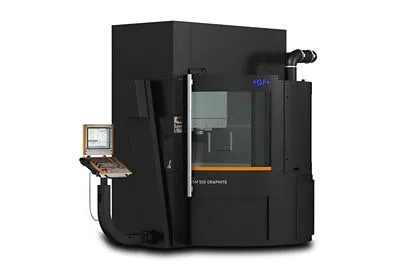
GF Machining Solutions Mikron HSM 500
Key Specifications
X Travel
Y Travel
Z Travel
Max Spindle
Spindle Taper
Tool Capacity
Overview
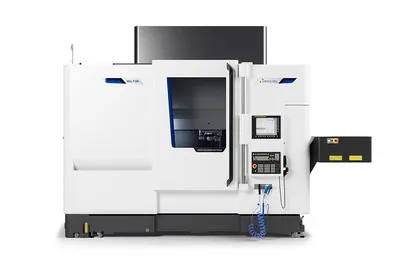
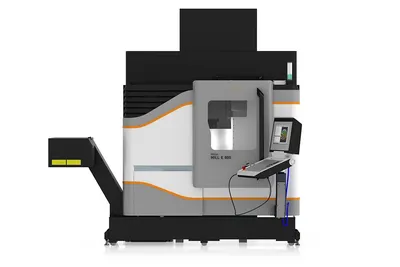
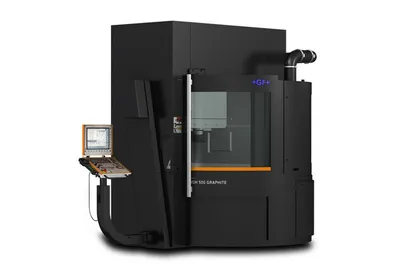
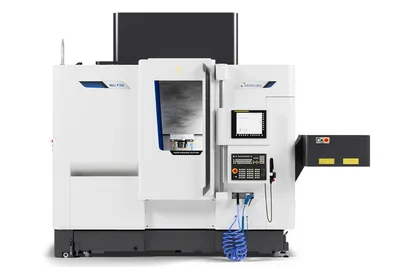
The GF Machining Solutions Mikron HSM 500 is a high-speed machining center targeting the precision mold, die, and toolmaking segment where spindle speed, surface finish quality, and thermal stability define competitive advantage. The HSM (High Speed Machining) designation reflects the machine's design philosophy: optimize every subsystem — spindle, structure, control, and cooling — for best-in-class cutting performance on hardened steel and graphite at high RPM.
The machine offers X/Y/Z travels of 500 x 450 x 400 mm (19.7 x 17.7 x 15.7 in) on a fixed table accepting workpieces up to 700 x 500 mm (27.6 x 19.7 in) and loads up to 500 kg (1,102 lb). The fixed table design — moving column rather than moving table — maintains workpiece mass in a fixed position throughout the cutting cycle, which significantly reduces dynamic loads on the workpiece mounting and improves surface finish quality during high-speed finishing passes.
The standard HSM 500 spindle is a Step-Tec unit rated at 36,000 RPM with 25 kW (33 hp) through an HSK-E50 taper. The 36 kW figure cited in some GF literature refers to the peak power rating; the 25 kW continuous rating is the production benchmark. For shops that don't need 36,000 RPM and prefer higher torque, GF offers a 20,000 RPM / 35 kW option that better suits mixed hardened steel and aluminum work.
The HSM 500's machine structure is built on a polymer concrete (Granitan) base — GF's proprietary casting material that provides vibration damping approximately 6-8 times better than cast iron. This base, combined with the fixed-table moving-column kinematic design, is what delivers the surface finish quality the HSM series is known for: Ra 0.1-0.2 µm on hardened steel in high-speed finishing mode, comparable to EDM surface quality for many mold applications.
Thermal management is comprehensive: all drive motors and spindle are liquid-cooled, the linear guide system is cooled, and a temperature compensation algorithm in the Heidenhain TNC 640 corrects for residual thermal drift continuously during machining. The result is dimensional stability that maintains part geometry accuracy over multi-hour mold cavity finishing programs without operator intervention.
The HSM 500 competes directly with the Röders RXP 500 DS, Yasda YMC 430, and the older Makino V33i. Its sweet spot is hardened steel mold cavity work up to 60 HRC and graphite electrode production, both of which it handles with surface finish quality that reduces or eliminates hand polishing. Pricing typically runs from $300,000 to $500,000 configured.
Full Specifications
| Parameter | Value |
|---|---|
| X-Axis Travel | 500 mm (19.7 in) |
| Y-Axis Travel | 450 mm (17.7 in) |
| Z-Axis Travel | 400 mm (15.7 in) |
| Table Size | 700 x 500 mm (27.6 x 19.7 in) |
| Table Load Capacity | 500 kg (1,102 lb) |
| Kinematic Design | Fixed table, moving column |
| Max Spindle Speed | 36,000 RPM (20,000 RPM option) |
| Spindle Taper | HSK-E50 |
| Spindle Motor Power | 25 kW continuous / 36 kW peak (33 hp / 48 hp) |
| Spindle Technology | Step-Tec precision spindle, liquid-cooled |
| Tool Capacity | 30 (expandable to 90) |
| Rapid Traverse Rate | 60 m/min (2,362 ipm) |
| Positioning Accuracy | 0.003 mm (3 µm) |
| Surface Finish Capability | Ra 0.1 µm on hardened steel (high-speed finishing) |
| Bed Material | Granitan polymer concrete |
| Machine Weight | 9,000 kg (19,842 lb) |
| CNC Control | Heidenhain TNC 640 |
Specifications sourced from gfms.com — verified 2026-03-28
Strengths & Limitations
Strengths
- 36,000 RPM Step-Tec spindle with Granitan base achieves Ra 0.1 µm surface finish on hardened steel (up to 62 HRC) — competitive with EDM surface quality for many mold cavities, directly reducing hand polishing requirements
- Fixed-table moving-column kinematic design eliminates workpiece inertia effects during high-speed passes, delivering more consistent surface finish and better dimensional accuracy than moving-table designs
- Granitan polymer concrete base provides 6-8x better vibration damping than cast iron, visibly improving surface finish quality at high spindle speeds and extended tool life on finishing passes
- Comprehensive liquid cooling of spindle, drives, and linear guides combined with Heidenhain TNC 640 thermal compensation maintains part geometry accuracy over multi-hour mold cavity programs
- 25 kW continuous spindle power is substantially higher than lighter HSM machines in this travel range, enabling productive hardened steel roughing in addition to precision finishing
- Compatible with System 3R WorkShopManager for unattended operation in electrode and mold component production environments
Limitations
- 500 x 450 mm X/Y travel limits the HSM 500 to small-to-medium mold components — large cavity blocks or dies require a machine with larger travel in the GF or competitive range
- HSK-E50 taper requires a dedicated toolholder inventory separate from standard HSK-A63 shops, adding tooling investment for new customers
- Granitan base makes field relocation more challenging than standard cast iron machines — the machine is designed for a permanent installation with a precision-poured foundation
- At $300K-$500K for a 3-axis VMC, the HSM 500 requires clear surface finish ROI versus lower-cost alternatives — shops without a specific Ra 0.1 µm mold finishing requirement may find the cost hard to justify
Best For
Frequently Asked Questions
01
The Mikron HSM 500 typically prices between $300,000 and $500,000 new, depending on spindle configuration (36,000 RPM vs 20,000 RPM), tool magazine size (30 vs 90 pockets), through-spindle air vs coolant, probing systems, and automation interfaces. A base machine with the standard Step-Tec 36,000 RPM spindle and 30-pocket magazine starts around $300,000. Fully equipped machines with expanded magazine, automation interface, and monitoring options approach $500,000. Used Mikron HSM 500 machines from 2015-2021 trade between $120,000 and $220,000 depending on condition and spindle hours.
02
Both are premium high-speed machining centers targeting precision mold and electrode work in similar price and travel ranges. The Röders RXP 500 DS is known for exceptional surface finish quality from its hydrostatic spindle bearing system and linear motor drives. The Mikron HSM 500 achieves comparable finish quality through its Step-Tec spindle and Granitan base. Key differences: Röders uses linear motors while GF uses ballscrews with high-accuracy preloaded nuts; Röders targets a slightly higher precision tier while the HSM 500 offers broader spindle speed and power options. Both machines command respect in the precision mold industry — the choice often depends on regional service availability and existing brand relationships.
03
GF strongly recommends a dedicated graphite extraction system for the HSM 500 when used for graphite electrode production. Unlike the dedicated MILL S Graphite series, the HSM 500 is not factory-configured for dry graphite machining as a standard option. However, GF offers a graphite machining package for the HSM 500 that includes external dust extraction connection, work zone sealing, and guide protection. This makes the HSM 500 a viable graphite machine for shops doing moderate electrode volumes, while the MILL S Graphite series is preferred for high-volume dedicated electrode production.
04
The HSM 500 excels in hardened tool steel (30-62 HRC), pre-hardened P20/H13 mold steel, aluminum (including high-speed finishing), graphite (with appropriate extraction), copper, copper-tungsten, and engineering plastics. The 25 kW continuous spindle handles moderate titanium work, though for production titanium the MILL P series with higher spindle torque is more appropriate. The machine is optimized for hard material finishing rather than aggressive roughing — shops pair the HSM 500 with a high-torque roughing machine and use the HSM 500 for the semi-finishing and finishing operations that determine part quality.
05
In a moving-column design, the table is fixed to the machine base and the X-axis motion is provided by moving the column rather than the table. The key advantage for precision machining is that the workpiece mass does not change the system's dynamic behavior during X-axis moves — the inertia load is always the same regardless of workpiece size or weight, up to the table's rated capacity. In a moving-table design, a heavy workpiece increases axis inertia and can cause velocity-dependent positional errors and vibration during direction changes. For mold cavity finishing where surface finish quality depends on smooth, consistent axis motion, the fixed-table design provides a measurable quality advantage.
Videos
United Machining (USA)
UNITED MACHINING
masoncnc
UNITED MACHINING
Cutting Tool Engineering
Community Discussions
Troubleshooting and problem-solving — Mikron Mill E 500 U tool changer problem ...
Owner experience and review — Mikron 500 LP - Practical Machinist
Community discussion — New CNC 5 axis
Community discussion — New (to us) machine day! 5 axis mikron | Page ...
Owner experience and review — Best and worst CNC machines and brands you've ever used ...
Community discussion — What do you use for your speed and feeds? : r/Machinists - Reddit
Community discussion — What does everyone see as the most trusted CNC ... - Reddit
Troubleshooting and problem-solving — Endmill Recommendations : r/Machinists - Reddit
Links to community discussions. Summaries are editorial — visit the original thread for full context.