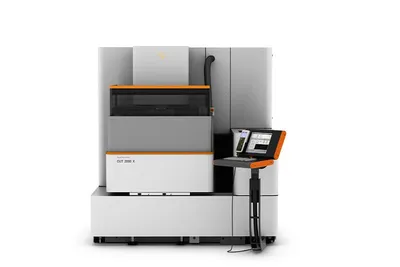
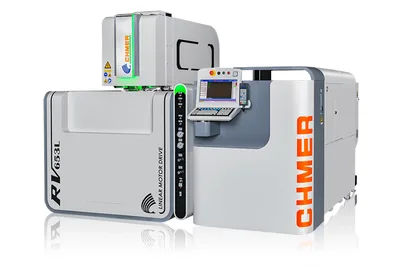
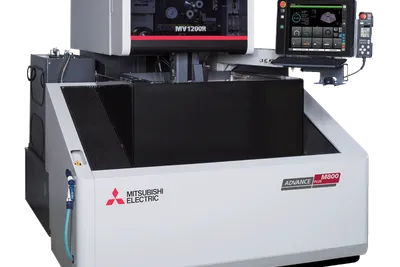
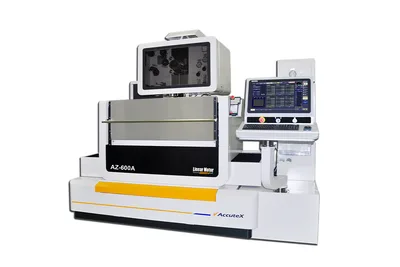
GF Machining AgieCharmilles CUT 1000 OilTech
This model was not found in GF Machining Solutions's current lineup when we checked on 2026-10-02 (lineup page). It may be a superseded or older model; the specifications below are as we last recorded them.
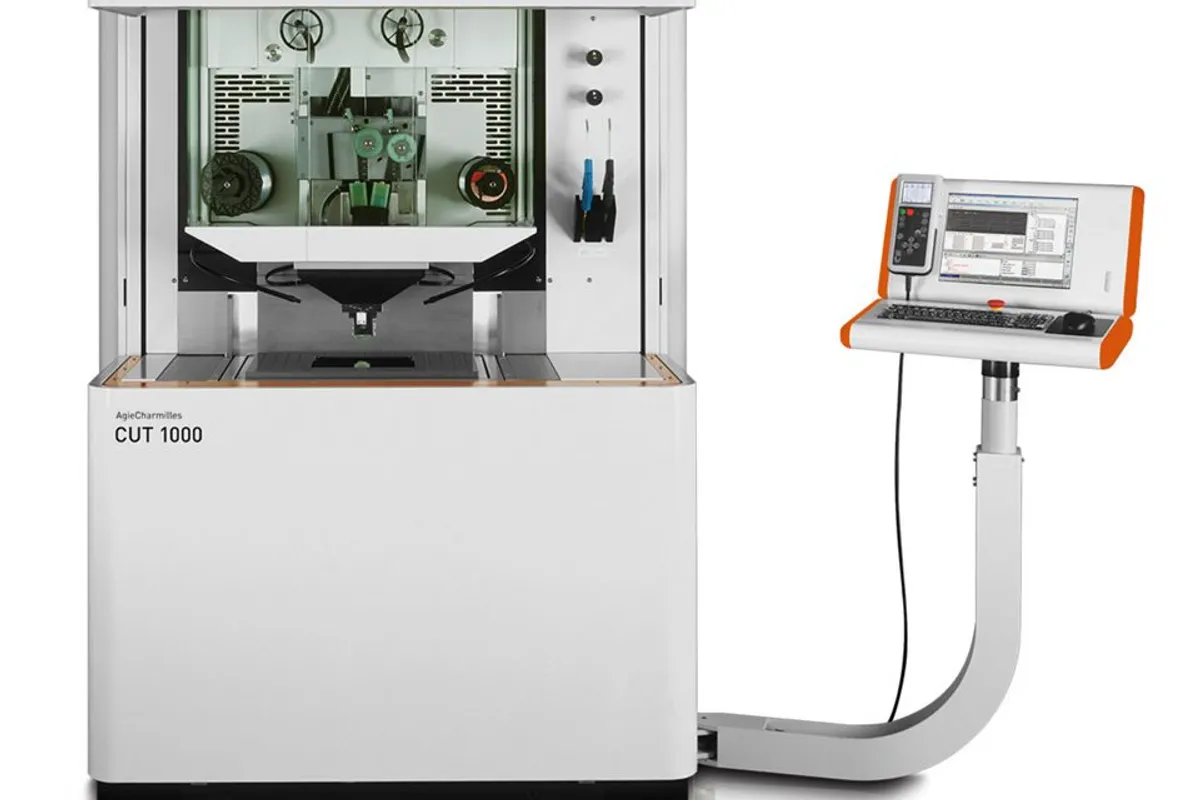
Image: assets.georgfischer.com, GF Machining Solutions
Key Specifications
X Travel
Y Travel
Z Travel
travel u v
max workpiece size
max workpiece weight
How much does the GF Machining AgieCharmilles CUT 1000 OilTech cost?
Estimated price range
Our best estimate for a wire edm in this class — not a quote from GF Machining Solutions. Configuration moves it a long way.
Overview
The AgieCharmilles CUT 1000 OilTech is the oil-dielectric version of a compact precision wire EDM: its listed dielectric is an inert hydrocarbon oil instead of deionized water, on 220 x 160 x 100 mm of X, Y and Z travel. GF Machining Solutions does not include it in its current lineup, so machines on the market are older ones.
The oil is the reason to choose this version. An oil dielectric is usually picked where water would attack the work, for example carbide, whose binder can be leached by a water dielectric, and parts that must not corrode between operations. It also changes the installation: oil brings fire protection, fume extraction and oil handling requirements a water machine does not have, so check the site can meet them before buying.
For detail work the wire range is the other deciding row. Standard wire runs 0.07 to 0.20 mm, and 0.02 to 0.05 mm is optional, which lets very small inside radii be cut. Best listed finish is Ra 0.05 µm. Spool capacity is listed as two 8 kg spools per circuit.
The envelope limits it to small parts. Workpieces can be up to 300 x 200 x 80 mm and 35 kg, and the U and V axes travel ±40 mm for a taper of only ±3° at 80 mm. Apart from the dielectric, every listed figure matches the water-based AgieCharmilles CUT 1000.
Full Specifications
| Parameter | Value |
|---|---|
| X-Axis Travel | 220 mm (8.7 in) |
| Y-Axis Travel | 160 mm (6.3 in) |
| Z-Axis Travel | 100 mm (3.9 in) |
| Travel U V | ± 40 mm± 1.57 in |
| Max Workpiece Size | 300 x 200 x 80 mm (11.8 x 7.9 x 3.1 in) |
| Max Workpiece Weight | 35 kg (77 lbs) |
| Wire Diameter Standard | 0.07 - 0.20 mm |
| Wire Diameter Optional | 0.02 - 0.05 mm |
| Surface Finish | Ra 0.05 µm (best) |
| Max Taper Angle | +/-3 deg / 80 mm |
| Wire Spool Capacity | 2 x 8 kg per circuit |
| Dielectric | Inert hydrocarbon oil (OilTech) |
| Travel X Y Z | 220 x 160 x 100 mm8.66 x 6.3 x 3.93 |
| Min Surface Roughness Ra | 0.05 μm |
| Max Taper Angle Height | ± 3°/80 mm± 3°/3.14 in |
| Max Workpiece Dimensions | 300 x 200 x 80 mm11.81 x 7.87 x 3.14 in |
| Wire Diameters | 0.07 - 0.20 (0.02-0.05 optional) mm0.003 - 0.008 (0.0008 - 0.002 optional) in |
| Max Wire Spool Weight | 2x8 kg |
Specifications compiled from manufacturer literature and industry references. Not independently verified against a published spec sheet — confirm with the manufacturer or an authorised dealer before making a purchasing decision.
Strengths & Limitations
Strengths
- Cuts in inert hydrocarbon oil instead of deionized water
- Fine wire as an option (0.02 to 0.05 mm), with 0.07 to 0.20 mm standard
- Best surface finish listed at Ra 0.05 µm
- 220 x 160 x 100 mm of travel sized for small precision parts
Limitations
- Oil dielectric brings fire-protection and fume-extraction requirements that a water machine does not
- Taper capacity of only ±3° at 80 mm
- Workpiece limit of 300 x 200 x 80 mm and 35 kg
- The 0.02-0.05 mm fine wire is optional, so a used machine may lack it
Best For
Frequently Asked Questions
01
It refers to the dielectric. The listed dielectric for this version is an inert hydrocarbon oil, where the standard AgieCharmilles CUT 1000 uses deionized water. Travel, wire range, taper and workpiece limits are listed the same for both.
02
Plan for fire protection around the work tank, fume extraction, and storage and handling for the oil and its filters. Local fire and insurance rules often apply to oil EDM machines, so check them before the machine arrives rather than after.
03
0.07 to 0.20 mm as standard, with 0.02 to 0.05 mm listed as an option. Wire spool capacity is two 8 kg spools per circuit. Ask whether the fine-wire option is fitted on any used machine you look at.
04
Up to 300 x 200 x 80 mm and 35 kg, within 220 x 160 x 100 mm of axis travel. Taper is limited to ±3° at 80 mm, so it is suited to small, straight-walled precision parts rather than dies with clearance angles.
Videos

macticino
More from GF Machining Solutions
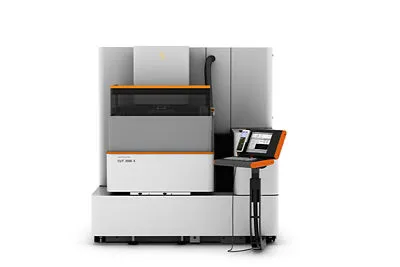
GF AgieCharmilles CUT 2000
GF Machining AgieCharmilles CUT P 550 Pro
GF Machining Solutions Cut E 350
GF AgieCharmilles CUT E 350
GF Machining Solutions AgieCharmilles CUT P 1250