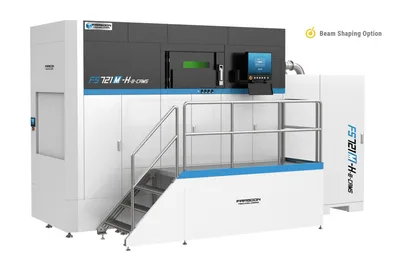
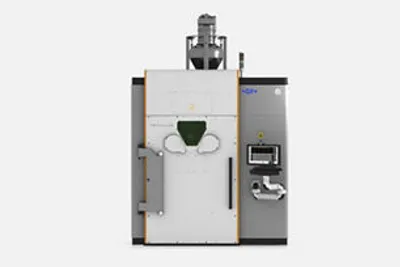
GF DMP Factory 500
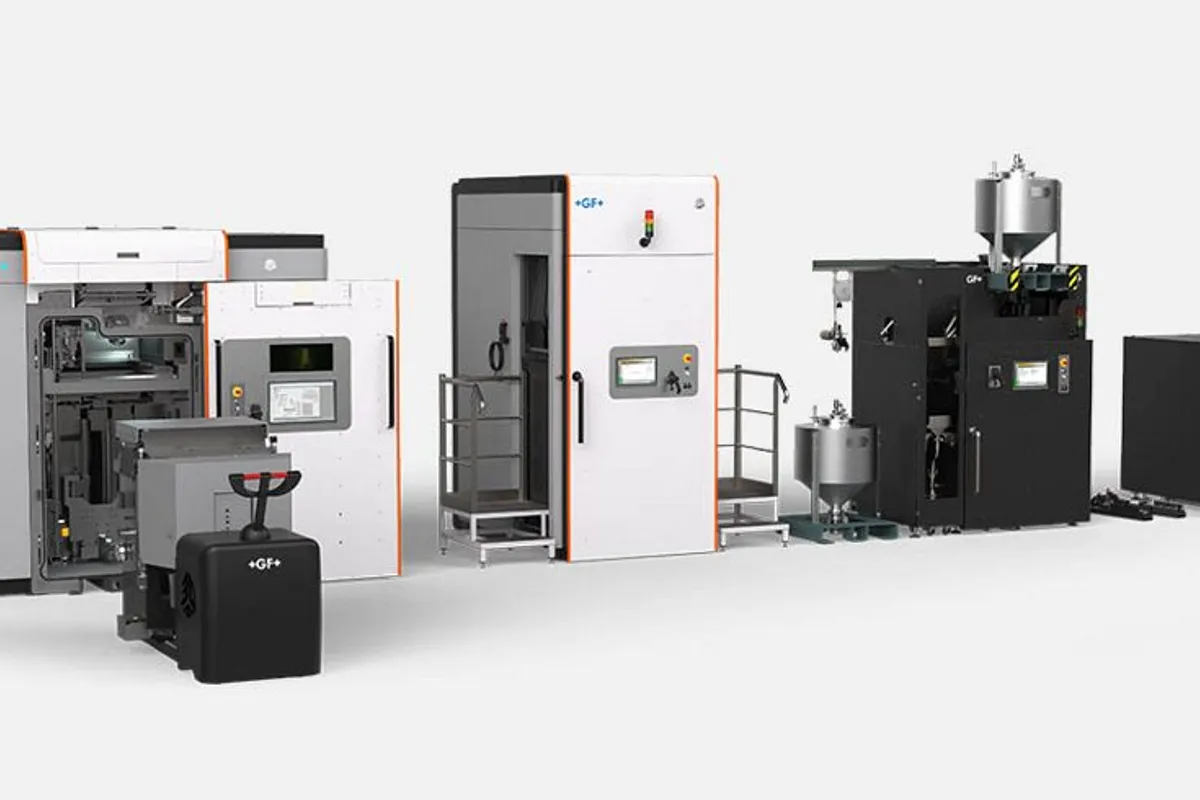
Image: assets.georgfischer.com, GF Machining Solutions
Key Specifications
Repeatability
build volume
laser type
laser power
layer thickness
minimum feature size
How much does the GF DMP Factory 500 cost?
Estimated price range
Our best estimate for a metal additive manufacturing in this class — not a quote from GF Machining Solutions. Configuration moves it a long way.
Overview
The DMP Factory 500 is a production metal printer built as a set of modules around a 500 x 500 x 500 mm build volume, height inclusive of the build plate. Three 500 W fiber lasers at 1070 nm work the plate, and the listed laser power row notes full-field access, meaning each laser can reach the whole build area rather than a fixed zone.
What sets this machine apart is the removable, swappable print module, listed for continuous production. The module measures 1120 x 850 x 1400 mm and moves between the printer, a depowdering module (3000 x 2530 x 3300 mm uncrated), a powder recycling module (1935 x 2262 x 2521 mm) and a parking module (1450 x 1780 x 1850 mm). While one build is depowdered, another module can be printing. The printer module alone is 3,010 x 2,350 x 3,160 mm and weighs 8232 kg excluding the RPM, so the full installation is a room-scale project, not a single cabinet.
Layer thickness is adjustable between 2 µm and 200 µm, with 60 µm as the typical setting. The listed materials are Inconel 718, Ti Gr23 and AlSi10Mg, with additional materials on request, and the software row names 3DXpert. A soft blade recoater spreads the powder.
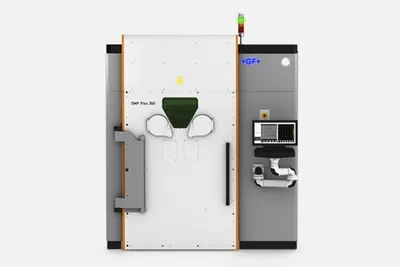
Accuracy is ± 0.1-0.2% with a ± 100 μm minimum, and repeatability is 75um (3σ) on each axis. The minimum feature size is 300 μm. These are the listed figures for this page and have not been matched against a current product page, so confirm them with GF before planning a part around them. Next to the DMP Flex 350, which has a 275 x 275 x 420 mm build volume, the Factory 500 offers a plate 500 mm wide instead of 275 mm, room for large single parts or nested batches.
Full Specifications
| Parameter | Value |
|---|---|
| Build Volume | 500 x 500 x 500 mm (19.7 x 19.7 x 19.7 in), height inclusive of build plate |
| Laser Type | 3 x 500 W / Fiber laser |
| Laser Power | 3x 500 W (full-field access) |
| Layer Thickness | Adjustable, min 2 um, max 200 um; typical 60 um |
| Minimum Feature Size | 300 μm |
| Accuracy | ± 0.1-0.2% with ± 100 μm minimum |
| Repeatability | Δx (3σ) = 75um, Δy (3σ) = 75um, Δz (3σ) = 75um |
| Recoater | Soft blade recoater |
| Print Module | Removable/swappable print module for continuous production |
| Materials | Inconel 718, Ti Gr23, AlSi10Mg (additional materials on request) |
| Software | 3DXpert |
| Printer Module Dimensions | 3,010 x 2,350 x 3,160 mm |
| Printer Module Weight | 8232 kg (excluding RPM) |
| Printer Module Uncrated | 3010 x 2350 x 3160 mm |
| Depowdering Module Uncrated | 3000 x 2530 x 3300 mm |
| Powder Recycling Module Uncrated | 1935 x 2262 x 2521 mm |
| Removable Print Module | 1120 x 850 x 1400 mm |
| Parking Module | 1450 x 1780 x 1850 mm |
| Laser Wavelength | 1070 nm |
| Layer Thickness Range Preset | Adjustable, min. 2 μm, max.200 μm, typ. 60 μm |
| Build Envelope | 500 x 500 x 500 mm (height inclusive of build plate) |
| Material Deposition | Soft blade recoater |
Specifications compiled from manufacturer literature and industry references. Not independently verified against a published spec sheet — confirm with the manufacturer or an authorised dealer before making a purchasing decision.
Strengths & Limitations
Strengths
- 500 x 500 x 500 mm build volume, height inclusive of the build plate
- Three 500 W fiber lasers with full-field access across the plate
- Removable, swappable 1120 x 850 x 1400 mm print module so depowdering does not stop the printer
- Separate depowdering, powder recycling and parking modules for a continuous production flow
- Layer thickness adjustable from 2 µm to 200 µm, typical 60 µm
Limitations
- The printer module alone weighs 8232 kg excluding the RPM and stands 3,160 mm high
- The depowdering module is 3,300 mm tall uncrated, so the hall needs that clearance as well
- Minimum feature size is 300 μm, coarser than the 200 μm of the smaller DMP Flex 350
- Only Inconel 718, Ti Gr23 and AlSi10Mg are listed; other alloys are on request
Best For
Frequently Asked Questions
01
500 x 500 x 500 mm, height inclusive of the build plate. That is both wider and taller than the 275 x 275 x 420 mm of the DMP Flex 350, the smaller printer in the range.
02
The print module (1120 x 850 x 1400 mm) is listed as removable and swappable for continuous production. It travels between the printer module, the depowdering module, the powder recycling module and a parking module, so a finished build can be unpacked while a fresh module prints.
03
Uncrated, the printer module is 3010 x 2350 x 3160 mm, the depowdering module 3000 x 2530 x 3300 mm, the powder recycling module 1935 x 2262 x 2521 mm and the parking module 1450 x 1780 x 1850 mm. Add aisles for moving the print module between them.
04
Inconel 718, Ti Gr23 and AlSi10Mg are listed, with additional materials on request. Ask for the parameter sets you need before ordering, since anything outside those three is not part of the listed table.
05
The table lists ± 0.1-0.2% with a ± 100 μm minimum and a repeatability of 75um (3σ) in X, Y and Z. The minimum feature size is 300 μm. Functional faces and bores will normally be finish-machined after the build.
Videos

Practical Machinist

Peak Machine Sales (Peak EDM)

MACHINE & ROBOT

Agence Vidéo Bluevista
Comparisons
More from GF Machining Solutions
Other Metal Additive Manufacturing