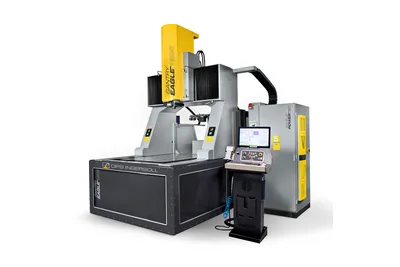
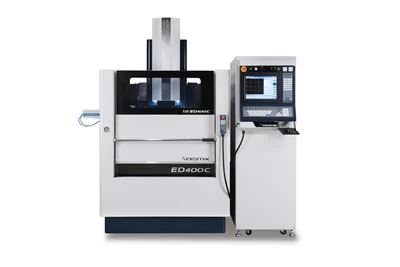
GF AgieCharmilles FORM S 350
Key Specifications
X Travel
Y Travel
Z Travel
machine dimensions wxdxh
machine weight without dielectric
table to chuck distance
How much does the GF AgieCharmilles FORM S 350 cost?
Estimated price range
Our best estimate for a sinker edm (ram edm) in this class — not a quote from GF Machining Solutions. Configuration moves it a long way.
Overview
The AgieCharmilles FORM S 350 is GF Machining Solutions' precision die-sinking EDM for small, detailed parts: 350 x 250 x 300 mm of X, Y and Z travel, a best surface finish of 0.05 μm Ra, and workpieces up to 760 x 460 x 275 mm and 500 kg. It is the only size of the FORM S series, and GF aims it at mold makers dealing with miniaturized and quality-critical components.
The finish figure is the centre of the machine. GF quotes a mirror finish down to VDI -6 / Ra 0.05 on copper-to-steel work, intended to remove manual polishing and the variation an operator brings to it. A dedicated micro-machining generator produces the very small, controlled sparks that sharp inside corners and burr-free edges on tiny features need. For carbide, an embedded generator module adds a finer VDI0 finish with copper electrodes. Advanced thermo-stabilization holds machine conditions steady against the room, which matters when a cavity takes many hours of finishing passes.
The connector application, driven by TECFORM, targets electrical connector moulds with copper or graphite electrodes on steel parts, balancing erosion rate against electrode wear. A Renishaw measuring probe is optional, for setting up coated workpieces where electrical probing does not work.
Physically the FORM S 350 shares its frame with the AgieCharmilles FORM P 350: 1900 x 1690 x 2600 mm, 2400 kg without dielectric, a 150 - 450 mm table to chuck distance and a 0 - 325 mm bath level. Where the AgieCharmilles FORM P 350 lists 0.08 μm and a 700 x 460 x 275 mm workpiece, the FORM S 350 lists 0.05 μm and 760 x 460 x 275 mm. Electrodes on both are limited to 50 kg.
Full Specifications
| Parameter | Value |
|---|---|
| Machine Dimensions Wxdxh | 1900 x 1690 x 2600 mm |
| Machine Weight Without Dielectric | 2400 kg |
| X-Axis Travel | 350 mm |
| Y-Axis Travel | 250 mm |
| Z-Axis Travel | 300 mm |
| Table to Chuck Distance | 150 - 450 mm |
| Best Surface Finish Ra | 0.05 μm |
| Max Workpiece Dimensions | 760 x 460 x 275 mm |
| Max Workpiece Weight | 500 kg |
| Max Electrode Weight | 50 kg |
| Bath Level | 0 - 325 mm |
Specifications sourced from agiecharmilles.com — verified 2026-10-02
Strengths & Limitations
Strengths
- Best surface finish of 0.05 μm Ra, quoted by GF as VDI -6 on copper to steel
- Dedicated micro-machining generator for sharp micro corners and burr-free edges
- Embedded generator module for a finer VDI0 finish on carbide with copper electrodes
- Advanced thermo-stabilization to keep geometry repeatable regardless of the room
- Takes workpieces up to 760 x 460 x 275 mm and 500 kg in a 1900 x 1690 x 2600 mm footprint
Limitations
- Travels of 350 x 250 x 300 mm suit small parts only; there is no larger FORM S size
- Electrodes are limited to 50 kg
- The Renishaw measuring probe for coated workpieces is an option
- No tool changer appears in the FORM S 350 table or feature list, so unattended capacity must be specified separately
Best For
Frequently Asked Questions
01
The table lists a best finish of 0.05 μm Ra. GF describes it as a mirror finish down to VDI -6 / Ra 0.05 for copper to steel, and adds a finer VDI0 finish on carbide with copper electrodes through an embedded generator module.
02
Both use a 1900 x 1690 x 2600 mm, 2400 kg frame with 350 x 250 x 300 mm travels and a 500 kg workpiece limit. The AgieCharmilles FORM P 350 is built for throughput and lists 0.08 μm; the FORM S 350 adds a micro-machining generator and thermo-stabilization and lists 0.05 μm.
03
Up to 760 x 460 x 275 mm and 500 kg, with electrodes up to 50 kg. The table to chuck distance is 150 - 450 mm and the bath level 0 - 325 mm, so tall parts with long electrodes need checking against both ranges.
04
Yes, with the optional Renishaw measuring probe. GF offers it for coated parts where conventional electrical probing cannot make contact, giving more reliable setup on those jobs. It is not standard equipment.
Videos

UNITED MACHINING

United Machining (USA)
More from GF Machining Solutions
GF AgieCharmilles FORM P
GF Machining AgieCharmilles FORM X 400
GF AgieCharmilles Form P 600
GF Machining Solutions AgieCharmilles FORM P 900
GF Machining Solutions Form 200 Sinker EDM