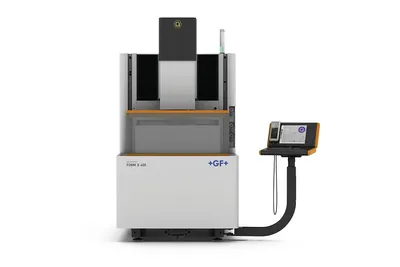
GF AgieCharmilles FORM P 350
Key Specifications
X Travel
Y Travel
Z Travel
machine dimensions wxdxh
machine weight without dielectric
table to chuck distance
How much does the GF AgieCharmilles FORM P 350 cost?
Estimated price range
Our best estimate for a sinker edm (ram edm) in this class — not a quote from GF Machining Solutions. Configuration moves it a long way.
Overview
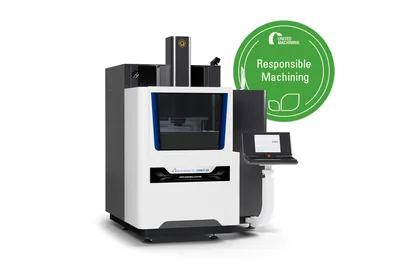
The AgieCharmilles FORM P 350 is the smallest size of GF Machining Solutions' FORM P production die-sinking series, with 350 x 250 x 300 mm of X, Y and Z travel, a 410 l dielectric capacity and room for workpieces up to 700 x 460 x 275 mm and 500 kg. Its best surface finish is 0.08 μm Ra, and the machine weighs 2400 kg without dielectric in a 1900 x 1690 x 2600 mm footprint.
GF positions the FORM P for throughput and cost per part, and the series features follow from that. iGAP controls the lateral spark gap to push more power into roughing while limiting electrode wear and parting-line edge effects, and iQ Technology is aimed at electrode wear as well. The TECFORM expert system sets erosion parameters for mixed electrode work, graphite for roughing and copper for finishing, backed by an application database of cavity geometries and materials. Econowatt cuts power draw while the machine is idle.
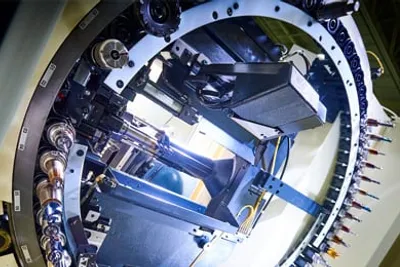
Several of the listed features are options, not standard equipment. The rotary tool changer is optional, from 16 to 160 positions depending on configuration. The Accura C-Axis, with an inertia capacity of up to 5,000 kg·cm², is optional, as is multi-axis machining with up to two additional axes and Multi Flushing with six extra programmable outlets. A buyer comparing quotes should check which of these each offer includes.
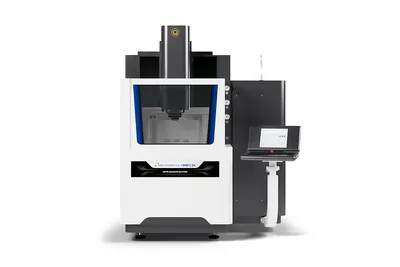
The AgieCharmilles FORM S 350 shares this frame, the 350 x 250 x 300 mm travels and the 500 kg workpiece limit, but lists a best finish of 0.05 μm against 0.08 μm here; it is the one to choose when the finest finish matters most. For larger parts the AgieCharmilles FORM P 600 steps up to 600 x 400 x 450 mm of travel.
Full Specifications
| Parameter | Value |
|---|---|
| Machine Dimensions Wxdxh | 1900 x 1690 x 2600 mm |
| Machine Weight Without Dielectric | 2400 kg |
| X-Axis Travel | 350 mm |
| Y-Axis Travel | 250 mm |
| Z-Axis Travel | 300 mm |
| Table to Chuck Distance | 150 - 450 mm |
| Best Surface Finish Ra | 0.08 μm |
| Capacity | 410 l |
| Max Workpiece Dimensions | 700 x 460 x 275 mm |
| Max Workpiece Weight | 500 kg |
| Max Electrode Weight | 50 kg |
| Bath Level | 0 - 325 mm |
Specifications sourced from agiecharmilles.com — verified 2026-10-02
Strengths & Limitations
Strengths
- Compact 1900 x 1690 x 2600 mm footprint and 2400 kg weight without dielectric
- Takes workpieces up to 700 x 460 x 275 mm and 500 kg, with electrodes up to 50 kg
- iGAP spark-gap control and iQ Technology both target lower electrode wear
- TECFORM sets parameters for graphite roughing and copper finishing from an application database
- Rotary tool changer available as an option from 16 to 160 positions for unattended work
Limitations
- Best finish of 0.08 μm Ra is coarser than the 0.05 μm of the AgieCharmilles FORM S 350 on the same frame
- The rotary tool changer, Accura C-Axis, extra axes and Multi Flushing are all extra-cost options
- 300 mm of Z with a 150 - 450 mm table to chuck distance limits tall parts with long electrodes
- Bath level of 0 - 325 mm caps how deep a workpiece can be submerged
Best For
Frequently Asked Questions
01
Both have 350 x 250 x 300 mm travels, a 150 - 450 mm table to chuck distance, 500 kg workpiece and 50 kg electrode limits, and the same 1900 x 1690 x 2600 mm, 2400 kg frame. The AgieCharmilles FORM S 350 lists a best finish of 0.05 μm and 760 x 460 x 275 mm workpieces; the FORM P 350 lists 0.08 μm and 700 x 460 x 275 mm.
02
GF describes the rotary tool changer as an optional feature, available from 16 to 160 positions, with double gripper and automatic scanning as further additions. Check the quotation for the changer size, since the base machine does not include it.
03
The Accura C-Axis is listed as an optional feature, with an inertia capacity of up to 5,000 kg·cm². A separate multi-axis option supports up to two additional axes in indexing or interpolation for complex geometries.
04
Up to 700 x 460 x 275 mm and 500 kg. Travels are 350 x 250 x 300 mm, the table to chuck distance is 150 - 450 mm and the bath level runs 0 - 325 mm. Electrodes can weigh up to 50 kg.
05
GF states that its AgieCharmilles die-sinking machines are designed for integration with SYSTEM 3R automation for unattended operation. On the machine itself, the optional rotary tool changer extends unattended machining time, and the embedded macro system streamlines repetitive operations.
Videos

Steinbacher Werkzeugmaschinen GmbH
More from GF Machining Solutions
FORM E
GF Machining AgieCharmilles FORM S 350
GF Machining Solutions AgieCharmilles FORM P 600
GF Machining AgieCharmilles FORM P 350
GF AgieCharmilles FORM S