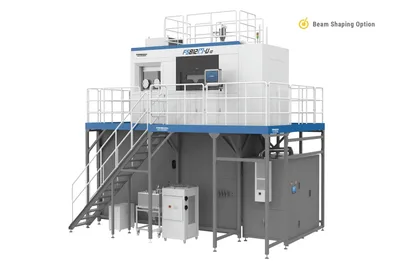
GE Additive M2 Series
Key Specifications
build envelope
build height range
layer thickness
laser safety
laser system options
scanning speed
How much does the GE Additive M2 Series cost?
Estimated price range
Our best estimate for a metal additive manufacturing in this class — not a quote from Colibrium Additive. Configuration moves it a long way.
Overview
The Colibrium M2 is a dual-laser metal additive machine with a 245 x 245 mm build area and up to 405 mm of Z, offered with either of two fibre laser systems: 2x1kW (cw) or 2 x 400 W (cw). Choosing between them is the main configuration decision, and the material list hints at why: one entry, Titanium Ti6Al4V ELI Grade 23 (1kW), is marked for the 1kW system specifically.
Build height deserves a second look. The envelope is given as 245 x 245 x max 405 mm (x, y, z), and the build height range is 405-313 mm depending on build plate configuration and platform thickness. A part drawn close to 405 mm tall may not fit once a thicker platform is in place. The reference clamping system is optional (EROWA, others on request), and a heating system is listed as available.
Optically the table gives a focus diameter of 61-72um and a spot size range of 70-500um, with layers of 25 - 120 μm and a scanning speed of max 4.5 m/s. Laser safety carries T2 certification, and the integrated filtering system has a 20 m2 filter surface. The material list is long. It runs through stainless, maraging and tool steels, three aluminium alloys, Nickel 718, Nickel 625 and Nickel X, four titanium entries, Cobalt CoCrMo and CoCrW, and less common choices such as Tantalum and Copper Nickel CuNi2SiCr.
Services go beyond electricity. The power supply is 3/N/PE AC 400V on a 32A connector with approx. power consumption of 28A, compressed air is needed at 6-10bar, and there are 2 gas connections with an external N2 generator as an option. The machine measures 2,739 x 2,050 x 2,781 mm (W x D x H) and weighs approx. 2,500 kg, between the Concept Laser Mlab Cusing R at approx. 600 kg and the X Line 2000R at approx. 9,500 kg (tare weight). Operating conditions are 18 - 25°C, which in practice means a temperature-controlled room.
Full Specifications
| Parameter | Value |
|---|---|
| Build Envelope | 245 x 245 x max 405 mm (x, y, z) |
| Build Height Range | 405-313 mm, dependent on build plate configuration and platform thickness |
| Layer Thickness | 25 - 120 μm |
| Laser Safety | T2 certification |
| Laser System Options | Fibre Laser 2x1kW (cw), Fibre Laser 2 x 400 W (cw) |
| Scanning Speed | Max 4.5 m/s |
| Focus Diameter | 61-72um |
| Spot Size Range | 70-500um |
| Heating System | Available |
| Reference Clamping System Optional | EROWA, others on request |
| Connected Loads | Approx. power consumption 28A; Power supply 3/N/PE AC 400V, 32A connector, compressed air 6-10bar |
| Inert Gas Supply | 2 gas connections provided; N2 generator external (optional) |
| Inert Gas Consumption | 5l / min < 1 m³/h |
| Filtering System | Integrated, with a 20 m2 filter surface |
| Machine Dimensions | 2,739 x 2,050 x 2,781 mm (W x D x H) |
| Machine Weight | Approx. 2,500 kg |
| Operating Conditions | 18 - 25°C |
| Materials | Stainless Steel 316L, Stainless Steel 17-4PH, Maraging Steel M300, Tool Steel H13, Aluminium AlSi10Mg, Aluminium A205, Aluminium AlSi7Mg, Nickel 718, Nickel 625, Nickel X, Titanium Ti6Al4V ELI Grade 23, Titanium Ti6Al4V ELI Grade 23 (1kW), Titanium cp-Ti, Titanium Ti6242, Cobalt CoCrMo, Cobalt CoCrW, rematitan CL, Tantalum, Copper Nickel CuNi2SiCr, Corax |
Specifications sourced from colibriumadditive.com — verified 2026-10-03
Strengths & Limitations
Strengths
- Two laser system options: Fibre Laser 2x1kW (cw) or Fibre Laser 2 x 400 W (cw)
- Up to 405 mm of build height over a 245 x 245 mm area
- Spot size range of 70-500um with a focus diameter of 61-72um
- Long material list, from Stainless Steel 316L and Tool Steel H13 to Tantalum, Titanium Ti6242 and Copper Nickel CuNi2SiCr
- Integrated filtering system with a 20 m2 filter surface, and T2 certification for laser safety
Limitations
- Build height can be as low as 313 mm, depending on build plate configuration and platform thickness
- The reference clamping system (EROWA, others on request) is optional
- Needs compressed air at 6-10bar as well as the 3/N/PE AC 400V supply
- Operating conditions of 18 - 25°C call for a temperature-controlled room
- The N2 generator is external and optional, so the nitrogen source has to be arranged separately
Best For
Frequently Asked Questions
01
245 x 245 x max 405 mm (x, y, z). The build height range is 405-313 mm, dependent on build plate configuration and platform thickness, so confirm the usable height for the plate setup you intend to run before designing a part near the maximum.
02
Two laser systems are listed: Fibre Laser 2x1kW (cw) and Fibre Laser 2 x 400 W (cw). Both are dual-laser. Focus diameter is 61-72um, the spot size range is 70-500um and scanning speed is max 4.5 m/s.
03
Stainless Steel 316L and 17-4PH, Maraging Steel M300, Tool Steel H13, Aluminium AlSi10Mg, A205 and AlSi7Mg, Nickel 718, Nickel 625 and Nickel X, Titanium Ti6Al4V ELI Grade 23, cp-Ti and Ti6242, Cobalt CoCrMo and CoCrW, rematitan CL, Tantalum, Copper Nickel CuNi2SiCr and Corax. Titanium Ti6Al4V ELI Grade 23 also appears as a separate (1kW) entry.
04
A 3/N/PE AC 400V power supply on a 32A connector, with approx. power consumption of 28A, and compressed air at 6-10bar. There are 2 gas connections, an external N2 generator is optional, and inert gas consumption is listed as 5l / min. Operating conditions are 18 - 25°C.
05
The machine measures 2,739 x 2,050 x 2,781 mm (W x D x H) and weighs approx. 2,500 kg. Allow for the 2,781 mm height when checking doors and ceiling, and add space for the external N2 generator if that option is chosen.
More from Colibrium Additive
Concept Laser M1 Cusing
Concept Laser M2 Series 5 Metal 3D Printer
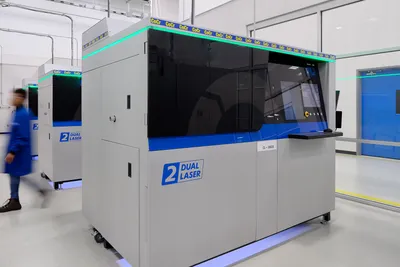
Colibrium M2
GE Additive Arcam Spectra H
Concept Laser X LINE 2000R
GE Additive Arcam EBM Spectra H
Other Metal Additive Manufacturing
Markforged Metal X
Desktop Metal Production System P-50
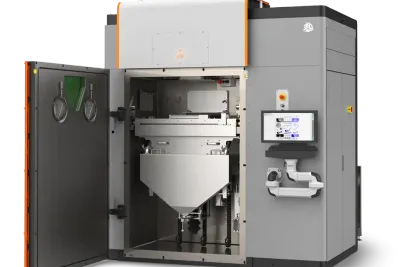
3D Systems DMP Flex 350
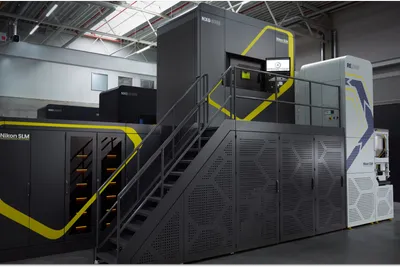
SLM Solutions NXG XII 600E
GF DMP Flex 350