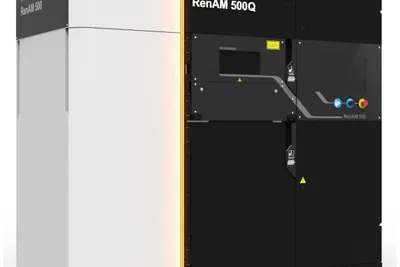
GE Additive Arcam EBM Spectra H
Key Specifications
max build size
max beam power
cathode type
minimum chamber pressure
typical build atmosphere
power supply
How much does the GE Additive Arcam EBM Spectra H cost?
Estimated price range
Our best estimate for a metal additive manufacturing in this class — not a quote from Colibrium Additive. Configuration moves it a long way.
Overview
The GE Additive Arcam Spectra H is a high-temperature electron beam machine: a maximum beam power of 6kW, a typical process temperature range of 600-1,100°C and a maximum build size listed as 250 x 430 mm (D,H). Those figures go with its material list, which opens with TiAl, Nickel Alloy 718 and Highly Alloyed Tool Steel, alloys for which a hot build is the reason to choose this process in the first place.
Height is the generous dimension. With 430 mm of H against 250 mm of D, the envelope favours tall parts, or stacks of smaller ones arranged through the height, over anything wide. Colibrium Additive gives the build size as two dimensions only, so ask for a build envelope drawing before laying out a part that comes close to the 250 mm limit.
The beam comes from a single crystalline cathode and works in vacuum, with a minimum chamber pressure of 5 x 10^-4 mbar and a typical build atmosphere of 4 x 10^-3 mbar partial pressure of He. Helium is therefore a consumable to plan for: 5 liter/h in the build process and 150-200l/build for ventilation. Beyond the three alloys already named, the list carries Ti6Al4V Grade 5 as P-Mtrl and Cobalt Chrome CoCr.
For installation, the power supply is 3 x 400 V, 32A, 13kVA. The machine measures 1,328 x 2,344 x 2,858 mm (D,W,H) and weighs 2,915kg, well above the 1,681 kg of the GE Additive Arcam EBM Q10plus, so both ceiling clearance and floor loading deserve a check. Build files are taken as STL. The table gives no layer thickness, build rate or part resolution for this model.
Full Specifications
| Parameter | Value |
|---|---|
| Max Build Size | 250 x 430 mm (D,H) |
| Max Beam Power | 6kW |
| Cathode Type | Single crystalline |
| Minimum Chamber Pressure | 5 x 10^-4 mbar |
| Typical Build Atmosphere | 4 x 10^-3 mbar (partial pressure of He) |
| Power Supply | 3 x 400 V, 32A, 13kVA |
| He Consumption Build Process | 5 liter/h |
| He Consumption Ventilation | 150-200l/build |
| Typical Process Temperature Range | 600-1,100°C |
| Machine Dimensions | 1,328 x 2,344 x 2,858 mm (D,W,H) |
| Machine Weight | 2,915kg |
| CAD Interface | Standard STL |
| Materials | TiAl D-Mtrl, Nickel Alloy 718 D-Mtrl, Highly Alloyed Tool Steel D-Mtrl, Ti6Al4V Grade 5 P-Mtrl, Cobalt Chrome CoCr |
Specifications sourced from colibriumadditive.com — verified 2026-10-03
Strengths & Limitations
Strengths
- 6kW maximum beam power from a single crystalline cathode
- Typical process temperature range of 600-1,100°C, alongside a material list that includes TiAl and Nickel Alloy 718
- 430 mm of height within a maximum build size of 250 x 430 mm (D,H)
- Listed materials: TiAl, Nickel Alloy 718, Highly Alloyed Tool Steel, Ti6Al4V Grade 5 and Cobalt Chrome CoCr
- Power supply of 3 x 400 V, 32A, 13kVA for a 6kW beam
Limitations
- D is limited to 250 mm, so a wide part does not fit however much of the 430 mm height is free
- Helium consumption is 5 liter/h in the build process plus 150-200l/build for ventilation
- At 2,858 mm high and 2,915kg, the machine calls for a ceiling and floor-loading check
- No layer thickness, build rate or part resolution is stated in the table
Best For
Frequently Asked Questions
01
Colibrium Additive lists a maximum build size of 250 x 430 mm (D,H): 250 mm for D and 430 mm for H. Only those two dimensions are given, so request an envelope drawing if a part approaches either limit.
02
The listed materials are TiAl, Nickel Alloy 718 and Highly Alloyed Tool Steel, each marked D-Mtrl, Ti6Al4V Grade 5 marked P-Mtrl, and Cobalt Chrome CoCr. The table does not explain the two labels, so ask the supplier what each means for parameter support.
03
The typical process temperature range is 600-1,100°C. The maximum beam power is 6kW from a single crystalline cathode, and the process runs in vacuum with a typical build atmosphere of 4 x 10^-3 mbar partial pressure of He.
04
Helium consumption is 5 liter/h in the build process and 150-200l/build for ventilation. Minimum chamber pressure is 5 x 10^-4 mbar. Plan the helium supply around the length of the builds the machine will run.
05
A power supply of 3 x 400 V, 32A, 13kVA. The machine measures 1,328 x 2,344 x 2,858 mm (D,W,H) and weighs 2,915kg, so check door openings, ceiling clearance and floor loading. The standard CAD interface is STL.
More from Colibrium Additive
Concept Laser Xline 2000R
Colibrium M Line
Colibrium Additive Concept M2 Series 5
GE Additive Arcam A2XX
GE Additive Arcam EBM Q10plus
Concept Laser Mlab Cusing R
Other Metal Additive Manufacturing
EOS M 100 Compact Metal 3D Printer
EOS M 100
Thermwood LSAM-MT (Additive Manufacturing Trim Cell)
SLM Solutions SLM 500