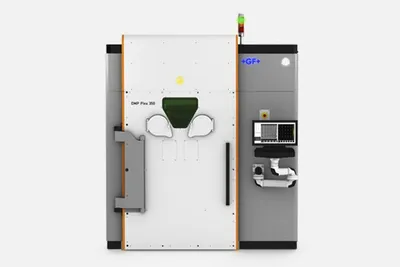
GE Additive Arcam EBM Q10plus
Key Specifications
max build size
max beam power
cathode type
minimal part resolution x y
performance door to door
active cooling
How much does the GE Additive Arcam EBM Q10plus cost?
Estimated price range
Our best estimate for a metal additive manufacturing in this class — not a quote from Colibrium Additive. Configuration moves it a long way.
Overview
The GE Additive Arcam EBM Q10plus is an electron beam melting machine with a maximum build size of 200 x 200 x 200 mm (W x D x H) and a maximum beam power of 3kW from a single crystalline cathode. It melts under vacuum instead of a shielding gas: minimum chamber pressure is 5 x 10^-4 mbar, and the typical build atmosphere is 4 x 10^-3 mbar as a partial pressure of He.
Colibrium Additive states throughput door to door and gives two figures, 53.5 cm3/h for a high density build and 16.6 cm3/h for a low density build. The gap between them is roughly three to one, so the rate a shop sees depends heavily on the build itself. Estimate cycle times from a job that resembles your own, not from the higher number. Minimal part resolution in X and Y is 0.75mm with the 70um layer parameter set, which puts a floor under wall and strut thickness.
The material list is short and led by titanium. Ti6Al4V Grade 5 and Ti6Al4V Grade 23 are listed as P-Material. CoCr and Ti Grade 2 are listed as D-Material for Machine v1.0, and Pure Copper as D-Material for Machine v1.0 and v2.0. Since the entries differ by machine version, establish which version a given machine is before assuming a material is available on it.
Utilities are light for the process. The electrical connection is 3 x 400 V, 32 A, 7kW, and active cooling is by a water-cooled heat sink. Helium consumption is 1 liter / hour in the build process plus 50-75 liters / build for ventilation. The machine measures 2112 x 1134 x 2758 mm (W x D x H), so ceiling clearance is the dimension to check first, and it weighs 1,681 kg against 2,915kg for the GE Additive Arcam Spectra H. Build data arrives as STL, the standard CAD interface.
Full Specifications
| Parameter | Value |
|---|---|
| Max Build Size | 200 x 200 x 200 mm (W x D x H) |
| Max Beam Power | 3kW |
| Cathode Type | Single crystalline |
| Minimal Part Resolution X Y | 0.75mm (70um layer parameter set/theme) |
| Performance Door to Door | 53.5 cm3/h (High density build), 16.6 cm3/h (Low density build) |
| Active Cooling | Water-cooled heat sink |
| Minimum Chamber Pressure | 5 x 10^-4 mbar |
| Typical Build Atmosphere | 4 x 10^-3 mbar (Partial pressure of He) |
| He Consumption Build Process | 1 liter / hour |
| He Consumption Ventilation | 50-75 liters / build |
| Power Supply | 3 x 400 V, 32 A, 7kW |
| Machine Dimensions | 2112 x 1134 x 2758 mm (W x D x H) |
| Machine Weight | 1,681 kg |
| CAD Interface | Standard: STL |
| Materials | Ti6Al4V Grade 5, P-Material; Ti6Al4V Grade 23, P-Material; CoCr, D-Material (Machine v1.0); Ti Grade 2, D-Material (Machine v1.0); Pure Copper, D-Material (Machine v1.0 and v2.0) |
Specifications sourced from colibriumadditive.com — verified 2026-10-03
Strengths & Limitations
Strengths
- Maximum beam power of 3kW from a single crystalline cathode over a 200 x 200 x 200 mm (W x D x H) build
- Door-to-door performance of 53.5 cm3/h on a high density build
- Vacuum process with a minimum chamber pressure of 5 x 10^-4 mbar
- Helium consumption of 1 liter / hour in the build process and 50-75 liters / build for ventilation
- Electrical connection of 3 x 400 V, 32 A, 7kW and a machine weight of 1,681 kg
Limitations
- Maximum build size is 200 x 200 x 200 mm (W x D x H), so larger parts need a different machine
- Minimal part resolution in X and Y is 0.75mm with the 70um layer parameter set, which excludes finer walls and struts
- Door-to-door performance drops to 16.6 cm3/h on a low density build
- CoCr and Ti Grade 2 are listed for Machine v1.0 only, so material choice depends on the machine version
Best For
Frequently Asked Questions
01
The maximum build size is 200 x 200 x 200 mm (W x D x H). Minimal part resolution in X and Y is 0.75mm, quoted for the 70um layer parameter set, so features thinner than that are outside what Colibrium Additive states for the machine.
02
Colibrium Additive quotes door-to-door performance: 53.5 cm3/h for a high density build and 16.6 cm3/h for a low density build. The two differ by roughly three to one, so the realistic rate for a job depends on the build it runs in.
03
Ti6Al4V Grade 5 and Ti6Al4V Grade 23 are listed as P-Material. CoCr and Ti Grade 2 are listed as D-Material for Machine v1.0, and Pure Copper as D-Material for Machine v1.0 and v2.0. Confirm the machine version before planning CoCr or Ti Grade 2 work.
04
Helium consumption is 1 liter / hour during the build process and 50-75 liters / build for ventilation. The typical build atmosphere is 4 x 10^-3 mbar partial pressure of He, with a minimum chamber pressure of 5 x 10^-4 mbar.
05
Power supply is 3 x 400 V, 32 A, 7kW, and active cooling uses a water-cooled heat sink. The machine is 2112 x 1134 x 2758 mm (W x D x H) and weighs 1,681 kg. Check ceiling clearance against the 2758 mm height before committing to a location.
More from Colibrium Additive
Concept Laser Mlab Cusing R
Colibrium X Line 2000R
GE Additive M2 Series
Concept Laser M1 Cusing
Concept Laser M2 Series 5 Metal 3D Printer
Colibrium M2
Other Metal Additive Manufacturing
GF DMP Factory 350
Farsoon FS621M Pro
Markforged Metal X Gen 2 Metal 3D Printer
EOS M 400-4