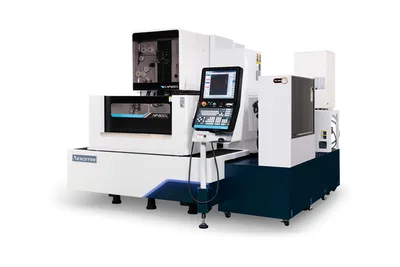
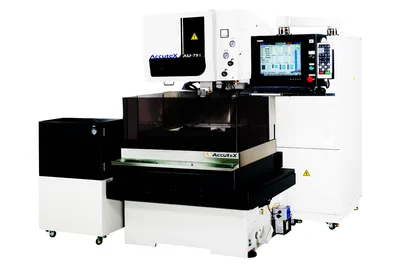
Fanuc ROBOCUT α-C600iB Pro
Key Specifications
X Travel
Y Travel
Z Travel
travel u
travel v
max workpiece size
Overview
The Fanuc ROBOCUT α-C600iB Pro is an enhanced-specification variant of the standard α-C600iB, configured for applications that demand extended taper angle capability, improved surface finish, and higher unattended operation reliability. While the standard C600iB targets mid-range production wire EDM work with ±30° taper, the C600iB Pro extends taper cutting capacity to ±45° over 100 mm height — a specification that opens the machine to specialized die and mold components whose draft angles and clearance profiles exceed what a standard-configuration machine can achieve.
The Pro configuration is built on the same 600 x 400 mm X/Y travel, 310 mm Z-axis, and Series 31i-WB control platform as the standard C600iB, but integrates several generator and mechanical enhancements. The generator operates in a high-precision discharge mode that extends surface finish capability to Ra 0.10 µm — matching the surface quality of premium-tier machines in the mid-size category. This finish level satisfies fine blanking die applications, precision forming tools, and medical device cavity work that the standard C600iB's Ra 0.15 µm limit cannot always meet.
The AWF3 automatic wire feeding system, an upgrade over the standard C600iB's AWF2, provides more reliable wire threading in submerged conditions and through start holes as small as 1.5 mm. For precision programs where start holes are drilled at minimum size to reduce material removal and maintain blank integrity, AWF3's small-hole threading capability is a meaningful operational advantage. AI Pulse Control II — the second generation of Fanuc's adaptive discharge management, standard on Pro variants — further reduces wire break frequency compared to the original AI Pulse Control, extending the effective unmanned production window.
Pricing for the α-C600iB Pro falls in the $220,000–$290,000 range, representing a step above the standard C600iB and competitive with the GF AgieCharmilles CUT C 600 and Sodick ALC600G at the high-precision mid-size tier. For shops whose standard C600iB would require frequent process compromises on extreme taper angles or final surface finish requirements, the Pro configuration eliminates those compromises at a cost premium that the additional application coverage often justifies.
Full Specifications
| Parameter | Value |
|---|---|
| X-Axis Travel | 600 mm (23.6 in) |
| Y-Axis Travel | 400 mm (15.7 in) |
| Z-Axis Travel | 310 mm (12.2 in) |
| Travel U | ±100 mm (±3.94 in) |
| Travel V | ±100 mm (±3.94 in) |
| Max Workpiece Size | 1,050 x 820 x 310 mm (41.3 x 32.3 x 12.2 in) |
| Max Workpiece Weight | 1,000 kg (2,205 lb) |
| Wire Diameter Range | 0.10 - 0.30 mm |
| Surface Finish | Ra 0.10 µm (achievable with multi-pass skim cutting) |
| Cutting Accuracy | ±0.001 mm |
| Max Taper Angle | ±45° at 100 mm height |
| Auto Wire Threading | AWF3 (3rd gen — submerged, 1.5 mm minimum start hole) |
| CNC Control | Fanuc Series 31i-WB |
| Ai Pulse | AI Pulse Control II (2nd gen real-time adaptive discharge) |
| Dielectric | Deionized water |
| Machine Weight | approx. 5,000 kg (11,023 lb) |
Specifications sourced from emastercam.com — verified 2026-03-28
Strengths & Limitations
Strengths
- ±45° taper capability over 100 mm height opens die and mold applications with extreme draft angles, clearance profiles, and extrusion die openings that standard ±30° machines cannot complete in a single setup
- Ra 0.10 µm surface finish meets fine blanking die, medical device cavity, and precision forming tool requirements that the standard C600iB's Ra 0.15 µm capability falls short of
- AWF3 automatic wire threading handles submerged conditions and 1.5 mm minimum start holes reliably — enabling programs on parts where start hole placement is constrained by part geometry
- AI Pulse Control II reduces wire break frequency compared to first-generation AI Pulse Control, extending unmanned production windows on long-running precision programs
- ±0.001 mm cutting accuracy matches the precision specification of premium-tier machines — a step up from the standard C600iB's ±0.002 mm
Limitations
- Premium pricing at $220,000–$290,000 requires a clear justification from either the taper angle requirement (above ±30°) or the surface finish requirement (Ra 0.10 µm) — shops not needing either advantage should buy the standard C600iB
- 1,000 kg workpiece capacity matches the standard C600iB — for shops needing higher weight capacity, no Pro-specific advantage exists; the C800iB or larger models are needed
- ±45° taper cutting at high angles requires careful programming and slower cutting speeds — the theoretical taper range is not always achievable at production cutting speeds on all workpiece geometries
Best For
Frequently Asked Questions
01
A ±30° taper range — standard on most mid-size wire EDMs — accommodates the relief angles, punch clearances, and draft angles in typical stamping and forming die work. A ±45° taper range opens an additional 15° of taper cutting, which matters for three specific application categories: extrusion dies where the die opening taper exceeds 30°, fine blanking dies where extreme clearance profiles are EDM-cut rather than ground, and aerospace forming dies with compound draft angles. For shops whose standard work stays within ±30°, the additional taper range of the Pro provides no production benefit. For shops with even occasional requirements above ±30°, the Pro eliminates the need to outsource those cuts or rework them with secondary operations.
02
AI Pulse Control II adds a second layer of adaptive response to the original AI Pulse Control. Where the first generation responded to gap condition changes over a time window of milliseconds, AI Pulse Control II additionally learns and adapts to the specific characteristics of an ongoing cut — material condition variations, contamination patterns, and workpiece geometry effects — and proactively adjusts discharge parameters based on predicted rather than merely detected gap instability. The practical result is a reduction in wire break frequency, particularly on long, complex programs where gap conditions vary significantly across the cut path. For lights-out production on overnight programs, the reduced break rate translates directly to higher utilization and fewer morning interventions.
03
Yes. Titanium is a standard ROBOCUT application material. The AI Pulse Control II generator includes parameter tables for titanium alloys including Ti-6Al-4V, the most common aerospace titanium grade. Titanium cutting requires deionized water as the dielectric (which the ROBOCUT uses as standard), low discharge energy to control the white layer, and proper wire selection — typically 0.20 mm or 0.25 mm plain brass wire. Surface finish to Ra 0.10 µm is achievable on titanium with the Pro's generator configuration. The white layer thickness on titanium EDM parts is a quality consideration for aerospace applications; the IPG's low-energy settings minimize recast layer depth.
04
The AWF3 system can reliably thread wire through start holes as small as 1.5 mm in diameter, compared to the AWF2's 3 mm practical minimum. For precision parts where start holes are placed at minimum size to preserve material integrity — medical implant blanks, fine pitch punch profiles, and small insert profiles — AWF3 eliminates the need to drill oversized start holes that compromise the remaining material. Submerged threading reliability is also significantly improved in AWF3, allowing programs that run in submerged dielectric mode throughout, including the wire threading sequence, for consistent flushing and temperature stability.
05
The Pro configuration does not include iWire technology (which is specific to GF AgieCharmilles' CUT X series), so it uses fixed-rate wire feed like the standard C600iB. Wire consumption on both machines depends on the cutting program — cutting speed, wire diameter, and workpiece material. The Pro's AI Pulse Control II reduces wire break frequency, which indirectly reduces wire waste associated with re-threading and discard after breaks. For wire cost management on high-production programs, the Pro provides modest wire savings through break reduction rather than the more substantial savings achievable with GF's iWire adaptive feed rate technology.
Videos
Methods Machine Tools, Inc
PENTA TRADING
TITANS of CNC MACHINING
Infinity Assets
Community Discussions
Troubleshooting and problem-solving — Fanuc robocut Wire Edm Machine low-V and Reverse Alarm
Community discussion — New Fanuc robocut post example?? - Practical Machinist
Community discussion — Fanuc EDM questions - Practical Machinist
Community discussion — Fanuc Robocut - Practical Machinist
Community discussion — Search Results - CNCzone.com- Largest Forums for CNC ...
Troubleshooting and problem-solving — Need Help! Fanuc Robocut Alpha 0C Power Up Issue - CNCzone
Maintenance and service — Need Help! FANUC ROBOCUT ALPHA. Setting positions after ...
Troubleshooting and problem-solving — Cutting taper with Fanuc Robocut - CNCzone
Links to community discussions. Summaries are editorial — visit the original thread for full context.