EOS M 300-4 Metal Additive Manufacturing System
Key Specifications
laser system
beam diameter
build rate
materials
software
build volume
How much does the EOS M 300-4 Metal Additive Manufacturing System cost?
Estimated price range
Our best estimate for a metal additive manufacturing in this class — not a quote from EOS. Configuration moves it a long way.
Overview
The EOS M 300-4 Metal Additive Manufacturing System puts four 400 W fiber lasers over a 300 x 300 x 435 mm (11.8 x 11.8 x 17.1 in) build volume, and EOS states a build rate of up to 100 cm³/h. The table attaches two qualifiers to that figure, multi-laser and material dependent. Read it as a ceiling reached when all four beams are busy on a favourable alloy, and expect less from a job that leaves some of the lasers waiting.
The material row names Ti64, Inconel 625/718, AlSi10Mg, MS1 steel and CobaltChrome. That is titanium, nickel, aluminium, steel and cobalt-chrome on one machine, which suits a shop serving more than one industry, although the table says nothing about how long a change from one alloy to another takes.
Beam diameter is listed as 100 micron at focus, with a scan speed of up to 7.0 m/s (23.0 ft/s) through 4 F-theta lenses and 4 high-speed scanners. For comparison, the M 290 1kW concentrates 1,000 W in a single beam over 250 x 250 x 325 mm (9.8 x 9.8 x 12.8 in), where this machine spreads 4 x 400 W across four.
Installation is on a different scale from the build chamber. The cabinet is 5221 x 2680 x 2340 mm (205.6 x 105.5 x 92.1 in), weighs approx. 5500 kg (12125 lbs) and runs from a 3 x 63 A supply, drawing typical 16.0 kW and max. 19.6 kW. Compressed air demand is 15 m³/h at 7 bar (530 ft³/h at 102 psi), and job preparation is done in EOSprint 2.
Full Specifications
| Parameter | Value |
|---|---|
| Laser System | 4 x 400W fiber laser |
| Beam Diameter | 100 micron at focus |
| Build Rate | Up to 100 cm³/h (multi-laser, material dependent) |
| Materials | Ti64, Inconel 625/718, AlSi10Mg, MS1 steel, CobaltChrome |
| Software | EOSprint 2 |
| Build Volume | 300 x 300 x 435* mm (11.8 x 11.8 x 17.1 in) |
| Laser Type | Yb-fiber laser; 4 x 400 W |
| Presicion Optics | 4 F-theta-lens(es); 4 High-speed scanner(s) |
| Scan Speed | up to 7.0 m/s (23.0 ft/s) |
| Focus Diameter | approx. 100 µm (0.00394 in) |
| Power Supply | 3 x 63 A |
| Power Consumption | max. 19.6 kW / typical 16.0 kW |
| Compressed Air Supply | 7 Bar; 15 m³/h (102 psi; 530 ft³/h) |
| Machine Dimensions | 5221 x 2680 x 2340 mm (205.6 x 105.5 x 92.1 in) |
| Recommended Installation Space | min. 8800 x 5200 x 3500 mm (346.5 x 204.7 x 137.8 in) |
| Machine Weight | approx. 5500 kg (12125 lbs) |
Specifications sourced from eos.info — verified 2026-10-03
Strengths & Limitations
Strengths
- Build rate of up to 100 cm³/h with multiple lasers working, material dependent
- Material row covers Ti64, Inconel 625/718, AlSi10Mg, MS1 steel and CobaltChrome
- 4 x 400 W Yb-fiber lasers served by 4 F-theta lenses and 4 high-speed scanners
- 100 micron beam diameter at focus and scan speed up to 7.0 m/s (23.0 ft/s)
- 435 mm (17.1 in) of build height above a 300 x 300 mm (11.8 x 11.8 in) plate
Limitations
- The 100 cm³/h figure is a multi-laser, material-dependent maximum, so it cannot be used as it stands to estimate a specific job
- Typical power consumption of 16.0 kW on a 3 x 63 A supply, with a max. of 19.6 kW
- Occupies 5221 x 2680 mm (205.6 x 105.5 in) of floor, and EOS recommends min. 8800 x 5200 x 3500 mm (346.5 x 204.7 x 137.8 in) of room
- No layer thickness appears in the table, so surface finish and build time per alloy need confirming with EOS
Best For
Frequently Asked Questions
01
EOS lists up to 100 cm³/h and qualifies it as multi-laser and material dependent. It is the top of the range with all four 400 W lasers exposing at once, not an average. For a real estimate, ask for the rate in your alloy and at the layer thickness you intend to run.
02
The material row names Ti64, Inconel 625/718, AlSi10Mg, MS1 steel and CobaltChrome. That covers a titanium alloy, two nickel alloys, an aluminium alloy, a steel and a cobalt-chrome alloy. If you need a material outside that list, confirm with EOS that a process exists for it on this machine.
03
Beam diameter is listed as 100 micron at focus, and the focus diameter row gives approx. 100 µm (0.00394 in). Scan speed is up to 7.0 m/s (23.0 ft/s). The optics consist of 4 F-theta lenses and 4 high-speed scanners, one set for each of the 400 W lasers.
04
A 3 x 63 A power supply, compressed air at 7 bar and 15 m³/h (102 psi; 530 ft³/h), and a recommended installation space of min. 8800 x 5200 x 3500 mm (346.5 x 204.7 x 137.8 in). The machine is 5221 x 2680 x 2340 mm (205.6 x 105.5 x 92.1 in) and weighs approx. 5500 kg (12125 lbs).
Videos

EOS 3D Printing

EOS 3D Printing
Community Discussions
Troubleshooting and problem-solving
Troubleshooting and problem-solving
Links to community discussions. Summaries are editorial — visit the original thread for full context.
More from EOS
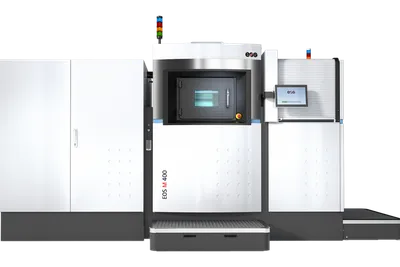
Other Metal Additive Manufacturing
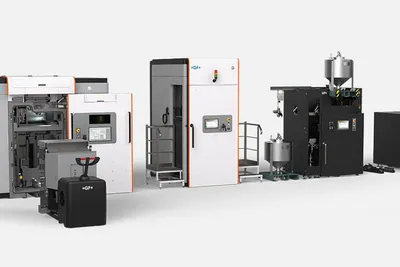
GF DMP Factory 500
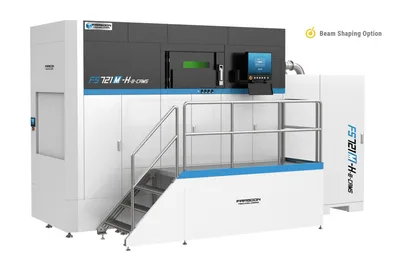
Farsoon FS721M-CAMS
Concept Laser X LINE 2000R