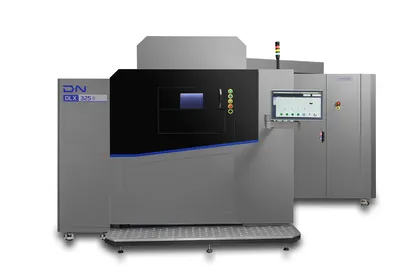
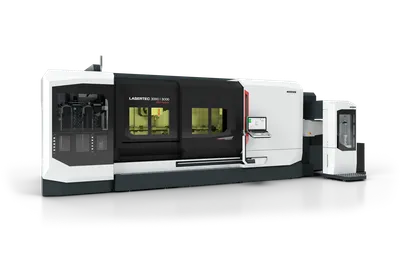
DN Solutions DLX 450
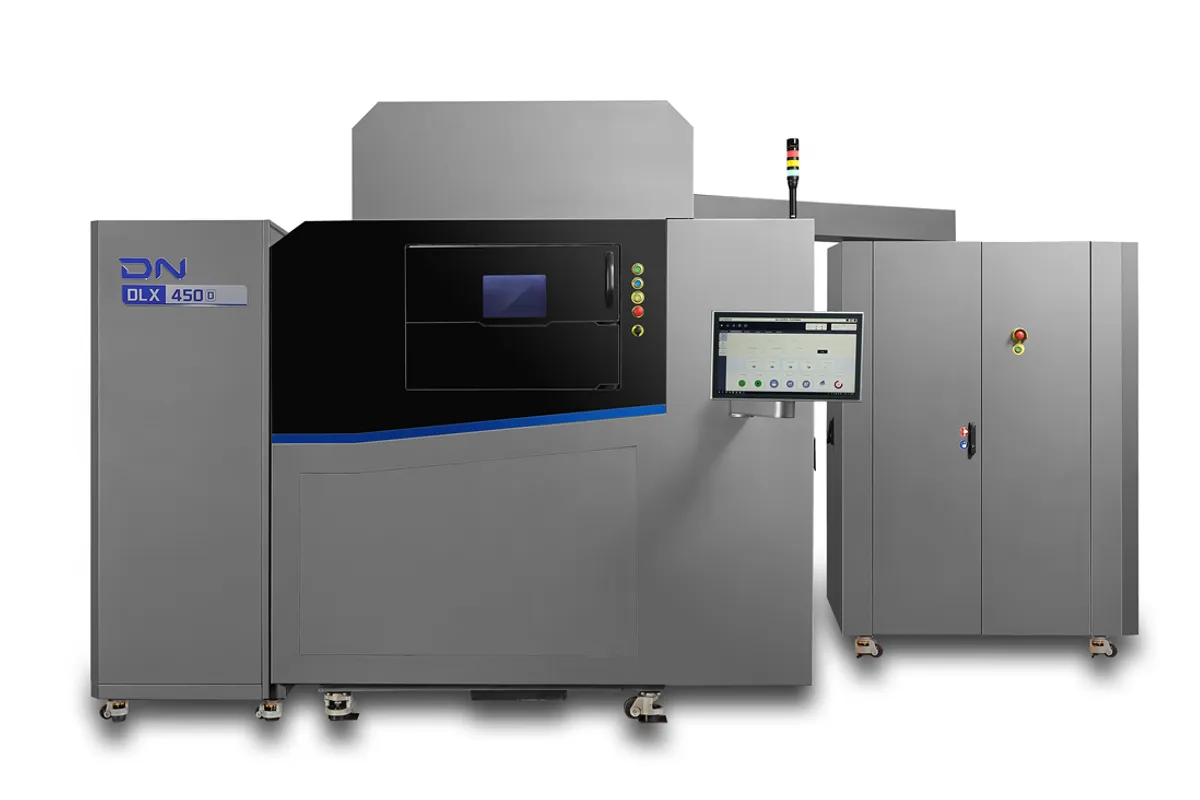
Image: awsimg.dn-solutions.com, DN Solutions
Key Specifications
Weight
build volume
laser type
laser count
laser power
focus diameter
How much does the DN Solutions DLX 450 cost?
Estimated price range
Our best estimate for a metal additive manufacturing in this class — not a quote from DN Solutions. Configuration moves it a long way.
Overview
The DN Solutions DLX 450 is a metal additive manufacturing machine with a cubic build volume of 450 x 450 x 450 mm (17.7 x 17.7 x 17.7 in) and a single Yb-fiber laser of 500 W or 1,000 W. DN Solutions places it in its powder bed fusion range.
Size is the argument for this model. Each side of the plate is about 38% longer than on the DLX 325, which builds 325 x 325 x 400 mm (12.8 x 12.8 x 15.7 in). That opens the machine to larger housings, impellers, tooling inserts and brackets printed in one piece, and to more small parts per build.
The laser count does not grow with the plate. One beam with an 80 micron focus diameter has to expose the whole 450 mm square, so a plate filled edge to edge takes a long time per layer and a tall build can run for days. Specifying 1,000 W instead of 500 W helps where the material allows more energy, but the table gives no build rate to quantify it. The DLX 450 D lists its power per laser and a build volume of 450 x 450 x 470 mm (17.7 x 17.7 x 18.5 in), and is the model to compare when throughput matters more than simplicity.
A build this size also consumes a large quantity of powder to fill the volume around the parts, most of it recovered and sieved afterwards. The table does not cover powder handling, layer thickness or materials, so those belong on the list of questions for DN Solutions.
For the site, the listed dimensions are 4,600 x 4,100 x 2,800 mm (181.1 x 161.4 x 110.2 in) and the weight is 5,500 kg (12,125 lb). Protective gas is argon or nitrogen. Gas filtration is given as "Permanent Chalk" with no further explanation in the table.
Full Specifications
| Parameter | Value |
|---|---|
| Build Volume | 450 x 450 x 450 mm (17.7 x 17.7 x 17.7 in) |
| Laser Type | Yb-Fiber Laser |
| Laser Count | 1 |
| Laser Power | 500W or 1000W |
| Focus Diameter | 80 microns |
| Gas Filtration | Permanent Chalk |
| Protective Gas | Argon / Nitrogen |
| Machine Dimensions | 4,600 x 4,100 x 2,800 mm (181.1 x 161.4 x 110.2 in) |
| Machine Weight | 5,500 kg (12,125 lb) |
| Length | 450 mm |
| Width | 450 mm |
| Height | 450 mm |
| Number of Laser | 1 |
Specifications sourced from dn-solutions.com — verified 2026-03-28
Strengths & Limitations
Strengths
- 450 x 450 x 450 mm (17.7 x 17.7 x 17.7 in) build volume, against 325 x 325 x 400 mm (12.8 x 12.8 x 15.7 in) on the DLX 325
- Laser power of 500 W or 1,000 W from a Yb-fiber source
- 80 micron focus diameter across the full plate
- Argon and nitrogen are both listed, covering reactive and non-reactive alloys
Limitations
- One laser serves a 450 mm square plate, so dense builds have long layer times
- At 5,500 kg (12,125 lb) and 4,600 x 4,100 mm (181.1 x 161.4 in) it needs a prepared floor area and a planned delivery route
- Layer thickness, build rate, powder handling and electrical supply are not in the table
- Gas filtration is described only as "Permanent Chalk", which leaves filter service requirements unclear
Best For
Frequently Asked Questions
01
The build volume is 450 x 450 x 450 mm (17.7 x 17.7 x 17.7 in). The real limit for a part is a little less, since the base plate, support structures and a margin at the edges all come out of that space.
02
It depends on how full the plate is. The DLX 450 has one Yb-fiber laser of 500 W or 1,000 W with an 80 micron focus, and that beam exposes every part. A few large, thin-walled parts are practical. Plates packed with solid parts are where the DLX 450 D, which lists 500 W or 1,000 W per laser, is worth comparing.
03
The DLX 450 lists a single laser power figure and a 450 x 450 x 450 mm (17.7 x 17.7 x 17.7 in) build volume. The DLX 450 D lists power per laser and a build volume of 450 x 450 x 470 mm (17.7 x 17.7 x 18.5 in). Both offer 500 W or 1,000 W.
04
The machine measures 4,600 x 4,100 x 2,800 mm (181.1 x 161.4 x 110.2 in) and weighs 5,500 kg (12,125 lb). Add space for the gas supply, powder storage and sieving, and for removing a build plate that can carry a heavy block of parts. The table does not give service clearances.
Videos

DN Solutions Europe

P.A. Bachke AS
More from DN Solutions
Other Metal Additive Manufacturing
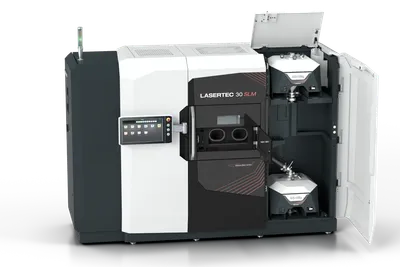
DMG Mori LASERTEC 30 SLM
DMG Mori LASERTEC 3000 DED hybrid
SLM Solutions SLM 500 HL
EOS M 400-4
Hermle MPA 42