DN Solutions DLX 325
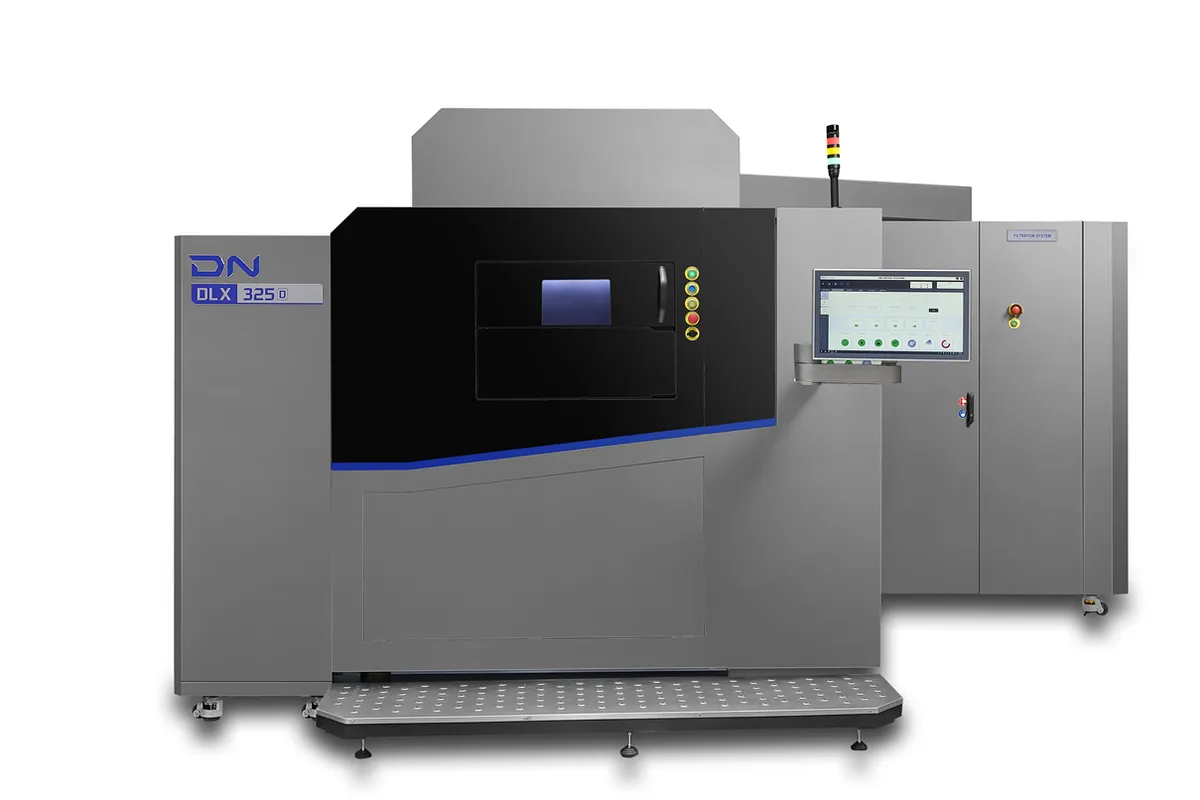
Image: awsimg.dn-solutions.com, DN Solutions
Key Specifications
Weight
build volume
laser type
laser count
laser power
focus diameter
How much does the DN Solutions DLX 325 cost?
Estimated price range
Our best estimate for a metal additive manufacturing in this class — not a quote from DN Solutions. Configuration moves it a long way.
Overview
The DN Solutions DLX 325 is a single-laser metal additive manufacturing machine in DN Solutions' powder bed fusion range, with a build volume of 325 x 325 x 400 mm (12.8 x 12.8 x 15.7 in). The laser is a Yb-fiber unit offered at 500 W or 1,000 W, with a focus diameter of 80 microns.
A single laser sets the pace. Every part on the plate is melted by one 80 micron spot, so build time grows with the total melted area in each layer. For one tall part, or a few parts spread thinly, that is acceptable. For a full plate of dense parts, the DLX 325 D covers a similar 325 x 325 x 420 mm (12.8 x 12.8 x 16.5 in) volume and lists its 500 W or 1,000 W power per laser.
The choice between 500 W and 1,000 W is made when the machine is specified. Higher power allows thicker layers or faster scanning in materials that tolerate it, while fine features and thin walls depend more on the 80 micron focus than on power. The table gives no layer thickness, scan speed or build rate, so ask for those figures with the material in question.
Protective gas is listed as argon or nitrogen. Argon is the usual choice for reactive alloys such as titanium and aluminium, nitrogen is common for many steels, and the shop needs the matching supply. Gas filtration is listed as "Permanent Chalk". The table does not explain the term, so ask DN Solutions what the filter needs in service.
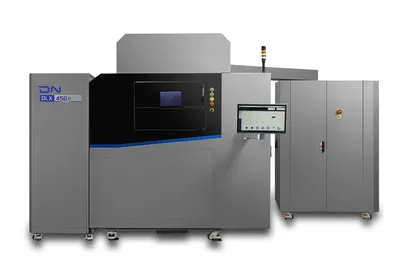
The machine is listed at 4,500 x 3,800 x 2,700 mm (177.2 x 149.6 x 106.3 in) and 4,500 kg (9,921 lb). If parts outgrow the 325 mm plate, the DLX 450 offers 450 x 450 x 450 mm (17.7 x 17.7 x 17.7 in) with the same choice of laser power.
Full Specifications
| Parameter | Value |
|---|---|
| Build Volume | 325 x 325 x 400 mm (12.8 x 12.8 x 15.7 in) |
| Laser Type | Yb-Fiber Laser |
| Laser Count | 1 |
| Laser Power | 500W or 1000W |
| Focus Diameter | 80 microns |
| Gas Filtration | Permanent Chalk |
| Protective Gas | Argon / Nitrogen |
| Machine Dimensions | 4,500 x 3,800 x 2,700 mm (177.2 x 149.6 x 106.3 in) |
| Machine Weight | 4,500 kg (9,921 lb) |
| Length | 325 mm |
| Width | 325 mm |
| Height | 400 mm |
| Number of Laser | 1 |
Specifications sourced from dn-solutions.com — verified 2026-03-28
Strengths & Limitations
Strengths
- Build volume of 325 x 325 x 400 mm (12.8 x 12.8 x 15.7 in)
- Yb-fiber laser available at 500 W or 1,000 W
- 80 micron focus diameter for fine features and thin walls
- Runs under argon or nitrogen, so reactive and non-reactive alloys can both be planned for
- One laser means no overlap zone between scan fields to calibrate
Limitations
- A single laser melts every part on the plate, so full plates build slowly; the DLX 325 D lists power per laser on a similar volume
- The 325 x 325 mm plate limits part size; the DLX 450 offers 450 x 450 x 450 mm (17.7 x 17.7 x 17.7 in)
- The table states no layer thickness, build rate or list of qualified materials
- Needs 4,500 x 3,800 mm of floor (177.2 x 149.6 in) plus an inert gas supply, before powder handling and post-processing space
Best For
Frequently Asked Questions
01
The build volume is 325 x 325 x 400 mm (12.8 x 12.8 x 15.7 in): a 325 mm square plate with 400 mm of height. Usable part size is somewhat smaller in practice, because supports, the base plate and edge margins all take space.
02
One Yb-fiber laser, offered at either 500 W or 1,000 W, with an 80 micron focus diameter. The DLX 325 D is the related model that lists the same 500 W or 1,000 W power per laser on a 325 x 325 x 420 mm (12.8 x 12.8 x 16.5 in) build volume.
03
The table lists argon and nitrogen as protective gases. Which one a job needs depends on the alloy: argon is the normal choice for reactive metals, while nitrogen is used with many steels. The table does not give gas consumption, so ask for the flow rate when sizing the supply.
04
The machine is listed at 4,500 x 3,800 x 2,700 mm (177.2 x 149.6 x 106.3 in) and weighs 4,500 kg (9,921 lb). Beyond that, plan for the argon or nitrogen supply and for the powder handling, part removal and heat treatment steps that follow a build. The table gives no electrical figures.
05
Choose on part size. The DLX 325 builds 325 x 325 x 400 mm (12.8 x 12.8 x 15.7 in) and the DLX 450 builds 450 x 450 x 450 mm (17.7 x 17.7 x 17.7 in). Both are listed with 500 W or 1,000 W of laser power, so the larger machine spreads the same laser over a bigger plate.
More from DN Solutions

Other Metal Additive Manufacturing
EOS M 290
Desktop Metal Studio System+
DMG Mori LASERTEC 30 SLM US
Farsoon FS191M
Markforged X3