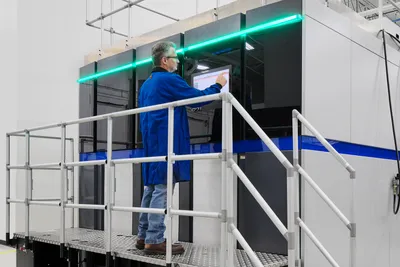
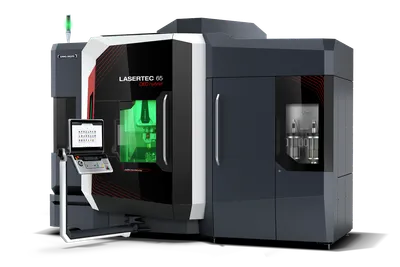
DMG Mori LASERTEC 65 DED hybrid 2nd Generation
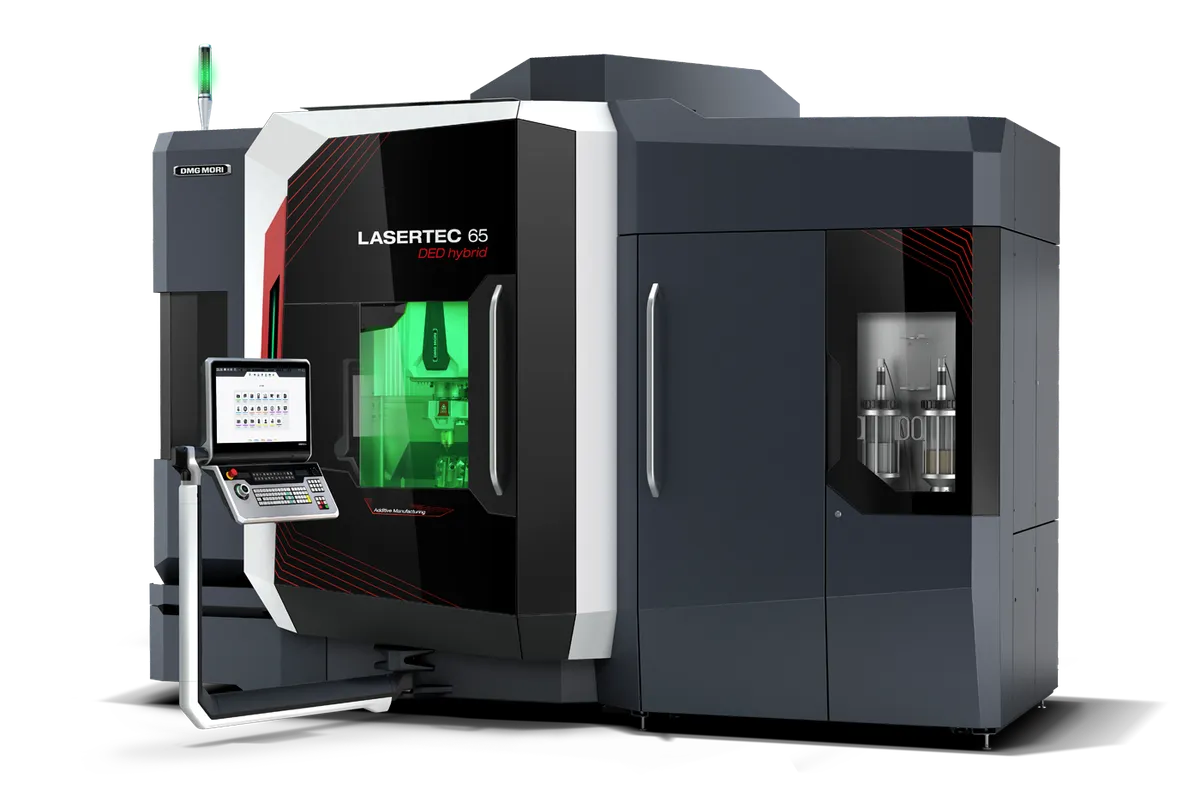
Image: dmgmori.com, DMG Mori
Key Specifications
X Travel
Y Travel
Z Travel
laser power
max workpiece weight
deposition nozzle
How much does the DMG Mori LASERTEC 65 DED hybrid 2nd Generation cost?
Estimated price range
Our best estimate for a metal additive manufacturing in this class — not a quote from DMG Mori. Configuration moves it a long way.
Overview
The 2nd Generation of the DMG MORI LASERTEC 65 DED hybrid takes a workpiece that DMG MORI puts at 170% bigger than the 1st Generation's: Ø 840 × 350 mm or Ø 680 × 400 mm, up to 600 kg (1,322.8 lb). The build rate is stated as 35% higher, without naming the baseline. Neither figure comes with an absolute value, so ask for the build rate in your material.
The deposition head uses a nozzle DMG MORI calls multiJet, moved in 5 axes, which is said to give a homogeneous powder distribution whatever the direction of the weld path. Two kinds of laser source are available, infrared and blue. The spec table lists 3,000 W of laser power.
Process monitoring is grouped under the AM Assistant. A thermal imaging camera observes the whole work area, which makes it possible to control the interpass temperature and to use the laser for pre-heating. A second camera monitors the thermal energy of the meltpool and regulates laser power in a closed loop. A lateral camera keeps the working distance under constant control, and the powder mass flow is calibrated automatically and watched by an optical sensor. The AM Evaluator displays the recorded process data, such as meltpool size and powder mass flow, both as a digital 3D model and in time sequence, which is the traceability record for a welded part.
Powder management is described as new as well. Pots come in three sizes, S with 0.5 l, M with 2.3 l and L with 5 l, the containers are stored under argon pressure, and the hopper cabinet has automatic dust extraction. A pressure leak check and level sensor is optional.
The machine around the laser offers 735 mm (28.9 in) of X, 650 mm (25.6 in) of Y and 560 mm (22 in) of Z, with milling, turning and grinding in the same setup.
Full Specifications
| Parameter | Value |
|---|---|
| Laser Power | 3,000 W |
| Max Workpiece Weight | 600 kg (1,322.8 lb) |
| X-Axis Travel | 735 mm (28.9 in) |
| Y-Axis Travel | 650 mm (25.6 in) |
| Z-Axis Travel | 560 mm (22 in) |
| Deposition Nozzle | 5-axis material deposition with multiJet nozzle |
| Processes | Milling, turning, grinding, laser pre-heating, additive manufacturing, scan3D |
| Max Workpiece Size | Ø 840 x 350 mm or Ø 680 x 400 mm |
| Laser Source | Infrared and blue laser technology available |
| Powder Pot Sizes | S = 0.5 l, M = 2.3 l, L = 5 l |
| Meltpool Monitoring | Meltpool camera, closed-loop control of the laser power |
Specifications sourced from dmgmori.com — verified 2026-10-02
Strengths & Limitations
Strengths
- Workpiece 170% bigger than the 1st Generation, at Ø 840 × 350 mm or Ø 680 × 400 mm
- Build rate stated as 35% higher
- Thermal imaging camera for interpass temperature control and laser pre-heating
- Closed-loop control of laser power from a meltpool camera
- AM Evaluator records meltpool size and powder mass flow as a digital 3D model and over time
- Infrared and blue laser technology available
Limitations
- Pressure leak check and level sensor for the powder containers is an option
- The 35% build rate gain is given without an absolute build rate
- The largest powder pot is 5 l, so powder supply has to be planned for long deposition jobs
- Height is limited to 350 mm at the full Ø 840 mm diameter
- Listed data covers no spindle or tool magazine figures for milling, turning and grinding
Best For
Frequently Asked Questions
01
DMG MORI states a 170% bigger workpiece than the 1st Generation, now Ø 840 × 350 mm or Ø 680 × 400 mm, and a 35% higher build rate. The Highlights also describe the multiJet nozzle and the powder management as new.
02
The whole work area with a thermal imaging camera, the meltpool's thermal energy with an integrated camera that controls laser power in a closed loop, the working distance with a lateral camera, and the powder mass flow with automatic calibration and an optical sensor. The AM Evaluator then visualises the process data.
03
Three: S with 0.5 l, M with 2.3 l and L with 5 l. The powder containers are pressurised with argon during storage and the hopper cabinet has automatic dust extraction. An integrated pressure leak check and level sensor is listed as an option.
04
735 mm (28.9 in) in X, 650 mm (25.6 in) in Y and 560 mm (22 in) in Z, with 3,000 W of listed laser power and a maximum workpiece weight of 600 kg (1,322.8 lb). Infrared and blue laser technology are available.
05
Yes. Laser pre-heating is one of the six processes DMG MORI lists for the machine, and the thermal imaging camera that observes the work area is what allows the interpass temperature to be controlled and the laser to be used for pre-heating.
Videos

DMG MORI

NYC CNC
Community Discussions
Links to community discussions. Summaries are editorial — visit the original thread for full context.
More from DMG Mori
Other Metal Additive Manufacturing
HP Metal Jet S100 Metal 3D Printer
Farsoon FS350M
Velo3D Sapphire
ATLIX xBUILD 5000
Matsuura LUMEX Avance-60