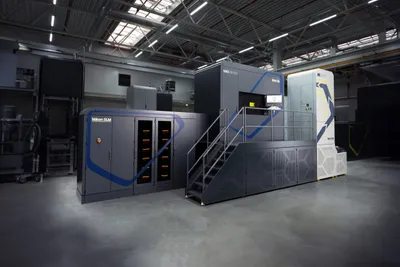
Desktop Metal Studio System+
Key Specifications
build volume
technology
layer thickness
max part density
materials
feedstock form
Overview
The Desktop Metal Studio System+ is the flagship office-friendly metal 3D printing platform that brought bound metal deposition (BMD) into engineering offices without the safety hazards associated with laser powder bed fusion. Launched as an evolution of the original Studio System, the Studio System+ introduced a higher-power debinding furnace and refined rod-based feedstock to increase throughput and expand the alloy library. The build volume of 300 x 200 x 200 mm accommodates most engineering prototype and tooling insert applications, and the closed material cartridge system eliminates the loose powder handling that restricts LPBF to industrial environments.
BMD extrudes metal rods composed of metal powder embedded in a wax and polymer binder — similar in principle to Markforged's ADAM process. The Studio System+ prints green parts that are then washed in the debind station to remove the primary binder, then sintered in the integrated furnace to achieve full density. The three-station workflow (printer, debinder, furnace) is self-contained and ventilated to office codes, making it viable in engineering labs, product development centers, and universities without dedicated industrial HVAC or explosion-proof enclosures.
Material options include 17-4 PH stainless steel, 316L stainless, H13 tool steel, 4140 low-alloy steel, Inconel 625, copper, and several others. Final part density typically reaches 96-99% depending on alloy and geometry, which is sufficient for functional prototypes, tooling inserts, and end-use parts in non-critical applications. Surface finish after sintering is rougher than LPBF — typically Ra 4-8 µm — and machining allowances should be planned for critical surfaces.
The Studio System+ is priced in the $150,000-$200,000 range for the complete three-station system, positioning it well below entry-level LPBF systems. The tradeoff is throughput: BMD build rates are significantly slower than laser systems, and the sintering cycle adds 24-36 hours to the overall part production time. For organizations needing rapid design iteration in metal without committing to LPBF infrastructure costs, the Studio System+ fills a genuine gap in the market.
Full Specifications
| Parameter | Value |
|---|---|
| Build Volume | 300 x 200 x 200 mm (11.8 x 7.9 x 7.9 in) |
| Technology | Bound Metal Deposition (BMD) |
| Layer Thickness | 50 - 150 µm |
| Max Part Density | 96 - 99% (post-sinter) |
| Materials | 17-4 PH Stainless Steel, 316L Stainless, H13 Tool Steel, 4140 Low-Alloy Steel, Inconel 625, Copper |
| Feedstock Form | Metal rod (closed cartridge) |
| Debinder Type | Proprietary fluid debind station |
| Furnace Max Temp | 1,400°C |
| Surface Finish Sintered | Ra 4 - 8 µm (material dependent) |
| Print Head | Dual extrusion |
| Power Requirements | Standard 110/220V — no 3-phase required |
| System Components | Printer + Debinder + Furnace (three stations) |
| Build Area | 30 x 20 x 20 cm (12 x 8 x 8 in) |
| Retort Size | 30 x 20 x 17cm (12 x 8 x 6.7 in) |
| Peak Temperature | 1400°C (2552°F) |
| Enviroment | Argon, Argon + Hydrogen Blend, Inert vacuum sintering |
| Benefits | The Studio System™ 2 is the easiest way for designers and engineers to print metal parts.¹ |
| Industries | Explore applications for 3D printing across a range of industries. |
Specifications sourced from desktopmetal.com — verified 2026-03-28
Strengths & Limitations
Strengths
- Office-safe operation — closed cartridge feedstock eliminates loose powder handling, allowing installation in standard engineering labs without industrial HVAC
- Significantly lower acquisition cost than entry-level LPBF systems, with a three-station complete workflow included in the purchase price
- Broad alloy library including Inconel 625 and H13 tool steel at accessible price points, enabling functional tooling and high-temp prototypes
- Integrated debind and furnace stations from a single vendor simplify the workflow and reduce process development burden
Limitations
- Sintering shrinkage of 15-20% requires careful compensation in CAD and limits dimensional accuracy compared to LPBF for tight-tolerance parts
- Total part cycle time of 24-48 hours (print + debind + sinter) is substantially longer than LPBF for small parts
- Surface finish post-sinter is rougher than LPBF, requiring secondary machining for mating surfaces or cosmetic applications
Best For
Frequently Asked Questions
01
The complete three-station Studio System+ (printer, debinder, furnace) is typically priced at $150,000 to $200,000 depending on configuration. Material costs vary by alloy, with rod feedstock priced per kilogram. Annual service agreements are available separately. Compared to LPBF systems starting at $400,000-$500,000, the Studio System+ is the most accessible industrial metal AM entry point.
02
The Studio System+ achieves typical tolerances of ±0.5% of nominal dimension after sintering, with a minimum of ±0.2 mm. Sintering shrinkage of approximately 15-20% is compensated automatically in the Fabricate software, but part geometry complexity affects final accuracy. Critical mating surfaces typically require post-sinter machining for tolerances tighter than ±0.1 mm.
03
Yes — this is the Studio System's primary design intent. The closed metal rod feedstock eliminates the loose powder hazards that require LPBF to be installed in industrial environments. The debinder uses a proprietary fluid with standard ventilation, and the furnace meets office building codes. No explosion-proof room, inert gas supply infrastructure, or powder PPE is required for routine operation.
04
Available materials include 17-4 PH stainless steel, 316L stainless steel, H13 tool steel, 4140 low-alloy steel, Inconel 625, and copper. Desktop Metal continues to expand the alloy library. Material rods ship in sealed cartridges that load directly into the printer, eliminating handling of loose powder.
05
Both use bound metal deposition and similar three-stage print/wash/sinter workflows. The Studio System+ offers a larger build volume (300x200x200mm vs 250x220x200mm) and a broader alloy library including Inconel 625. The Metal X uses a separate Wash-1 and Sinter-1 from Markforged with a slightly different binder chemistry. Both achieve 96-99% density. Choice often comes down to vendor ecosystem preference and specific material requirements.
Videos
Desktop Metal
Desktop Metal
Desktop Metal
Laser Lines Ltd - 3D Printers & Laser Systems
Cimquest
Community Discussions
Community discussion — Desktop Metal Shop System (New in Box) for sale.
Community discussion — Additive Manufacturing/3D Printing | 3D metal printing ...
Community discussion — Desktop metal printing gets cheaper - Practical Machinist
Community discussion — New Haas Desktop CNC Mill, surely some mistake?
Community discussion — Looking for a desktop CNC milling machine for brass, copper ...
Capabilities and material handling — Needs Advice - building a small desktop CNC rigid enough to ...
Community discussion — A Desktop CNC by David A - CNCzone
Pricing and buying discussion — New Machine Build welded metal frame desktop cnc - Page 2
Community discussion — Looking For A Desktop CNC That Can Mill Steel - Reddit
Options and configuration advice — Desktop mill options? : r/machining - Reddit
Options and configuration advice — Small Cnc mill that can cut steel : r/machining - Reddit
Pricing and buying discussion — Has anyone had experience with the Bantam Tool Desktop CNC ...
Links to community discussions. Summaries are editorial — visit the original thread for full context.