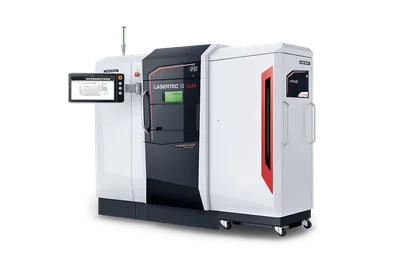
Desktop Metal Production System P-50
Key Specifications
print technology
print direction
binder jetting module
max build rate
resolution
layer thickness
How much does the Desktop Metal Production System P-50 cost?
Estimated price range
Our best estimate for a metal additive manufacturing in this class — not a quote from Desktop Metal. Configuration moves it a long way.
Overview
The Desktop Metal Production System P-50 is a binder jetting metal printer sized for volume work: a 490 x 380 x 260 mm (19.2 x 15.0 x 10.2 in) build box, a maximum build rate of 12,000 cc/hr (732 in3/hr) at 65 µm layer thickness, and Single Pass Jetting as its print technology.
Print direction is bi-directional, so the carriage does productive work on passes in both directions instead of returning empty. The binder jetting module carries 8 piezo-electric printheads with 16,384 nozzles and a native resolution of 1,200 dpi. Layer thickness is adjustable from 30 µm to 200 µm in the green state. The headline build rate is quoted at 65 µm, so a job run at thinner layers for finer detail will build more slowly than that maximum, and a job at thicker layers trades surface detail for output.
Part tolerance is listed as ± 0.5%. A percentage means the absolute deviation grows with feature size, which is the point to weigh for larger parts: critical fits on long dimensions should be given machining stock. The material platform is open, with third party MIM powders named, so powder sourcing is not tied to a single supplier. The chamber runs under CDA or nitrogen inerting at less than 2% oxygen.
This is a factory-floor machine. External dimensions are 1,900 x 5,000 x 1,900 mm (74.8 x 196.9 x 74.8 in) and it weighs 4,751 kg (10,476 lb). Power is 380 - 480 V, 50/60 Hz, 3-phase, 4 wire at 60 Amp, and operators work from a 24-inch touchscreen display. Desktop Metal's table for the P-50 covers the printer only and gives no figures for the equipment that follows printing, so the rest of the line has to be planned and quoted separately.
Full Specifications
| Parameter | Value |
|---|---|
| Print Technology | Single Pass Jetting™ |
| Print Direction | Bi-directional |
| Binder Jetting Module | 8 piezo-electric printheads (16,384 nozzles) |
| Max Build Rate | 12,000 cc/hr (732 in3/hr) at 65 µm layer thickness |
| Resolution | Native 1,200 dpi |
| Layer Thickness | 30 µm - 200 µm (green) |
| Part Tolerance | ± 0.5% |
| External Dimensions | 1,900 x 5,000 x 1,900 mm (74.8 x 196.9 x 74.8 in) |
| Machine Weight | 4,751 kg (10,476 lb) |
| Build Box Envelope | 490 x 380 x 260 mm (19.2 x 15.0 x 10.2 in) |
| Chamber Environment | CDA or Nitrogen inerting (< 2% Oxygen) |
| Onboard Controls | 24-inch touchscreen display |
| Power Requirements | 380 - 480 V, 50/60 Hz, 3-phase, 4 wire 60 Amp |
| Material Platform | Open platform (third party MIM powders) |
Specifications sourced from desktopmetal.com — verified 2026-10-03
Strengths & Limitations
Strengths
- Maximum build rate of 12,000 cc/hr (732 in3/hr) at 65 µm layer thickness
- 490 x 380 x 260 mm (19.2 x 15.0 x 10.2 in) build box
- 8 piezo-electric printheads with 16,384 nozzles at a native 1,200 dpi
- Open material platform that accepts third party MIM powders
- Layer thickness adjustable from 30 µm to 200 µm (green)
- Chamber runs under CDA or nitrogen inerting below 2% oxygen
Limitations
- External dimensions of 1,900 x 5,000 x 1,900 mm (74.8 x 196.9 x 74.8 in) and 4,751 kg (10,476 lb) call for a dedicated production area
- Needs 380 - 480 V 3-phase, 4 wire power at 60 Amp plus a CDA or nitrogen supply
- Part tolerance is listed as ± 0.5%, so close-tolerance features on larger parts need secondary machining
- The 12,000 cc/hr figure applies at 65 µm layers; thinner layers down to 30 µm trade output for detail
Best For
Frequently Asked Questions
01
Desktop Metal lists a build box envelope of 490 x 380 x 260 mm (19.2 x 15.0 x 10.2 in). Parts are nested through the full height of the box, so the practical batch size depends on part geometry and on the layer thickness chosen between 30 µm and 200 µm.
02
The maximum build rate is 12,000 cc/hr (732 in3/hr), quoted at 65 µm layer thickness. Printing is bi-directional using Single Pass Jetting. Because the rate is tied to a 65 µm layer, expect lower output at thinner layers.
03
Desktop Metal describes the material platform as open and names third party MIM powders. The chamber environment is CDA or nitrogen inerting at less than 2% oxygen. The table does not list individual alloys, so qualification of a specific powder should be confirmed with Desktop Metal.
04
Floor space for a machine measuring 1,900 x 5,000 x 1,900 mm (74.8 x 196.9 x 74.8 in) and weighing 4,751 kg (10,476 lb), a 380 - 480 V, 50/60 Hz, 3-phase, 4 wire supply at 60 Amp, and CDA or nitrogen for chamber inerting.
05
They are different classes of machine. The Studio System 2 printer weighs 97 kg (214 lbs), while the Production System P-50 weighs 4,751 kg (10,476 lb) and is 5,000 mm long. The P-50 is a production line asset; it is not something to place in an office or lab.
Videos

Arc Impact

Arc Impact
More from Desktop Metal
Other Metal Additive Manufacturing
3D Systems DMP Flex 350
SLM Solutions NXG XII 600E
GF DMP Flex 350
Farsoon FS812M
GF Machining DMP Factory 500