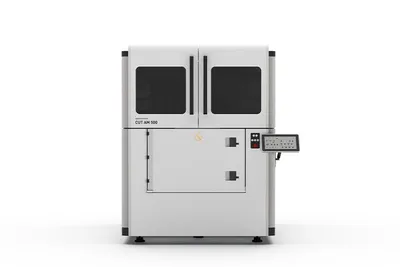
Concept Laser Mlab Cusing R
Key Specifications
build envelope
layer thickness
production speed
laser system
max scanning speed
focus diameter
How much does the Concept Laser Mlab Cusing R cost?
Estimated price range
Our best estimate for a metal additive manufacturing in this class — not a quote from Colibrium Additive. Configuration moves it a long way.
Overview
The Concept Laser Mlab Cusing R is a small-format laser metal additive machine: a 100 W (cw) fibre laser, a focus diameter of approx. 50 µm and layers of 15 – 30 µm, working in a build envelope listed as 50 x 50 x 80 mm or 90 x 90 x 80 mm (x,y,z). Everything in the table points at small, finely detailed parts. Production speed is 1 – 5 cm3/h depending on material, so this is a machine for work counted in grams of metal, not kilograms.
The material list shows where that leads. Next to Stainless Steel 316L and 17-4PH, Aluminum AlSi10Mg, Titanium Ti6Al4V ELI Grade 23 and Titanium CPTi Grade 2, Colibrium Additive lists Bronze CuSn, Silver 930, yellow and rose gold and Platinum, together with remanium star CL (CoCrW) and rematitan CL (Ti6Al4V ELI). A 90 x 90 mm area with 80 mm of height is tight for engineering components but ample for precious-metal pieces, and a small envelope keeps the quantity of metal tied up in each build low.
Site demands are closer to a laboratory than a production hall. Power comes from a 1/N/PE AC 230 V, 16 A supply with a maximum consumption of 1.5 kW. There is one gas connection for Nitrogen or Argon, and inert gas consumption is approx. 0.6 – 0.8 l/min. The machine measures 705 x 1848 x 1220 mm (W x H x D) and weighs approx. 600 kg. A separate handling station of 729 x 1391 x 628 mm (W x H x D) and approx. 100 kg belongs to the installation, so floor space is needed for both. Operating conditions are 15 – 30°C.
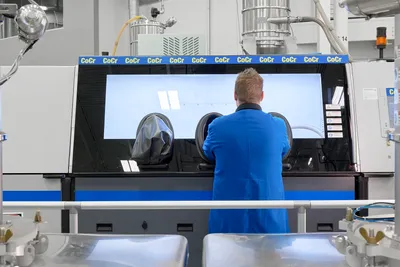
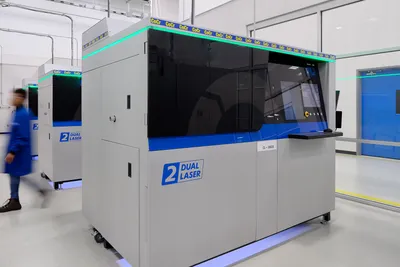
In weight terms it is far from the larger machines in the range: the Colibrium M2 is listed at Approx. 2,500 kg and the X Line 2000R at approx. 9,500 kg (tare weight).
Full Specifications
| Parameter | Value |
|---|---|
| Build Envelope | 50 x 50 x 80 mm (x,y,z); 90 x 90 x 80 mm (x,y,z) |
| Layer Thickness | 15 – 30 µm |
| Production Speed | 1 – 5 cm3/h (depending on material) |
| Laser System | Fibre laser 100 W (cw) |
| Max Scanning Speed | 7 m/s |
| Focus Diameter | approx. 50 µm |
| Connected Loads | Power consumption max. 1.5 kW; Power supply 1/N/PE AC 230 V, 16 A |
| Inert Gas Supply | 1 gas connection provided / Nitrogen or Argon |
| Inert Gas Consumption | approx. 0.6 – 0.8 l/min |
| Machine Dimensions | 705 x 1848 x 1220 mm (W x H x D) |
| Handling Station Dimensions | 729 x 1391 x 628 mm (W x H x D) |
| Machine Weight | approx. 600 kg |
| Handling Station Weight | approx. 100 kg |
| Operating Conditions | 15 – 30°C |
| Materials | Stainless Steel 316L; Stainless Steel 17-4PH; Aluminum AlSi10Mg; Titanium Ti6Al4V ELI Grade 23; Titanium CPTi Grade 2; Bronze CuSn; remanium star CL (CoCrW); rematitan CL (Ti6Al4V ELI); Silver 930; Gold, Yellow; Gold, Rose; Platinum |
Specifications sourced from colibriumadditive.com — verified 2026-10-03
Strengths & Limitations
Strengths
- Fine resolution from a focus diameter of approx. 50 µm and layers of 15 – 30 µm
- Runs from a 1/N/PE AC 230 V, 16 A supply with a maximum power consumption of 1.5 kW
- Inert gas consumption of approx. 0.6 – 0.8 l/min, with Nitrogen or Argon on one gas connection
- Material list includes Silver 930, yellow and rose gold, Platinum and Bronze CuSn as well as steels, aluminium and titanium
- Compact and light at 705 x 1848 x 1220 mm (W x H x D) and approx. 600 kg
Limitations
- The build envelope tops out at 90 x 90 x 80 mm (x,y,z), which excludes most structural and tooling-size parts
- Production speed of 1 – 5 cm3/h (depending on material) makes solid volume slow to build
- The layer range stops at 30 µm, so there is no thick-layer setting for faster, coarser builds
- A handling station of 729 x 1391 x 628 mm (W x H x D) and approx. 100 kg has to be sited next to the machine
Best For
Frequently Asked Questions
01
Colibrium Additive lists two build envelopes for the model: 50 x 50 x 80 mm and 90 x 90 x 80 mm (x,y,z). Height is 80 mm in both. The table does not say what decides between the two, so confirm with the supplier which envelope a particular machine is set up for.
02
Stainless Steel 316L and 17-4PH, Aluminum AlSi10Mg, Titanium Ti6Al4V ELI Grade 23, Titanium CPTi Grade 2, Bronze CuSn, remanium star CL (CoCrW), rematitan CL (Ti6Al4V ELI), Silver 930, yellow gold, rose gold and Platinum.
03
A 1/N/PE AC 230 V, 16 A power supply, with power consumption of max. 1.5 kW. One gas connection is provided for Nitrogen or Argon, and inert gas consumption is approx. 0.6 – 0.8 l/min. Operating conditions are 15 – 30°C.
04
Production speed is listed as 1 – 5 cm3/h, depending on material. The 100 W (cw) fibre laser scans at up to 7 m/s with a focus diameter of approx. 50 µm, and layer thickness is 15 – 30 µm, so the machine trades output for detail.
05
The machine is 705 x 1848 x 1220 mm (W x H x D) and weighs approx. 600 kg. The handling station is a second unit of 729 x 1391 x 628 mm (W x H x D) weighing approx. 100 kg. Allow floor space and access for both.
Videos

禾田工坊
More from Colibrium Additive
Colibrium X Line 2000R
GE Additive M2 Series
Concept Laser M1 Cusing
Concept Laser M2 Series 5 Metal 3D Printer
Colibrium M2
GE Additive Arcam Spectra H
Other Metal Additive Manufacturing
Markforged Metal X Gen 2 Metal 3D Printer
EOS M 400-4
GF Machining DMP Factory 350 Dual
3D Systems DMP Factory 350 Metal 3D Printer