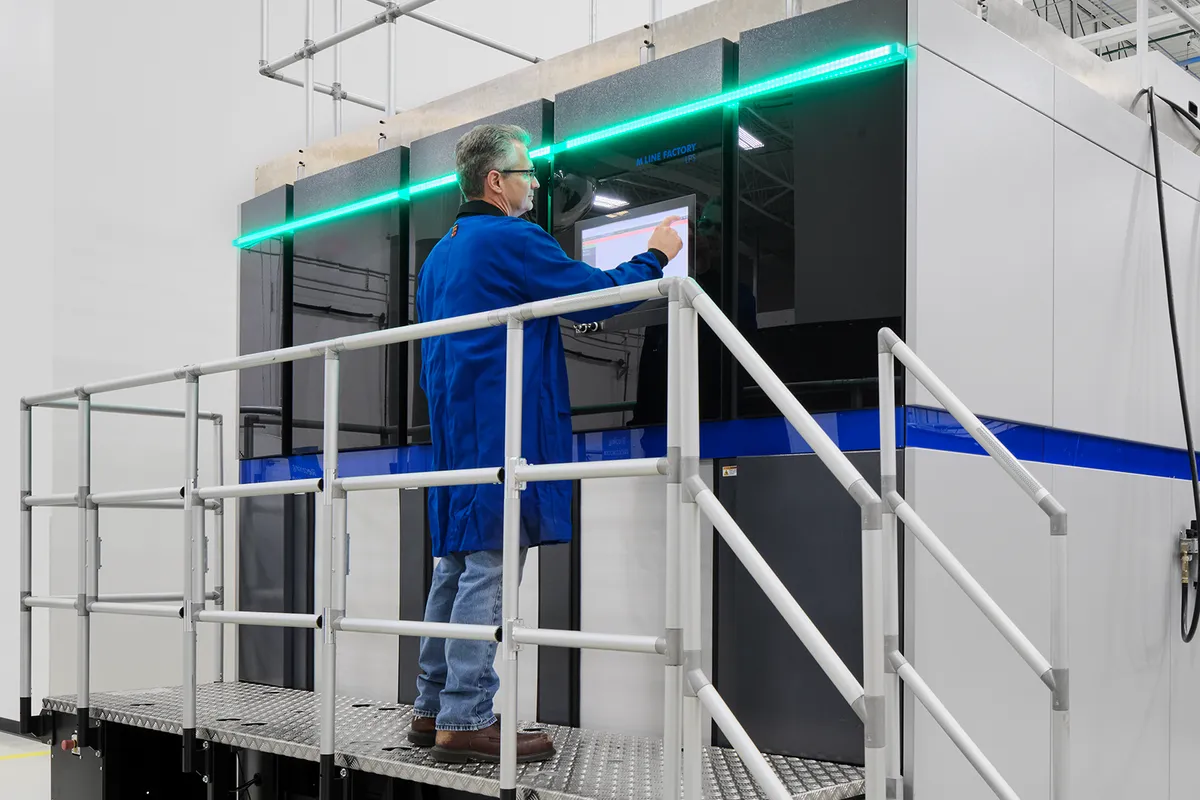
Colibrium M Line
Key Specifications
build envelope
layer thickness
scan speed
laser system
focus diameter
filter system
How much does the Colibrium M Line cost?
Estimated price range
Our best estimate for a metal additive manufacturing in this class — not a quote from Colibrium Additive. Configuration moves it a long way.
Overview
The Colibrium M Line is a four-laser metal additive system with a 500 x 500 x 400 mm (x, y, z) build envelope, 3D optics with 4 x 400 W and a focus diameter that adjusts dynamically from 50 µm – 400 µm. It is not a single cabinet. Colibrium Additive gives dimensions and weights for two units, labelled LPS and MHS, and an installation has to be planned around both.
Those two units are what to take to a facilities engineer first. The LPS measures 4,245 x 4,300 x 3,525 mm (W x D x H) and weighs approx. 14,000 kg at maximum full weight. The MHS is 2,960 x 3,090 x 4,190 mm (W x D x H) and approx. 7,000 kg, so it is the taller unit and its 4,190 mm sets the clear height the building must offer. For scale, the LPS alone outweighs the Colibrium X Line 2000R, which is listed at approx. 9,500 kg (tare weight).
On the process side, four 400 W sources share a square 500 x 500 mm area, and the dynamic focus adjustment is the feature that stands out. A spot that can be set anywhere from 50 µm to 400 µm lets fine contours and bulk infill be handled with different beam sizes in one job. Layer thickness is 20 – 100 µm and scan speed is max. 5 m/s. The filter system is integrated, with 2 x 20 m2 of filter surface.
Listed materials are the nickel based alloys Ni718, NiX and Ni625, the cobalt chromium alloys CoCrMo and CoCrW, Aluminum A205, and the steels 316L, 17-4PH, M300, Corrax and H13. No titanium alloy is on the list. The table states no build rate, electrical supply or inert gas figures, so those belong in the quotation request.
Full Specifications
| Parameter | Value |
|---|---|
| Build Envelope | 500 x 500 x 400 mm (x, y, z) |
| Layer Thickness | 20 – 100 µm |
| Scan Speed | max. 5 m/s |
| Laser System | 3D optics with 4 x 400 W |
| Focus Diameter | 50 µm – 400 µm (dynamic focus adjustment) |
| Filter System | integrated with 2 x 20 m2 filter surface |
| Lps Dimensions | 4,245 x 4,300 x 3,525 mm (W x D x H) |
| Lps Weight | approx. 14,000 kg (max. full weight) |
| Mhs Dimensions | 2,960 x 3,090 x 4,190 mm (W x D x H) |
| Mhs Weight | approx. 7,000 kg (max. full weight) |
| Materials | Nickel based alloy: Ni718, NiX, Ni625; Cobalt chromium alloy: CoCrMo, CoCrW; Aluminum: A205; Steels: 316L 17-4PH, M300, Corrax, H13 |
Specifications sourced from colibriumadditive.com — verified 2026-10-03
Strengths & Limitations
Strengths
- 500 x 500 x 400 mm (x, y, z) build envelope served by 3D optics with 4 x 400 W
- Dynamic focus adjustment from 50 µm – 400 µm, so spot size can follow the feature being built
- Integrated filter system with 2 x 20 m2 filter surface
- Materials span Ni718, NiX and Ni625, CoCrMo and CoCrW, Aluminum A205 and five steels
- Layer thickness of 20 – 100 µm at a scan speed of max. 5 m/s
Limitations
- Two large units to site: the LPS at 4,245 x 4,300 x 3,525 mm and the MHS at 2,960 x 3,090 x 4,190 mm (W x D x H)
- Heavy floor loads: approx. 14,000 kg for the LPS and approx. 7,000 kg for the MHS at maximum full weight
- No titanium alloy appears among the listed materials
- The table gives no build rate, power supply or inert gas consumption
Best For
Frequently Asked Questions
01
The build envelope is 500 x 500 x 400 mm (x, y, z). Layer thickness is 20 – 100 µm and the scan speed is max. 5 m/s, with four lasers of 400 W each working through 3D optics.
02
Colibrium Additive lists 3D optics with 4 x 400 W. The focus diameter is 50 µm – 400 µm with dynamic focus adjustment, so the spot can be kept small for detail or opened up for larger melted areas within the same build.
03
Two units have to be placed. The LPS is 4,245 x 4,300 x 3,525 mm (W x D x H) and the MHS is 2,960 x 3,090 x 4,190 mm (W x D x H). The MHS is the taller of the two, so clear height has to exceed 4,190 mm.
04
The LPS is listed at approx. 14,000 kg and the MHS at approx. 7,000 kg, both as maximum full weight. Have the floor checked for each unit's footprint and load before ordering.
05
Nickel based alloys Ni718, NiX and Ni625; cobalt chromium alloys CoCrMo and CoCrW; Aluminum A205; and the steels 316L, 17-4PH, M300, Corrax and H13. There is no titanium alloy on the list.
Videos

Colibrium Additive

Colibrium Additive

Colibrium Additive
Community Discussions
Links to community discussions. Summaries are editorial — visit the original thread for full context.
Comparisons
More from Colibrium Additive
Colibrium Additive Concept M2 Series 5
GE Additive Arcam A2XX
GE Additive Arcam EBM Q10plus
Concept Laser Mlab Cusing R
Colibrium X Line 2000R
GE Additive M2 Series
Other Metal Additive Manufacturing
SLM Solutions NXG XII 600 Metal Additive System
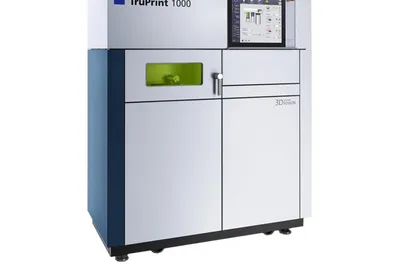
Trumpf TruPrint 1000
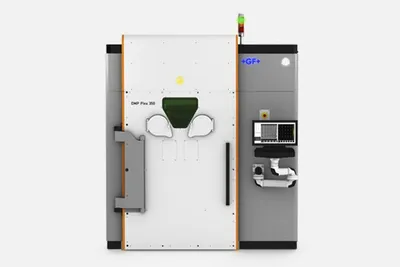
GF Machining DMP Flex 350 Dual
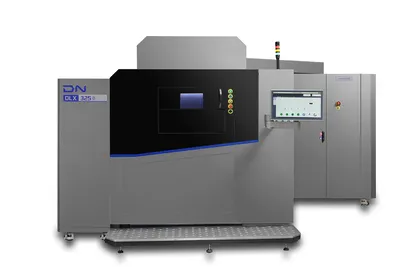
DN Solutions DLX 325 D