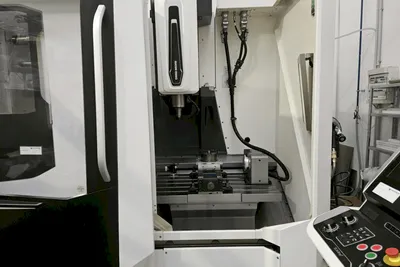
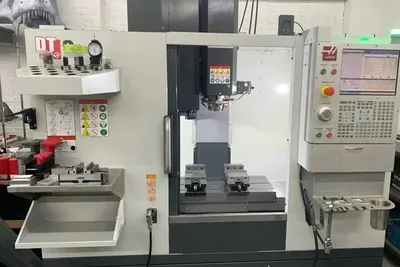
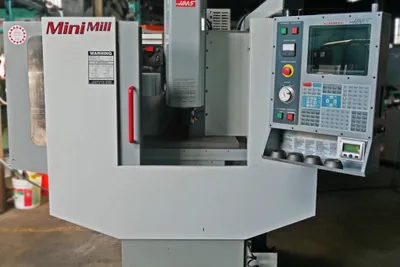
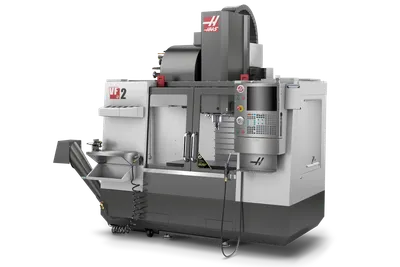
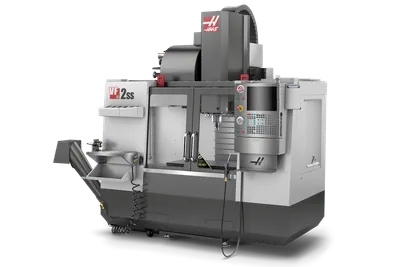
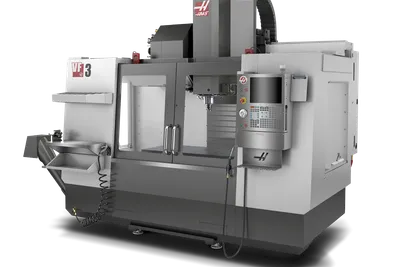
CHIRON VZ 36
Key Specifications
X Travel
Y Travel
Z Travel
Max Spindle
Spindle Taper
Tool Capacity
Overview
The CHIRON VZ 36 is a twin-spindle vertical machining center designed for production machining of larger workpieces — the 'V' platform's extended-stroke configuration that addresses medium-to-large parts while maintaining CHIRON's signature multi-spindle productivity philosophy. Where the DZ series addresses small and compact parts, the VZ 36 targets component sizes common in powertrain manufacturing, structural aerospace, and industrial machinery: parts up to 500 mm x 450 mm in the XY plane with 400 mm Z-axis travel.
The VZ 36 carries two HSK-A63 spindles at 15,000 rpm and 25 kW each — the same spindle specification as the DZ 25 P but on a larger structural platform with extended X-axis travel. The traveling-column design scales up accordingly, with the column traversing a longer X-axis carriage to serve both spindle stations. Linear encoders on all axes maintain positioning accuracy across the expanded work envelope, and CHIRON's thermostable construction ensures consistency during long production runs.
The extended travel of the VZ 36 opens it up to parts that the more compact DZ series cannot accommodate — longer aluminum structural extrusions, larger cast iron housings, and multi-feature components that require tool approaches across a wider surface. This makes the VZ 36 particularly relevant to commercial vehicle (truck and bus) powertrain suppliers, agricultural machinery manufacturers, and industrial equipment producers who need twin-spindle economics on larger part sizes.
CHIRON pairs the VZ 36 with the same Variocell automation ecosystem as the rest of the DZ/VZ family, enabling robot and gantry integration for unattended production. The Siemens Sinumerik 840D sl runs dual NC channels for synchronous or asynchronous spindle operation. New machine pricing is estimated in the $600,000–$850,000 range. Competition includes the Heller MCH 250 and MAG Cincinnati twin-spindle horizontal systems, though the VZ 36 's vertical orientation offers different accessibility advantages.
Full Specifications
| Parameter | Value |
|---|---|
| Spindles | 2 (twin-spindle) |
| Max Spindle Speed | 15,000 rpm per spindle |
| Spindle Taper | HSK-A63 |
| Spindle Motor Power | 25 kW (33.5 hp) per spindle (S1) |
| X-Axis Travel | 600 mm (23.6 in) per spindle |
| Y-Axis Travel | 450 mm (17.7 in) |
| Z-Axis Travel | 400 mm (15.7 in) |
| Rapid Traverse Rate | 60 m/min (2,362 ipm) |
| Tool Capacity | 30 tools per spindle (60 total) |
| Max Workpiece Weight | 250 kg (551 lb) per station |
| CNC Control | Siemens Sinumerik 840D sl |
| Floor Space Required | Approx. 5,500 x 3,800 mm (216.5 x 149.6 in) |
| Positioning Accuracy | +/- 0.004 mm |
Specifications compiled from manufacturer literature and industry references. Not independently verified against a published spec sheet — confirm with the manufacturer or an authorised dealer before making a purchasing decision.
Strengths & Limitations
Strengths
- Extended X/Y travel versus DZ series enables twin-spindle production of larger workpieces — components up to 500 mm that the more compact DZ models cannot accommodate
- Dual 25 kW HSK-A63 spindles provide both the torque for aggressive steel and cast iron machining and the speed for aluminum finishing on medium-large parts
- Twin-spindle configuration cuts cost-per-part nearly in half versus equivalent single-spindle machines, compelling for any high-volume contract with medium-sized parts
- CHIRON Variocell automation compatibility allows lights-out production with gantry or robot loading of both stations simultaneously
Limitations
- Larger footprint than DZ series requires more floor space — the extended travel and structural platform add significant machine length compared to compact twin-spindle configurations
- High capital cost at $600K–$850K demands production volume analysis to justify — medium-volume or high-mix shops rarely achieve adequate ROI
- Synchronous twin-spindle use requires matched fixtures and identical parts; the overhead of synchronous setup reduces flexibility versus single-spindle machines
Best For
Frequently Asked Questions
01
Both machines carry dual HSK-A63 spindles at 15,000 rpm with 25 kW each, but the VZ 36 has significantly extended X and Y travel — approximately 600 mm vs 500 mm per spindle in X, and 450 mm vs 400 mm in Y. The VZ 36 is designed for the next size class of workpieces that exceed the DZ 25 P's work envelope. The DZ 25 P is more compact and suited to smaller parts; the VZ 36 is the choice when part size grows beyond the DZ's reach.
02
Yes. The Siemens Sinumerik 840D sl control runs independent NC channels for each spindle. While synchronous operation on identical parts maximizes throughput, asynchronous operation allows each spindle to work a different part program simultaneously — useful for machining left and right-hand mirror-image parts, or for running different operations on a family of related parts.
03
The VZ 36's 25 kW HSK-A63 spindles are well-suited to aluminum and gray cast iron — the dominant materials in automotive and commercial vehicle powertrain components. They handle steel and ductile iron at appropriate cutting parameters. The 15,000 rpm maximum speed is excellent for aluminum high-speed machining and adequate for most steel finishing operations.
04
The VZ 36's extended travel makes it feasible for aerospace structural parts in the 400–600 mm range. However, most aerospace structural machining requires 5-axis capability for compound-angle features — something the standard VZ 36 does not provide as a 3-axis machine. With optional rotary table integration, aerospace applications are possible, but dedicated 5-axis platforms may be more appropriate for complex aerospace parts.
05
CHIRON's Variocell robot systems scale to serve the VZ 36's larger work envelope. Options include the Variocell Uno (single robot serving both stations), gantry loaders for overhead part transfer, and pallet automation for higher storage capacity. CHIRON also provides integration engineering services to design complete turnkey cells including part handling, washing, and inspection stations.
Videos

lancien black

NShadow

TRL Media

carwow

Catherine Plano
Community Discussions
Community discussion — Chiron tool holders and manuals. - CNCzone
Troubleshooting and problem-solving — Need Help! chiron tool change - cnczone.com
Maintenance and service — Chiron - CNCzone
Troubleshooting and problem-solving — Any experience - Good or Bad - with Chiron machines? - CNCzone
Community discussion — Vise recommendations? Best for the money : r/Machinists - Reddit
Community discussion — Whats your favorite machine vice brand : r/Machinists - Reddit
Community discussion — According to a guy in one cnc chat impact for vices is very ...
Comparison and buying advice — Chick Vises. What are your opinions? : r/Machinists - Reddit
Links to community discussions. Summaries are editorial — visit the original thread for full context.