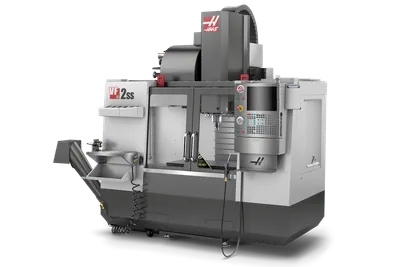
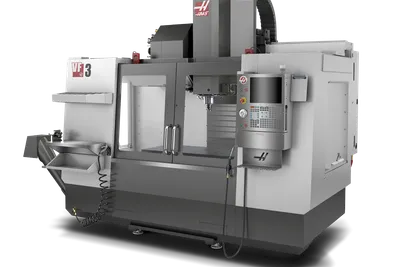
CHIRON VZ 16
Key Specifications
X Travel
Y Travel
Z Travel
Max Spindle
Spindle Taper
Tool Capacity
Overview
The CHIRON VZ 16 is a 4-spindle vertical machining center representing the highest level of production throughput in CHIRON's spindle-multiplication strategy. Where twin-spindle machines like the DZ series double output, the VZ 16's 4-spindle architecture quadruples it — machining four identical parts simultaneously in a single machine footprint. This makes the VZ 16 one of the most productive small-part machining platforms available for dedicated high-volume production runs.
All four spindles on the VZ 16 run synchronously, executing identical toolpaths simultaneously. Each spindle delivers up to 20,000 rpm with HSK-A40 tooling, providing the surface speeds needed for efficient aluminum, magnesium, and steel machining. The machine's traveling-column structure provides the rigidity to maintain consistent accuracy across all four cutting positions simultaneously — essential when part quality must be uniform across a 4-up configuration. Positioning accuracy is maintained at +/- 0.004 mm per axis across the array.
The VZ 16's automation integration takes the 4-spindle concept to its logical conclusion. CHIRON pairs the machine with their Variocell automation systems capable of loading and unloading all four stations simultaneously, achieving takt times measured in seconds rather than minutes. In automotive body-in-white and small powertrain component applications, VZ 16 cells routinely produce millions of parts per year with minimal operator intervention. The Siemens Sinumerik 840D sl control manages all four spindle channels with full synchronization.
The VZ 16 is a highly specialized machine — its 4-spindle synchronous operation means it is optimized for one thing: producing enormous quantities of a specific family of small parts as efficiently as possible. New machine pricing typically falls in the $600,000–$900,000 range, but the cost-per-part economics in suitable applications are exceptional. Primary competition comes from rotary transfer machines and dedicated multi-station transfer lines, against which the VZ 16 offers significantly faster changeover and more flexible toolpath programming.
Full Specifications
| Parameter | Value |
|---|---|
| Spindles | 4 (quad-spindle, synchronous) |
| Max Spindle Speed | 20,000 rpm per spindle |
| Spindle Taper | HSK-A40 |
| Spindle Motor Power | 12 kW (16 hp) per spindle (S1) |
| X-Axis Travel | 250 mm (9.8 in) per spindle |
| Y-Axis Travel | 300 mm (11.8 in) |
| Z-Axis Travel | 300 mm (11.8 in) |
| Rapid Traverse Rate | 60 m/min (2,362 ipm) |
| Tool Capacity | 24 tools per spindle (96 total) |
| Spindle Spacing | Fixed, matched to pallet/fixture pitch |
| CNC Control | Siemens Sinumerik 840D sl (4-channel) |
| Floor Space Required | Approx. 5,500 x 3,500 mm (216.5 x 137.8 in) |
| Positioning Accuracy | +/- 0.004 mm |
Specifications compiled from manufacturer literature and industry references. Not independently verified against a published spec sheet — confirm with the manufacturer or an authorised dealer before making a purchasing decision.
Strengths & Limitations
Strengths
- Four simultaneous spindles produce 4x the output of a single-spindle machine in the same operational time, achieving unmatched cost-per-part economics for high-volume small parts
- HSK-A40 spindles at 20,000 rpm deliver high surface speeds for aluminum and light alloy machining, the most common application for 4-spindle production
- Flexible NC programming via Sinumerik 840D sl means changeover to a new part family is far faster than a transfer line while approaching transfer line throughput
- CHIRON automation integration can load and unload all four stations simultaneously, enabling fully unattended production with seconds-level takt times
Limitations
- Synchronous 4-spindle operation means all four spindles must machine the same part — the VZ 16 has essentially no flexibility for mixed-part or low-volume production
- Fixture design and setup complexity is multiplied by four — precise alignment of all four pallet positions is critical and requires skilled setup technicians
- The very high throughput demands a supply chain and downstream operations capable of absorbing the output — a bottleneck anywhere in the cell negates the machine's advantage
Best For
Frequently Asked Questions
01
No. The VZ 16's four spindles operate synchronously — all four execute the same NC program simultaneously on identical workpieces. This is by design to maximize throughput for high-volume identical-part production. If mixed-part flexibility is required, CHIRON's twin-spindle DZ series with asynchronous capability is more appropriate.
02
Changeover on the VZ 16 typically takes 4–8 hours including fixture changes, tool reloads, and program qualification — vastly faster than the days or weeks required to retool a dedicated transfer line. This flexibility makes the VZ 16 viable for part families with seasonal demand variation or model year changes, while still approaching transfer line throughput during production runs.
03
The classic VZ 16 application is automotive powertrain components: small housings, bearing caps, valve bodies, pump bodies, and similar parts machined from aluminum or gray cast iron in volumes measured in millions per year. The machine is also used for consumer electronics aluminum enclosures and defense components requiring very high output with consistent quality.
04
CHIRON's Variocell automation systems are designed specifically for multi-spindle machines. A single robot or gantry system loads and unloads all four workpiece positions simultaneously, matching the machine's 4-up production rate without becoming a bottleneck. Part handling, cleaning, and inspection can be integrated into the cell. CHIRON engineers the complete automation solution including cell control software.
05
The VZ 16 specifies positioning accuracy of +/- 0.004 mm on all linear axes. In practice, part-to-part consistency across the four spindles depends heavily on fixture quality and thermal management. Well-maintained cells with proper thermal compensation and precision fixtures consistently hold part tolerances of +/- 0.01 mm across all four positions, meeting most automotive powertrain specifications.
Videos

LDB Cars

VirtuaSportsCars

Ahmet Koç

Automotive
Community Discussions
Community discussion — CHIRON FZ 16 FANUC 10 - Practical Machinist
Pricing and buying discussion — Cheap Chiron ... - Practical Machinist
Troubleshooting and problem-solving — Chiron no start - Practical Machinist
Capabilities and material handling — Vintage Chiron FZ12s, how good might it be ...
Links to community discussions. Summaries are editorial — visit the original thread for full context.