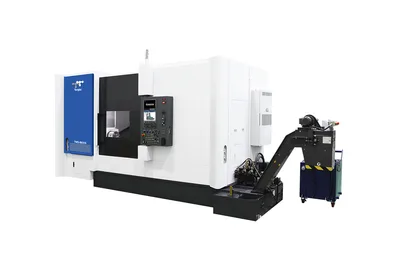
Stama MT 733 Twin
This model was not found in Stama's current lineup when we checked on 2026-10-03 . It may be a superseded or older model; the specifications below are as we last recorded them.
Key Specifications
Tool Capacity
Rapid Traverse
spindle count
chuck diameter
spindle speed turning
b axis swivel
How much does the Stama MT 733 Twin cost?
Estimated price range
Our best estimate for a mill-turn / multi-tasking machine in this class — not a quote from Stama. Configuration moves it a long way.
Overview
The Stama MT 733 Twin is listed as a twin-spindle mill-turn machine: two main spindles with 210 mm (8.3 in) chucks turning at up to 5,500 RPM, worked by two milling spindles of 18 kW (24.1 hp) each that reach 18,000 RPM on HSK-A50. Stama's current lineup does not include this model, and the table is not confirmed by the maker. These are the listed figures.
Turning capacity is 320 mm (12.6 in) in diameter and 500 mm (19.7 in) in length. A bar capacity of 65 mm (2.6 in) is listed as optional, so a given machine may be set up for chuck work only. Check for the bar option if the plan is to run from stock.
The milling spindles swivel on a B axis through ±115°, which reaches both end faces of a part and the angled features between them. Tooling is listed as 24 tools per milling spindle, 48 in total, plus a turret. The table does not say how many stations the turret has or whether they are driven.
Rapids are 40 m/min (1,575 ipm). Unlike the MC 531/Mill-Turn, which is listed with a turning mode capped at 1,200 RPM, the MT 733 turns at up to 5,500 RPM, so it is the choice where turning is the main operation and milling completes the part. No axis travels, torque, weight or accuracy rows are listed, and those gaps need filling from the machine's own documents before a job is planned around it.
Full Specifications
| Parameter | Value |
|---|---|
| Spindle Count | 2 (twin main spindles) |
| Chuck Diameter | 210 mm (8.3 in) |
| Spindle Speed Turning | 5,500 RPM (main spindle) |
| B Axis Swivel | ±115° |
| Milling Spindle Speed Max | 18,000 RPM |
| Milling Spindle Taper | HSK-A50 |
| Milling Spindle Power | 2 x 18 kW (2 x 24.1 hp) |
| Turning Diameter Max | 320 mm (12.6 in) |
| Turning Length Max | 500 mm (19.7 in) |
| Rapid Traverse Rate | 40 m/min (1,575 ipm) |
| Tool Capacity | 2 x 24 (48 total) + turret |
| Bar Capacity | 65 mm (2.6 in) optional |
| CNC Control | Siemens Sinumerik 840D sl |
Specifications compiled from manufacturer literature and industry references. Not independently verified against a published spec sheet — confirm with the manufacturer or an authorised dealer before making a purchasing decision.
Strengths & Limitations
Strengths
- Two main spindles with 210 mm (8.3 in) chucks at up to 5,500 RPM
- Two 18,000 RPM HSK-A50 milling spindles of 18 kW (24.1 hp) each
- B axis swivel of ±115° on the milling spindles
- Turning capacity of 320 mm (12.6 in) diameter by 500 mm (19.7 in) length
- 24 tools per milling spindle, 48 in total, plus a turret
Limitations
- Bar capacity of 65 mm (2.6 in) is an option, not standard
- Rapid traverse is 40 m/min (1,575 ipm), lower than the 60 m/min (2,362 ipm) listed for the MC 531/Mill-Turn
- No axis travels, torque, weight or accuracy figures are listed
- The turret is mentioned without a station count
Best For
Frequently Asked Questions
01
The listed figures give a maximum turning diameter of 320 mm (12.6 in), a maximum turning length of 500 mm (19.7 in) and a chuck diameter of 210 mm (8.3 in). The main spindles turn at up to 5,500 RPM.
02
Only with the option. Bar capacity is listed as 65 mm (2.6 in) and marked optional, so it depends on how the machine was configured. Without it the machine is a chucking machine with 210 mm (8.3 in) chucks.
03
Two milling spindles are listed, each 18 kW (24.1 hp), with a maximum speed of 18,000 RPM and an HSK-A50 taper. They swivel on a B axis through ±115°. No torque figure appears in the table.
04
The tool capacity row reads 2 x 24, 48 in total, plus a turret. The magazines serve the two milling spindles. The table gives no station count for the turret, so that has to be confirmed on the machine.
Videos

The Engineering Technology Group Limited

CNCBUL PERMAN MACHINERY INVESTMENT CONSULTANCY LTD
More from Stama
Other Mill-Turn / Multi-Tasking Machines
Willemin-Macodel 508MT2
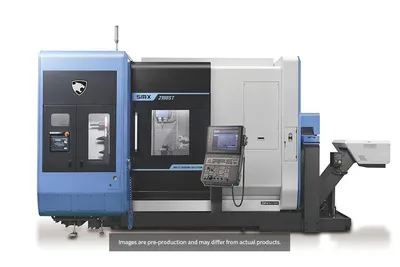
DN Solutions SMX 5100 L
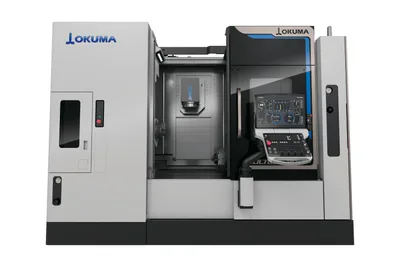
Okuma MULTUS U2000
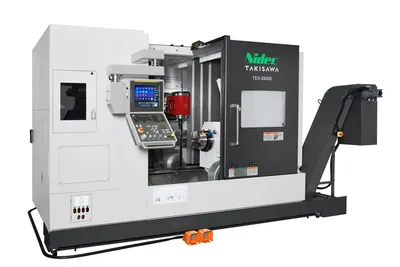
Takisawa TEX-2500S

DN Solutions SMX 3100