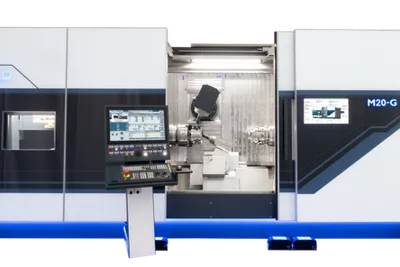
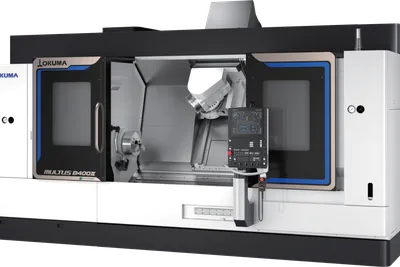
Okuma MULTUS B400II-W
Key Specifications
Tool Capacity
Rapid Traverse
standard chuck size
max machining diameter
max work length
spindle speed
How much does the Okuma MULTUS B400II-W cost?
Estimated price range
Our best estimate for a mill-turn / multi-tasking machine in this class — not a quote from Okuma. Configuration moves it a long way.
Overview
The Okuma MULTUS B400II-W is a long-bed multitasking mill-turn machine in the second-spindle specification, with a 10 in standard chuck, a maximum machining diameter of 710 mm (27.95 in) and work lengths of 1,500 / 2,000 mm (59.06 / 78.74 in). Okuma's table defines the W in the name as the second-spindle specification.
Length is what sets it apart. At 1,500 or 2,000 mm of work length, this is a machine for shafts, rolls, spindles and long hydraulic components, parts that are milled, drilled and turned along their length and then finished on both ends. With a second spindle the part can be gripped at each end in turn, or held at both ends while the middle is machined.
The main spindle runs 38~3,800 min⁻¹ on a 22/15 kW (30/20 hp) motor rated at 50% ED/cont, through a JIS A2-8 nose. Bracketed alternatives are a JIS A2-11 nose and a 30~2,800 min⁻¹ range, which is what to ask about for larger bar or heavier chucks. These speeds are well below the 50~6,000 min⁻¹ of the MULTUS B200II, as expected for a spindle carrying a 10 in chuck and long, heavy work.
Rapids are 40 m/min (1,575 ipm) in X and Z and 26 m/min (1,024 ipm) in Y, and the magazine holds 20 tools. Floor space needs planning: the two listed sizes are 5,750 × 2,693 × 3,000 mm (226.38 × 106.02 × 118.11 in) and 7,050 × 2,693 × 3,137 mm (277.56 × 106.02 × 123.50 in), so the longer machine is also the taller of the two.
Full Specifications
| Parameter | Value |
|---|---|
| Standard Chuck Size | 10 in |
| Max Machining Diameter | 710 mm (27.95 in) |
| Max Work Length | 1,500 / 2,000 mm (59.06 / 78.74 in) |
| Spindle Speed | 38~3,800 min⁻¹ [30~2,800 min⁻¹ optional] |
| Spindle Nose | JIS A2-8 [JIS A2-11] |
| Spindle Motor | 22/15 kW (30/20 hp), 50% ED/cont |
| Rapid Traverse Rate | 40/26 m/min (1,575/1,024 ipm), X,Z/Y |
| Tool Capacity | 20 tools |
| Machine Dimensions | 5,750 × 2,693 × 3,000 mm (226.38 × 106.02 × 118.11 in); 7,050 × 2,693 × 3,137 mm (277.56 × 106.02 × 123.50 in) |
| Spec Extension | W (second-spindle specification) |
Specifications sourced from okuma.co.jp — verified 2026-08-09
Strengths & Limitations
Strengths
- Work lengths of 1,500 / 2,000 mm (59.06 / 78.74 in) for shafts and other long parts
- Second spindle is part of the W specification, so both ends can be machined in one cycle
- 22/15 kW (30/20 hp) main spindle motor, rated 50% ED/cont, on a JIS A2-8 nose with JIS A2-11 as an option
- Maximum machining diameter of 710 mm (27.95 in), the same figure Okuma lists for the MULTUS B400II
- 40 m/min (1,575 ipm) rapids in X and Z shorten the long Z moves a machine of this length makes
Limitations
- The 20-tool magazine is small for long parts that combine turning, milling and drilling
- Top spindle speed is 3,800 min⁻¹, or 2,800 min⁻¹ with the optional range, which limits small-diameter turning
- The footprint reaches 7,050 × 2,693 × 3,137 mm (277.56 × 106.02 × 123.50 in) in the longer version
- No figures for the second spindle, milling spindle or B axis are in the listed rows
Best For
Frequently Asked Questions
01
Okuma's table lists W as the second-spindle specification. The MULTUS B400II-W therefore has a second spindle in addition to the main one, which allows a part to be transferred and finished on its second end without an operator turning it around.
02
Maximum machining diameter is 710 mm (27.95 in) and work length is listed as 1,500 / 2,000 mm (59.06 / 78.74 in), two versions of the machine. The standard chuck is listed at 10 in, and no maximum part weight is given in the listed rows.
03
38~3,800 min⁻¹ as standard with a 22/15 kW (30/20 hp) motor rated 50% ED/cont. A 30~2,800 min⁻¹ range is the listed option. The spindle nose is JIS A2-8, with JIS A2-11 as the bracketed alternative.
04
Okuma lists machine dimensions of 5,750 × 2,693 × 3,000 mm (226.38 × 106.02 × 118.11 in) and 7,050 × 2,693 × 3,137 mm (277.56 × 106.02 × 123.50 in). Width is the same for both. Allow extra room beyond these for chip conveyor discharge, part handling and door access.
05
The MULTUS B400II lists the same 710 mm (27.95 in) maximum turning diameter, the same JIS A2-8 nose with JIS A2-11 as an option, a VAC 22/15 kW (VAC 30/20 hp) spindle motor and 40 m/min rapids in X and Z. The MULTUS B400II-W adds the second spindle.
Videos

Hartwig

Machinery Central

Investment Recovery Services

PrestigeEquipment
Community Discussions
Links to community discussions. Summaries are editorial — visit the original thread for full context.
More from Okuma
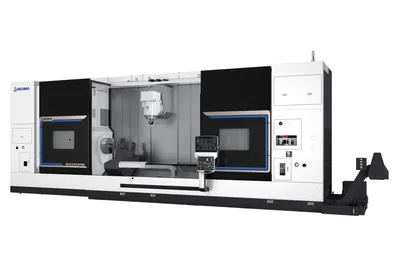
Other Mill-Turn / Multi-Tasking Machines
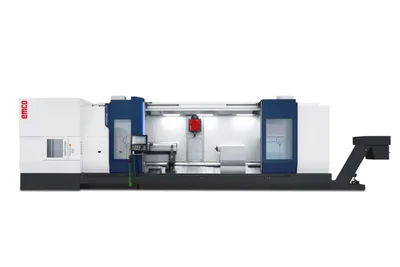
Emco Hyperturn 200 Powermill
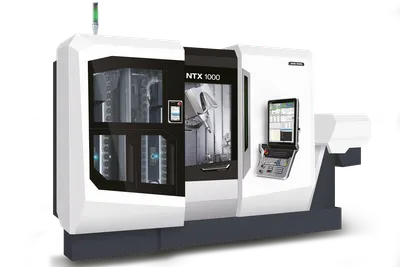
DMG Mori NTX 1000
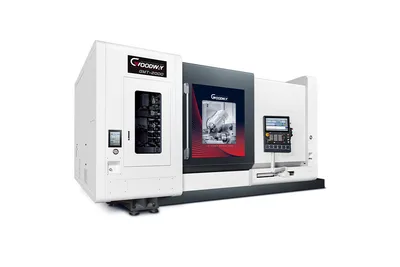
Goodway GMT-2000ST
Mazak INTEGREX i-450 NEO
Mazak INTEGREX e-1060