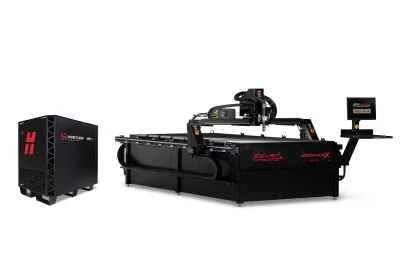
Lincoln Electric QuickTech CNC Plasma
Key Specifications
cutting current
cutting thickness mild steel
cutting thickness stainless
cutting thickness aluminum
plasma gas
shield gas
How much does the Lincoln Electric QuickTech CNC Plasma cost?
Estimated price range
Our best estimate for a cnc plasma cutting in this class — not a quote from Lincoln Electric. Configuration moves it a long way.
Overview
The Lincoln Electric QuickTech CNC Plasma is listed as an air plasma cutting system with up to 85 A of cutting current, rated for 20 mm of mild steel in production cutting and 25 mm at severance. Lincoln Electric's current lineup does not include a model under this name, so the listed figures are best used as a first screen and then checked against the documentation of the actual machine.
Air is listed as both the plasma gas and the shield gas in the standard configuration. That keeps the supply side simple, since clean, dry compressed air is the only gas to arrange, but it also sets the edge quality: no oxygen or nitrogen process appears in the listed figures. Stainless steel and aluminium are each listed at up to 12 mm, a little over half the mild steel production figure, so a shop cutting mostly non-ferrous plate should size its work against 12 mm and not against 20 mm.
The electrical side is flexible. Input is listed as single-phase 220 V or 3-phase 208–480 V, with a draw of roughly 7–12 kVA depending on the power source fitted. The single-phase option matters to small shops without three-phase service, though the upper end of that kVA range on a single-phase line calls for a substantial circuit and is worth confirming with an electrician before the machine arrives.
Cutting speed is listed as up to 8,000 mm/min on thin material and falls with thickness. Kerf is listed at 1.2–2.0 mm depending on material and thickness. That is the number to enter in nesting software for part spacing, and it bounds small internal features, because a slot narrower than the kerf cannot be cut at all. No bed size, weight or positioning data is listed, so those have to come from the machine itself.
Full Specifications
| Parameter | Value |
|---|---|
| Cutting Current | Up to 85 A |
| Cutting Thickness Mild Steel | Up to 20 mm (production); up to 25 mm (severance) |
| Cutting Thickness Stainless | Up to 12 mm |
| Cutting Thickness Aluminum | Up to 12 mm |
| Plasma Gas | Air (standard configuration) |
| Shield Gas | Air |
| Power Supply Voltage | Single-phase 220 V or 3-phase 208–480 V |
| Power Supply Power | ~7–12 kVA (power source dependent) |
| Cutting Speed | Up to 8,000 mm/min (thin material); speed dependent on material and thickness |
| Kerf Width | 1.2–2.0 mm (material and thickness dependent) |
Specifications compiled from manufacturer literature and industry references. Not independently verified against a published spec sheet — confirm with the manufacturer or an authorised dealer before making a purchasing decision.
Strengths & Limitations
Strengths
- Up to 85 A of cutting current, listed for 20 mm mild steel in production and 25 mm at severance
- Runs on air for both plasma and shield gas in the standard configuration, so no bottled gas supply is needed
- Input is listed as single-phase 220 V or 3-phase 208–480 V, which covers shops without three-phase service
- Cutting speed of up to 8,000 mm/min on thin material
Limitations
- Stainless steel and aluminium are each limited to 12 mm in the listed figures
- Air is the only plasma and shield gas listed; there is no oxygen or nitrogen process for finer edges
- Kerf of 1.2–2.0 mm rules out very fine internal features and has to be compensated in nesting
- No bed size, weight or positioning accuracy appears in the listed figures
Best For
Frequently Asked Questions
01
The listed figures give up to 20 mm of mild steel in production cutting and up to 25 mm at severance. Stainless steel and aluminium are each listed at up to 12 mm. A severance cut parts the plate but leaves a rougher edge, so quote work against the production figure.
02
Air. The standard configuration is listed with air as the plasma gas and air as the shield gas, which means a compressor with good filtration and drying is the only gas supply to plan for. No other gas combination appears in the listed figures.
03
Input is listed as single-phase 220 V or 3-phase 208–480 V, and the draw as roughly 7–12 kVA depending on the power source. Confirm which input the actual unit is wired for, and size the breaker and cable for the upper end of that range.
04
Kerf is listed at 1.2–2.0 mm, depending on material and thickness. Set kerf compensation from test cuts on the actual material, and avoid slots or holes close to the kerf width, since the arc removes that much material on every pass.