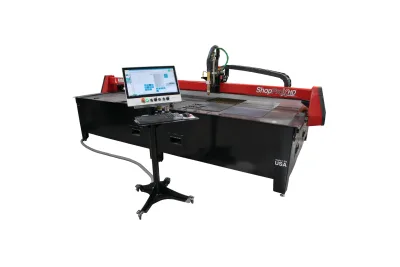
Kjellberg HiFocus 160neo
This model was not found in Kjellberg's current lineup when we checked on 2026-10-03 . It may be a superseded or older model; the specifications below are as we last recorded them.
Key Specifications
cutting current
cutting thickness mild steel
cutting thickness stainless
cutting thickness aluminum
plasma gas
shield gas
How much does the Kjellberg HiFocus 160neo cost?
Estimated price range
Our best estimate for a cnc plasma cutting in this class — not a quote from Kjellberg. Configuration moves it a long way.
Overview
The Kjellberg HiFocus 160neo is a 160 A plasma cutting source whose listed figures separate two thickness limits for each steel: how far production cutting goes and how far precision quality reaches. The model is absent from the maker's current lineup and may be an older one. Nobody has checked this table against a manufacturer page, so what follows are the listed figures and nothing firmer.
For mild steel the production limit is up to 50 mm, with precision quality to ~30 mm. For stainless the pair is up to 40 mm and ~25 mm. Aluminum has one figure, up to 35 mm, and no precision limit of its own. A buyer who needs clean, square edges should size the work against the lower number in each pair, because the higher one is a limit for production cutting where edge finish matters less.
Edge quality is stated in a form that can be compared between sources: a kerf of 1.0–2.5 mm, in ISO 9013 quality range 2–3 on mild steel. Cutting speed is up to 7,000 mm/min on thin material and is marked process-dependent, so expect it to fall as plate gets thicker.
Plasma gas can be oxygen, nitrogen, argon-hydrogen (H35) or air, and the shield gas row adds H2O water injection to air, N2 and O2. The supply is 3-phase at 400 V / 480 V (50/60 Hz), rated ~38 kVA. Control mode is listed as EtherCAT, the link between the source and the cutting machine's CNC.
Full Specifications
| Parameter | Value |
|---|---|
| Cutting Current | 160 A |
| Cutting Thickness Mild Steel | Up to 50 mm (production); precision quality to ~30 mm |
| Cutting Thickness Stainless | Up to 40 mm (production); precision quality to ~25 mm |
| Cutting Thickness Aluminum | Up to 35 mm |
| Plasma Gas | Oxygen (O2), Nitrogen (N2), Argon-Hydrogen (H35), Air |
| Shield Gas | Air, N2, O2, H2O (water injection) |
| Power Supply Voltage | 3-phase, 400 V / 480 V (50/60 Hz) |
| Power Supply Power | ~38 kVA |
| Cutting Speed | Up to 7,000 mm/min (thin material); process-dependent |
| Kerf Width | 1.0–2.5 mm (ISO 9013 quality range 2–3 on mild steel) |
| Control Mode | EtherCAT |
| Power Source | 43 |
Specifications compiled from manufacturer literature and industry references. Not independently verified against a published spec sheet — confirm with the manufacturer or an authorised dealer before making a purchasing decision.
Strengths & Limitations
Strengths
- Precision quality is listed to ~30 mm in mild steel and ~25 mm in stainless, stated separately from the production limits
- Production cutting up to 50 mm in mild steel, 40 mm in stainless and 35 mm in aluminum
- Kerf width of 1.0–2.5 mm in ISO 9013 quality range 2–3 on mild steel
- Shield gas choices include H2O water injection as well as air, N2 and O2
- EtherCAT control mode for the connection to the cutting machine's controller
Limitations
- Precision quality stops at ~30 mm in mild steel and ~25 mm in stainless, well short of the production limits
- The 7,000 mm/min cutting speed applies to thin material only and is process-dependent
- Needs a 3-phase 400 V / 480 V supply rated ~38 kVA, plus a supply for each plasma and shield gas in use
- Aluminum has no precision-quality figure, only the 35 mm limit
Best For
Frequently Asked Questions
01
The listed figures give precision quality to ~30 mm in mild steel and ~25 mm in stainless. Production cutting goes further, up to 50 mm and up to 40 mm respectively. Aluminum is listed at up to 35 mm without a precision figure. All of these are unverified and should be confirmed against the cutting data for the actual unit.
02
The kerf width row gives 1.0–2.5 mm and places the cut in ISO 9013 quality range 2–3 on mild steel. That statement covers mild steel only; no quality range is given for stainless or aluminum. Kerf grows with thickness, so nesting and lead-ins should use the kerf for the plate actually being cut.
03
Plasma gas is listed as oxygen (O2), nitrogen (N2), argon-hydrogen (H35) or air. Shield gas is air, N2, O2 or H2O by water injection. A shop planning to cut mild steel, stainless and aluminum on one source should expect to plumb several of these, and water injection needs a water supply at the torch.
04
It takes a 3-phase supply at 400 V / 480 V, 50/60 Hz, with the power supply listed at ~38 kVA, and the cutting current is 160 A. Control mode is EtherCAT. The table gives no input current, so fuse and cable sizes have to be read from the rating plate of the unit.
More from Kjellberg
Other CNC Plasma Cutting
Lincoln Electric Tomahawk 625
Machitech Silver Cut 5x20
ShopSabre SideKick 10
Arclight Dynamics Arc Pro Ultra V3 4x8