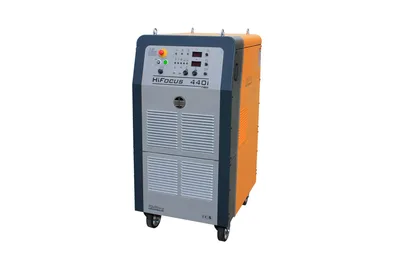
ESAB Plasmarc PT-36
This model was not found in ESAB's current lineup when we checked on 2026-10-03 . It may be a superseded or older model; the specifications below are as we last recorded them.
Key Specifications
system
carbon steel cut chart
carbon steel cut chart imperial
max carbon steel thickness in chart
mark and shield gases
How much does the ESAB Plasmarc PT-36 cost?
Estimated price range
Our best estimate for a cnc plasma cutting in this class — not a quote from ESAB. Configuration moves it a long way.
Overview
The ESAB Plasmarc PT-36 is the torch at the centre of the m3 plasma Generation 2 system, paired with an EPP power supply for precision Plasmarc cutting at up to 360 A. ESAB's current lineup does not show it under this name, so it may be an older model. What the listed figures give is a carbon steel cut chart, not a full machine specification.
The chart shows how current and gas change with thickness. Thin sheet of 1 mm runs at 3,800 mm/min on 30 A with O2-N2/O2. At 6 mm the speed is 2,000 mm/min on 60 A, and 12 mm holds the same 2,000 mm/min by stepping up to 130 A. From 20 mm at 1,900 mm/min (200 A, Air-Air) the speed falls gradually: 25 mm at 1,540 mm/min on 280 A, then 32 mm at 1,400 mm/min on the full 360 A with O2-Air.
The thickest rows deserve a close look. At 38 mm the chart gives 1,500 mm/min on 300 A and at 45 mm it gives 1,000 mm/min on 300 A, but 50 mm drops to 150 mm/min at 200 A with Air-Air. That last row is the maximum carbon steel thickness in the chart, 50 mm (2.0 in), and its speed is a tenth of the 38 mm figure, so treat 50 mm as an occasional cut and 45 mm as the practical ceiling for production.
Plasma marking is also listed, using Ar-Air as mark and shield gases, which lets one torch mark layout lines and cut the part in the same program.
Full Specifications
| Parameter | Value |
|---|---|
| System | m3 plasma Generation 2 with PT-36 torch and EPP power supply, up to 360 A (precision Plasmarc) |
| Carbon Steel Cut Chart | 1 mm at 3,800 mm/min (30 A, O2-N2/O2); 6 mm at 2,000 mm/min (60 A); 12 mm at 2,000 mm/min (130 A); 20 mm at 1,900 mm/min (200 A, Air-Air); 25 mm at 1,540 mm/min (280 A); 32 mm at 1,400 mm/min (360 A, O2-Air); 38 mm at 1,500 mm/min (300 A); 45 mm at 1,000 mm/min (300 A); 50 mm at 150 mm/min (200 A, Air-Air) |
| Carbon Steel Cut Chart Imperial | 0.040 in at 150 ipm (30 A); 0.25 in at 75 ipm (60 A); 0.5 in at 75 ipm (130 A); 0.75 in at 75 ipm (200 A); 1.0 in at 60 ipm (280 A); 1.25 in at 55 ipm (360 A); 1.5 in at 60 ipm (300 A); 1.75 in at 40 ipm (300 A); 2.0 in at 6 ipm (200 A) |
| Max Carbon Steel Thickness in Chart | 50 mm (2.0 in) |
| Mark and Shield Gases | Ar-Air (plasma marking) |
Specifications sourced from static.machinetools.com — verified 2026-09-24
Strengths & Limitations
Strengths
- Up to 360 A for precision Plasmarc cutting with the m3 plasma Generation 2 system and EPP power supply
- Carbon steel cut chart spans 1 mm at 3,800 mm/min to 50 mm (2.0 in)
- Holds 2,000 mm/min at both 6 mm (60 A) and 12 mm (130 A)
- Plasma marking with Ar-Air gases from the same torch
Limitations
- At 50 mm the chart speed is 150 mm/min, against 1,000 mm/min at 45 mm, so the last row is a slow cut
- The listed figures cover carbon steel only; no stainless or aluminum chart is given
- Not shown under this name in ESAB's current lineup
Best For
Frequently Asked Questions
01
The chart gives 1 mm at 3,800 mm/min (30 A), 6 mm at 2,000 mm/min (60 A), 12 mm at 2,000 mm/min (130 A), 20 mm at 1,900 mm/min (200 A), 25 mm at 1,540 mm/min (280 A), 32 mm at 1,400 mm/min (360 A), 38 mm at 1,500 mm/min (300 A), 45 mm at 1,000 mm/min (300 A) and 50 mm at 150 mm/min (200 A).
02
0.040 in at 150 ipm (30 A), 0.25 in at 75 ipm (60 A), 0.5 in at 75 ipm (130 A), 0.75 in at 75 ipm (200 A), 1.0 in at 60 ipm (280 A), 1.25 in at 55 ipm (360 A), 1.5 in at 60 ipm (300 A), 1.75 in at 40 ipm (300 A) and 2.0 in at 6 ipm (200 A).
03
50 mm (2.0 in), cut at 150 mm/min on 200 A with Air-Air gases. The row before it, 45 mm at 1,000 mm/min on 300 A, is far faster, so 50 mm is better treated as an occasional cut than a production thickness.
04
Yes. Plasma marking is listed with Ar-Air as the mark and shield gases. The same torch that cuts the profile can therefore mark part numbers or layout lines first, provided argon is plumbed to the system.
More from ESAB
ESAB Vision T5 CNC Plasma Cutting System
ESAB Plasmarc Precision CNC Plasma System
ESAB Vision 50
ESAB Vision 50 CNC Plasma Cutting System
ESAB Cutmaster 120i
ESAB m3 Plasma
Other CNC Plasma Cutting
STV CNC Optimum 10
Voortman V330
Kinetic K4000