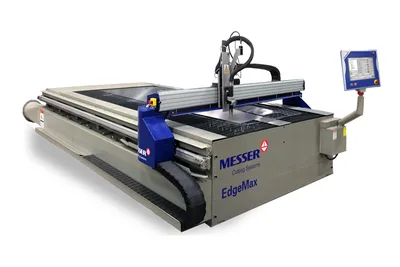
ESAB Plasmarc Precision CNC Plasma System
This model was not found in ESAB's current lineup when we checked on 2026-10-03 . It may be a superseded or older model; the specifications below are as we last recorded them.
Key Specifications
Table Size
cutting area
plasma power source
max cutting thickness
positioning speed
cutting speed
How much does the ESAB Plasmarc Precision CNC Plasma System cost?
Estimated price range
Our best estimate for a cnc plasma cutting in this class — not a quote from ESAB. Configuration moves it a long way.
Overview
The ESAB Plasmarc Precision CNC Plasma System is a table-and-gantry plasma machine with a 200–400A precision HD power source and cutting areas from 5 x 10 ft to 8 x 20 ft, depending on configuration. It is not in ESAB's current lineup and may be an older model. The table comes from a third-party listing, so the listed figures are unconfirmed.
On carbon steel the quality-cut limit is up to 1.5 in (38 mm), with severance to 2.5 in (64 mm). Positioning speed is up to 600 ipm (15,240 mm/min) and cutting speed runs from 20–500 ipm depending on material and thickness. The top of the cutting range is close to the positioning speed, so on thin sheet the machine spends little time waiting on rapids.
Standard beds are 5x10 ft and 6x12 ft, with larger configurations available, and the machine weighs approx. 4,000–7,000 lb (1,815–3,175 kg) depending on bed size. Add the heaviest plate you intend to load when checking the floor. Control is the ESAB Vision T5 CNC with precision plasma process tables, and the supply is three-phase.
Full Specifications
| Parameter | Value |
|---|---|
| Cutting Area | 5 x 10 ft to 8 x 20 ft (configuration-dependent) |
| Plasma Power Source | ESAB Plasmarc precision HD power source (200–400A, proprietary gas control) |
| Max Cutting Thickness | Up to 1.5 in (38 mm) quality cut; 2.5 in (64 mm) severance on carbon steel |
| Positioning Speed | Up to 600 ipm (15,240 mm/min) |
| Cutting Speed | 20–500 ipm depending on material and thickness |
| Control System | ESAB Vision T5 CNC with True-Hole, precision plasma process tables |
| Table Size | Standard 5x10 ft and 6x12 ft; larger configurations available |
| Machine Weight | Approx. 4,000–7,000 lb (1,815–3,175 kg) depending on bed size |
| Phase Type | Three-phase |
Specifications compiled from manufacturer literature and industry references. Not independently verified against a published spec sheet — confirm with the manufacturer or an authorised dealer before making a purchasing decision.
Strengths & Limitations
Strengths
- Precision HD power source of 200–400A with proprietary gas control
- Quality cuts up to 1.5 in (38 mm) on carbon steel, severance to 2.5 in (64 mm)
- Positioning speed up to 600 ipm (15,240 mm/min)
- Cutting areas from 5 x 10 ft to 8 x 20 ft
Limitations
- Quality cutting stops at 1.5 in (38 mm); thicker carbon steel up to 2.5 in (64 mm) is severance only
- Capacity is stated for carbon steel only, with no stainless or aluminum figure
- No positioning accuracy or kerf figure is listed, and the table is from a third-party listing
Best For
Frequently Asked Questions
01
Standard table sizes are 5x10 ft and 6x12 ft, with larger configurations available. The cutting area row gives a range of 5 x 10 ft to 8 x 20 ft depending on configuration. Machine weight is approx. 4,000–7,000 lb (1,815–3,175 kg) depending on bed size.
02
On carbon steel, up to 1.5 in (38 mm) for a quality cut and 2.5 in (64 mm) for severance, from a 200–400A power source. No thickness is listed for stainless or aluminum, so ask for cut charts for those metals.
03
Positioning speed is up to 600 ipm (15,240 mm/min). Cutting speed is 20–500 ipm depending on material and thickness, the low end applying to thick plate and the high end to thin sheet.
More from ESAB
ESAB Vision 50
ESAB Vision 50 CNC Plasma Cutting System
ESAB Cutmaster 120i
ESAB m3 Plasma
ESAB Plasmarc PT-36
ESAB Vision T5 CNC Plasma Cutting System
Other CNC Plasma Cutting
Voortman V304
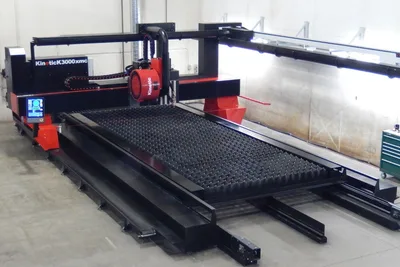
Kinetic K3000
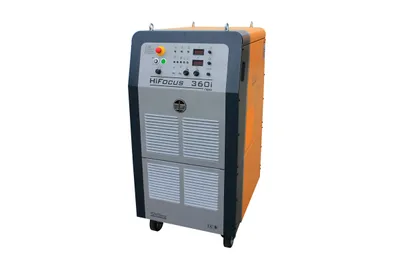
Kjellberg HiFocus 360i neo
Peddinghaus FPB 1500/1