ESAB Cutmaster 120i
This model was not found in ESAB's current lineup when we checked on 2026-10-03 . It may be a superseded or older model; the specifications below are as we last recorded them.
Key Specifications
Weight
output current
input voltage
output power
cut capacity mild steel
cut capacity stainless
How much does the ESAB Cutmaster 120i cost?
Estimated price range
Our best estimate for a cnc plasma cutting in this class — not a quote from ESAB. Configuration moves it a long way.
Overview
The ESAB Cutmaster 120i is a 120 A plasma power source in a 20 kg (44 lb) package, with 12 kW of output and a recommended mild steel capacity of 50 mm (2 in). ESAB's current lineup does not show this model, so it may be an older unit, and the listed figures have not been checked against a maker's document.
Capacity depends on the metal. The listed figures give 50 mm (2 in) recommended and 63 mm (2.5 in) severance on mild steel, 38 mm (1.5 in) recommended on stainless and 32 mm (1.25 in) recommended on aluminum. Duty cycle is 60% at 120A and 100% at 80A. For hand cutting that is rarely a limit. On a CNC table running long nests it is: a job that needs continuous arc time has to be planned at 80A, with the thinner capacity that implies, or accept pauses at full current.
The unit takes a hand torch or a machine torch, and an arc voltage output is listed for CNC torch height control, so a table's height control can read arc voltage from the unit. Gas is air, nitrogen or oxygen depending on the application, handled by IFC (Intelligent Flow Control) automatic gas management.
Input is 208-480 VAC 3-phase (50/60 Hz), auto-sensing, so the unit adapts to whichever supply in that range it is connected to. There is no single-phase input in the listed figures. Certifications are CE, CSA and UL.
Full Specifications
| Parameter | Value |
|---|---|
| Output Current | 120 A maximum |
| Input Voltage | 208-480 VAC 3-phase (50/60 Hz), auto-sensing |
| Output Power | 12 kW |
| Cut Capacity Mild Steel | 50 mm (2 in) recommended; 63 mm (2.5 in) severance |
| Cut Capacity Stainless | 38 mm (1.5 in) recommended |
| Cut Capacity Aluminum | 32 mm (1.25 in) recommended |
| Torch Types | Hand torch, machine torch (mechanized/CNC compatible) |
| Gas Types | Air, nitrogen, oxygen (application dependent) |
| Smart Gas Control | IFC (Intelligent Flow Control) automatic gas management |
| Duty Cycle | 60% at 120A; 100% at 80A |
| Arc Voltage Output | Yes (for CNC torch height control) |
| Machine Weight | 20 kg (44 lb) |
| Certifications | CE, CSA, UL |
| Electrical | 208-480 VAC 3-phase (auto-sensing) |
Specifications compiled from manufacturer literature and industry references. Not independently verified against a published spec sheet — confirm with the manufacturer or an authorised dealer before making a purchasing decision.
Strengths & Limitations
Strengths
- 120 A maximum output and 12 kW in a unit weighing 20 kg (44 lb), light enough to move between a table and a hand-cutting bay
- Recommended capacity of 50 mm (2 in) on mild steel, with 63 mm (2.5 in) severance
- Auto-sensing 208-480 VAC 3-phase input at 50/60 Hz
- Arc voltage output is listed for CNC torch height control, and both hand and machine torches are supported
- 100% duty cycle at 80A for continuous mechanised cutting
Limitations
- Duty cycle at the full 120A is 60%, so long CNC nests at maximum current need rest time or a lower current
- Recommended capacity drops to 38 mm (1.5 in) on stainless and 32 mm (1.25 in) on aluminum
- Three-phase input only in the listed figures; no single-phase supply option appears
- Not in ESAB's current lineup, and the listed figures are unconfirmed
Best For
Frequently Asked Questions
01
The listed figures give 50 mm (2 in) recommended on mild steel with 63 mm (2.5 in) severance, 38 mm (1.5 in) recommended on stainless and 32 mm (1.25 in) recommended on aluminum. Recommended capacity is the thickness for routine work; severance only parts the plate.
02
Yes, on the listed figures. A machine torch is one of the two torch types, described as mechanized/CNC compatible, and an arc voltage output is listed for CNC torch height control. Check the interface cable and the torch lead length for the table in question.
03
60% at 120A and 100% at 80A. At full current the unit is meant to rest for part of each cycle, which matters on long mechanised cuts. At 80A it can run continuously.
04
208-480 VAC 3-phase at 50/60 Hz, auto-sensing. Output power is listed as 12 kW. The listed figures do not give input current, so size the breaker and cable from the data plate of the unit.
05
Air, nitrogen or oxygen, depending on the application. Gas is handled by IFC (Intelligent Flow Control), described as automatic gas management. The listed figures do not give flow or pressure requirements.
Videos

ESAB

ESAB
More from ESAB
ESAB m3 Plasma
ESAB Plasmarc PT-36
ESAB Vision T5 CNC Plasma Cutting System
ESAB Plasmarc Precision CNC Plasma System
ESAB Vision 50
ESAB Vision 50 CNC Plasma Cutting System
Other CNC Plasma Cutting
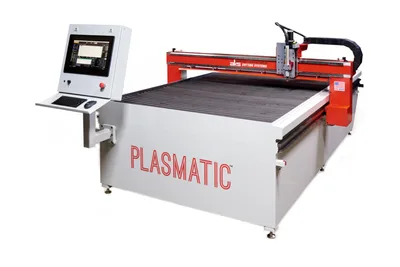
AKS Cutting Systems PLASMATIC
Hypertherm XPR170
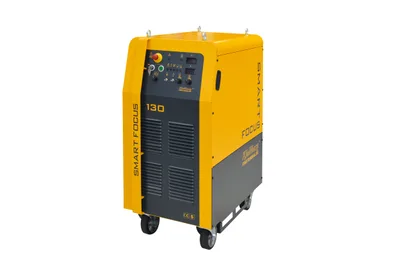
Kjellberg Smart Focus 130
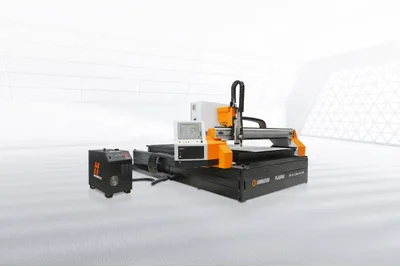
Ermak Smart Plasma 1530 Compact
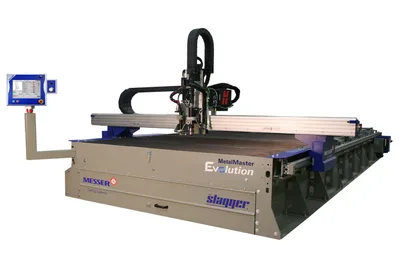
Messer Cutting Systems Metal Master