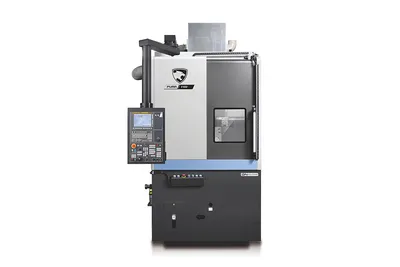
Tsugami M06SJ-II
Key Specifications
Max Spindle
Rapid Traverse
Spindle Power
Max Turn Length
max turning diameter
bar capacity
How much does the Tsugami M06SJ-II cost?
Estimated price range
Our best estimate for a cnc lathes / turning center in this class — not a quote from Tsugami. Configuration moves it a long way.
Overview
The Tsugami M06SJ-II pairs a 6 in main spindle with a 6 in sub-spindle, so a part taken from 51 mm (2.01 in) bar can be finished on both ends in one cycle. Its published envelope is 260 mm (10.2 in) in diameter by 380 mm (15.0 in) in length, with 12 turret stations.
The J in the name can mislead. On the M06J-II it marks the compact machine, with 8 stations, 290 mm (11.4 in) of turning length and a 5.5/7.5 kW spindle. The table for the M06SJ-II shows none of that: it has 12 stations, 380 mm of length and a 7.5/11 kW main spindle, and at 5,270 kg (11,618 lb) it is far heavier than the 3,300 kg (7,275 lb) M06J-II. Buyers expecting a compact twin-spindle machine should look at the figures rather than the suffix.
Power is split between the two ends. The main spindle has 7.5/11 kW for the bar-side roughing, the sub-spindle 5.5/7.5 kW for the second side, and both run to 4,500 rpm (rated 4,000 rpm). The sub-spindle's A axis is listed at 30 m/min, faster than the 24 m/min X and 27 m/min Z rapids, which keeps transfer and retract moves short.
Plan the floor around 2,474 × 2,050 × 1,750 mm (97.4 × 80.7 × 68.9 in). Compared with the M06D-II, which weighs 4,700 kg (10,362 lb) with the same turret and envelope but a single spindle, the M06SJ-II costs floor capacity and buys back an operator step on every part. Its table lists no Y axis and no driven-tool rating.
Full Specifications
| Parameter | Value |
|---|---|
| Max Turning Diameter | 260 mm (10.2 in) |
| Bar Capacity | 51 mm (2.01 in) |
| Max Turning Length | 380 mm (15.0 in) |
| Chuck Size | 6 in |
| Sub Spindle Chuck Size | 6 in |
| Max Spindle Speed | 4,500 rpm (rated 4,000 rpm) |
| Sub Spindle Speed | 4,500 rpm (rated 4,000 rpm) |
| Turret Stations | 12 |
| Rapid Traverse Rate | 24 m/min (X), 27 m/min (Z), 30 m/min (A) |
| Spindle Motor Power | 7.5/11 kW |
| Sub Spindle Power | 5.5/7.5 kW |
| Floor Space Required | 2,474 × 2,050 × 1,750 mm (97.4 × 80.7 × 68.9 in) |
| Machine Weight | 5,270 kg (11,618 lb) |
Specifications sourced from tsugami.co.jp — verified 2026-10-03
Strengths & Limitations
Strengths
- Second 6 in chuck spindle at 4,500 rpm (rated 4,000 rpm) removes the re-chucking step
- Main spindle 7.5/11 kW, sub-spindle 5.5/7.5 kW: power where the bar-side roughing happens
- A axis listed at 30 m/min for transfer moves
- 12 stations and 380 mm (15.0 in) of turning length, against 8 stations and 290 mm (11.4 in) on the M06J-II
Limitations
- At 5,270 kg (11,618 lb) it is far heavier than the single-spindle M06D-II at 4,700 kg (10,362 lb)
- Twelve stations have to hold the tools for both ends of the part
- Sub chuck is 6 in, which limits the diameter the second side can be gripped on
- No Y axis or driven-tool figures in the table
Best For
Frequently Asked Questions
01
No. The M06J-II has 8 stations, 290 mm (11.4 in) of turning length, a 5.5/7.5 kW spindle and weighs 3,300 kg (7,275 lb). The M06SJ-II table lists 12 stations, 380 mm (15.0 in), a 7.5/11 kW main spindle plus a sub-spindle, and 5,270 kg (11,618 lb).
02
Main spindle 7.5/11 kW, sub-spindle 5.5/7.5 kW. Both reach 4,500 rpm with a rated speed of 4,000 rpm, and both carry a 6 in chuck. The sub-spindle moves on an A axis listed at 30 m/min.
03
The M06D-II has the same 12-station turret, 51 mm (2.01 in) bar and 380 mm (15.0 in) length but one spindle, so the second side of a part needs a second chucking. The M06SJ-II does that side in the same cycle and weighs 5,270 kg (11,618 lb), against 4,700 kg (10,362 lb) for the M06D-II.
04
Floor space of 2,474 × 2,050 × 1,750 mm (97.4 × 80.7 × 68.9 in) and a floor that carries 5,270 kg (11,618 lb). Check also that every part's second-side grip diameter suits the 6 in sub chuck, and that the tool list for both ends fits 12 stations.
More from Tsugami
Other CNC Lathes / Turning Centers
Okuma LU35II
Accuway UT-600LX2
Johnford ST-70BX
Hardinge Talent 6/51
Accuway UV-55EC