Industrial CNC Machine Directory

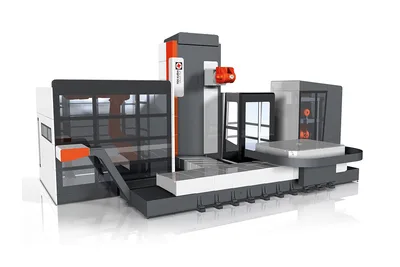
TOS Varnsdorf WRDQ 130

$1,200,000 - $2,500,000 Updated 2026-03-17
01

Key Specifications

X Travel

4,000 mm (157.5 in) standard (extendable)

Y Travel

2,500 mm (98.4 in)

Z Travel

1,200 mm (47.2 in)

Spindle Taper

ISO 50 / SK50

Rapid Traverse

5 m/min X, Y, Z

Spindle Power

45 kW (60.3 hp)

02

Overview

The TOS Varnsdorf WRDQ 130 is a CNC floor-type horizontal boring and milling center with a 130 mm (5.12 in) diameter boring spindle, produced by the Czech Republic's TOS Varnsdorf — a manufacturer with over 120 years of experience building heavy boring equipment for industrial markets worldwide. The 'Q' suffix in the WRDQ designation distinguishes this machine as a floor-type configuration with a traveling column on floor-mounted guideways — as opposed to the table-type WRD series where the workpiece table travels. This floor-type architecture enables the WRDQ 130 to machine very large, heavy workpieces that cannot be mounted on a rotary table — frame weldments, large valve bodies, turbine casings, and heavy machine tool beds.

In the WRDQ 130, the work column travels along precision-ground floor rails in the X-axis while the spindle head traverses vertically in Y and the cross-slide moves in Z. A CNC W-axis quill with 630 mm of stroke provides axial boring reach beyond the column face without Z repositioning. The column also provides B-axis rotation — the entire column face rotates on its base to reposition the spindle relative to the stationary workpiece for multi-face machining. This floor-type multi-face capability is the defining advantage of the WRDQ configuration: the workpiece sits fixed on the floor (or on a stationary table/floor plate), and the machine moves around it.

The WRDQ 130 is powered by a 45 kW (60.3 hp) main drive with spindle speeds from 5 to 2,500 RPM. Standard tooling is ISO 50 / SK50, with modular facing slide and boring bar systems from Sandvik, Walter, or Boring Bars International compatible. The machine integrates Siemens Sinumerik 840D sl as standard control — with Fanuc 30i-B as an alternative — providing 5-axis interpolation capability when combined with an optional angular milling head for full 5-side machining of complex workpieces.

The WRDQ 130 serves the energy, shipbuilding, heavy industrial equipment, and large-part aerospace sectors. Workpieces routinely exceed 30,000–50,000 kg and 4 meters in dimension — well beyond the capability of any table-type boring machine. TOS Varnsdorf supplies the WRDQ 130 to customers in over 40 countries, with reference installations in European heavy industry, Indian infrastructure manufacturing, Chinese energy equipment production, and North American heavy fabrication.

03

Full Specifications

Parameter Value
Spindle Diameter 130 mm (5.12 in)
Spindle Speed Range 5 - 2,500 RPM
Spindle Motor Power 45 kW (60.3 hp)
Spindle Taper ISO 50 / SK50
X-Axis Travel 4,000 mm (157.5 in) standard (extendable)
Y-Axis Travel 2,500 mm (98.4 in)
Z-Axis Travel 1,200 mm (47.2 in)
Quill Stroke W 630 mm (24.8 in)
B Axis Rotation 360° (column face rotation for multi-face machining)
B Axis Resolution 0.001 degrees
Floor Plate Area Unlimited (workpiece sits on floor plate or foundation)
Positioning Accuracy ±0.010 mm
Repeatability ±0.005 mm
Rapid Traverse Rate 5 m/min X, Y, Z
CNC Control Siemens Sinumerik 840D sl (Fanuc 30i-B optional)
Tos 会社概要審議会だより公益財団法人TOSみどり森・守財団個人情報保護方針社内見学
Pr 受験・テスト対策に「結果を出す!」個別指導塾WAM
Modelwrd 130brandtos Varnsdorftypehorizontal Floor Type Boring Millscontact Sales Rep Contact Sales Rep.
Modelwrd 130brandtos Varnsdorftypehorizontal Floor Type Boring Mills Contact Sales Rep.
Model WRD 130
Brand TOS VARNSDORF
Type Horizontal Floor Type Boring Mills
Spindle Size51181x Horiz Tvl Of Col3937y Vert Tvl Of Head11811 Power49.6 hpWeight70000 KGS
Spindle Size 5.1181"
X Horiz Tvl Of Col 393.7"
Y Vert Tvl Of Head 118.11"
Power496 Hp Weight70000 KGS
Power 49.6 hp
Machine Weight 70000 KGS
Looking To Purchase A New Tos Varnsdorf Wrd 130 Contact Sales Rep.
Canamera Machine Tools Inc204 1440 52 Street Necalgary Alberta T2a4tbcanada Danha's International Technology Ltd.1706 Hampton DriveCoquitlam, British Columbia V3E 3C9Canada
Benson Machines Pty Ltd348 Chisholm Roadauburn New South Wales 2144australia P & L Machine Tools Pty. Ltd.32 Culverlands StreetHeidelberg West, Victoria 3081Australia

Specifications sourced from machinetools.com — verified 2026-03-28

04

Strengths & Limitations

Strengths

  • Floor-type configuration enables machining of workpieces of unlimited weight — turbine housings, ship engine frames, large press beds, and machine tool castings that no table-type boring machine can accommodate
  • 130 mm spindle and 45 kW drive deliver the rigidity and power needed for heavy boring and facing cycles on hard-to-machine large-section steels, stainless, and high-alloy castings
  • Column B-axis rotation enables multi-face machining of very large stationary workpieces without craning and repositioning — a critical productivity and accuracy advantage on 20,000+ kg parts
  • 630 mm W-axis quill stroke reaches deep internal features without full column repositioning, covering typical boring requirements for deep housings, frames, and valve bodies
  • TOS Varnsdorf's 120+ year floor-type boring machine heritage means deep application knowledge and a proven spare parts infrastructure for machines that must run for 20–40 years

Limitations

  • Very high capital cost — $1.2M to $2.5M depending on travel configuration — requires large, long-duration production programs or diverse heavy part machining demand to justify
  • Floor installation requires precision-leveled foundation rails extending the full X-axis travel — installation is a significant civil engineering project with 3–6 month lead time before machine commissioning
  • Positioning accuracy (±0.010 mm) is adequate for heavy boring work but lower than table-type boring mills or precision HMCs — for tolerance-critical aerospace parts, a table-type machine or dedicated jig bore may be preferred
05

Best For

Energy and power generation equipment manufacturers machining very large turbine casings, compressor housings, generator frames, and valve bodies that exceed the capacity of any table-type boring machine Shipbuilding and marine engineering shops machining large diesel engine blocks, stern tube housings, propeller shaft brackets, and structural weldments too heavy for rotary table mounting Heavy industrial equipment manufacturers producing large press frames, rolling mill housings, cement mill bodies, and mining equipment components where floor-type boring is the only viable machining approach Large-part aerospace and defense fabricators machining fuselage frames, large structural test fixtures, and heavy mechanism housings that require precision boring across multiple faces
06

Frequently Asked Questions

01 What is the main advantage of a floor-type boring mill over a table-type machine?

A table-type boring mill (like the TOS WRD series) mounts the workpiece on a CNC rotary table that moves in X — this limits maximum workpiece weight to the table's load rating, typically 6,000–15,000 kg. A floor-type boring mill (like the WRDQ 130) places the workpiece on a stationary floor plate or foundation bolster, with the machine column traveling on floor-mounted guideways. The workpiece weight is borne directly by the foundation, not the machine — enabling machining of components weighing 50,000 kg or more. For very large castings and weldments, floor-type is the only viable configuration.

02 How does the B-axis column rotation work on the WRDQ 130?

The entire column — spindle head, quill, and all vertical components — rotates on the column base through 360° in 0.001-degree increments. To machine a different face of a large stationary workpiece, the operator programs a B-axis rotation move; the column face swings to the new angular position and locks precisely. This allows boring and milling operations on all faces of a large frame or housing without craning the part — the machine moves, the part stays fixed. B-axis rotation can also interpolate with linear axes for angled feature machining.

03 Can the WRDQ 130 travel range be extended beyond the standard 4,000 mm?

Yes. TOS Varnsdorf supplies the WRDQ 130 with floor rail configurations from 4,000 mm up to 20,000 mm or more in X-axis travel, depending on customer workpiece requirements. Extended X-axis travel requires additional floor rail sections poured into the foundation during installation. Very long rail configurations require precision laser alignment during commissioning. Extended-travel machines are custom-engineered and priced accordingly — Eurozone shipbuilding and power generation customers commonly order 8,000–12,000 mm X-axis configurations.

04 What workpiece clamping and support options are used with the WRDQ 130?

Large workpieces for the WRDQ 130 are typically clamped to T-slot floor plates, adjustable jacking screws, or custom fabricated bolster plates that are anchored to the machine foundation. Crane access is required for loading and unloading workpieces — the WRDQ 130 installation always includes overhead crane coverage for the full machine X-axis travel. For precision workpieces, precision 3-point jack supports are used to ensure the part is accurately leveled and fixtured before boring cycles begin.

05 How does the WRDQ 130 compare to equivalent Fermat and SNK floor-type boring mills?

The Fermat WFB series (Czech Republic) and SNK America RB series (Japanese) are the WRDQ 130's closest competitors. All three are well-regarded floor-type boring mills with comparable 130–140 mm spindle diameters and similar power levels. TOS Varnsdorf differentiates on price competitiveness, European delivery and service infrastructure, and over 120 years of boring machine application experience in Central European heavy industry. SNK has a stronger North American service footprint; Fermat and TOS Varnsdorf are stronger in Europe and emerging markets.

07

Community Discussions

08

Related Machines