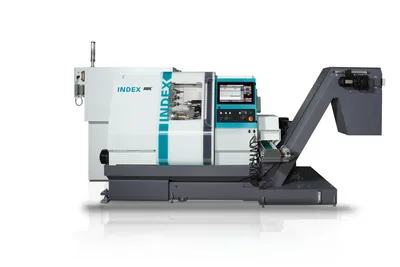
Schütte SC 32 CNC
This model was not found in Schütte's current lineup when we checked on 2026-10-03 . It may be a superseded or older model; the specifications below are as we last recorded them.
Key Specifications
Max Spindle
Accuracy
number of spindles
max bar diameter
spindle speed independent
cross slide stroke
How much does the Schütte SC 32 CNC cost?
Estimated price range
Our best estimate for a multi-spindle automatic in this class — not a quote from Schütte. Configuration moves it a long way.
Overview
The Schütte SC 32 CNC is listed as a six-spindle automatic for bar up to 32 mm (1.26 in), with each spindle independently programmable up to 6,000 RPM. Schütte's current lineup does not include it, so it is possibly an older model, and the listed figures should be confirmed on any machine under consideration.
The table describes how the machine earns its output. The drum is fixed and all 6 stations are machined simultaneously, so the cycle time equals the time of the single longest station. Balancing the work across stations is therefore the main programming task: dividing a long drilling or turning cut between two stations shortens every part. Because each spindle's speed is programmable on its own, a station that threads or reams does not force the others to slow down.
Each station has CNC driven rotary tools, and the tooling is listed as 12 cross-slide tools plus 6 longitudinal tool posts. Strokes are 60 mm (2.4 in) on the cross slides and 120 mm (4.7 in) longitudinally. An independent back-working spindle is optional; without it the cut-off face is left as parted.
Positioning accuracy is listed at ±0.005 mm. The machine weighs 18,000 kg (39,683 lb), runs on 400 VAC 3-phase 50 Hz and has a pneumatic or hydraulic bar feed interface, so the bar feeder is a separate item to check. The control is a Schütte CNC, described as proprietary.
Full Specifications
| Parameter | Value |
|---|---|
| Number of Spindles | 6 |
| Max Bar Diameter | 32 mm (1.26 in) |
| Max Spindle Speed | 6,000 RPM per spindle |
| Spindle Speed Independent | Yes (each spindle independently programmable) |
| Cross Slide Stroke | 60 mm (2.4 in) |
| Longitudinal Stroke | 120 mm (4.7 in) |
| Spindle Center Distance | Fixed drum; all 6 stations machined simultaneously |
| Tool Stations | 12 cross-slide tools + 6 longitudinal tool posts per cycle position |
| Live Tooling | Yes (CNC driven rotary tools at each station) |
| Back Working | Yes (independent back-working spindle optional) |
| Cycle Time | Equals single longest station time (parallel machining) |
| Positioning Accuracy | ±0.005 mm |
| Machine Weight | 18,000 kg (39,683 lb) |
| CNC Control | Schütte CNC (proprietary, based on Siemens hardware) |
| Bar Feed | Pneumatic or hydraulic bar feed interface |
| Electrical | 400 VAC 3-phase 50 Hz |
Specifications compiled from manufacturer literature and industry references. Not independently verified against a published spec sheet — confirm with the manufacturer or an authorised dealer before making a purchasing decision.
Strengths & Limitations
Strengths
- 32 mm (1.26 in) bar capacity with six independently programmable spindles up to 6,000 RPM
- CNC driven rotary tools are listed at each station
- 120 mm (4.7 in) longitudinal stroke and 60 mm (2.4 in) cross slide stroke
- Cycle time equals the longest single station, since all 6 stations cut simultaneously
- Positioning accuracy listed at ±0.005 mm
Limitations
- The independent back-working spindle is optional, not part of every machine
- Spindle speed tops out at 6,000 RPM per spindle, which limits cutting speed on small diameters
- An 18,000 kg (39,683 lb) machine weight requires a suitable foundation and heavy rigging
- The bar feed row lists only a pneumatic or hydraulic interface, so the feeder itself has to be confirmed
Best For
Frequently Asked Questions
01
The listed figures state that cycle time equals the single longest station time, because all 6 stations are machined simultaneously on a fixed drum. Shortening the slowest station therefore shortens the cycle for every part.
02
The table lists a pneumatic or hydraulic bar feed interface, not a specific bar feeder. Maximum bar diameter is 32 mm (1.26 in). Confirm which feeder, if any, comes with a particular machine and what bar length it accepts, since the table gives no bar length.
03
Yes. Each spindle is listed as independently programmable, up to 6,000 RPM per spindle. That lets one station run slowly for threading or reaming while the others run at turning speed.
04
An independent back-working spindle is listed as optional. Live tooling is separate from that: CNC driven rotary tools are listed at each station. Check the build of the individual machine if the part needs work on the cut-off side.
05
Machine weight is listed at 18,000 kg (39,683 lb) and the electrical supply at 400 VAC 3-phase 50 Hz. The table gives no footprint or connected power, so those figures have to come from the machine's documentation.
Community Discussions
Links to community discussions. Summaries are editorial — visit the original thread for full context.
More from Schütte
Other Multi-Spindle Automatics