Industrial CNC Machine Directory

Okuma LB4000 EX III

$165,000 - $260,000 Updated 2026-03-13
01

Key Specifications

Max Spindle

3,500 RPM

Rapid Traverse

20 m/min X, 24 m/min Z

Spindle Power

30/22 kW (40/30 hp)

Max Turn Length

750

Accuracy

±0.005 mm

Repeatability

±0.003 mm

02

Overview

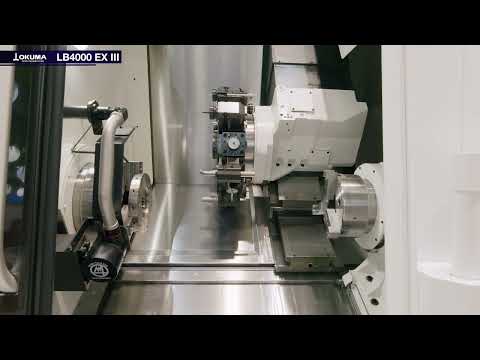
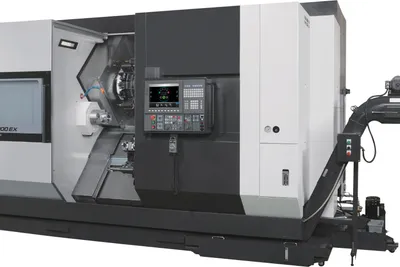
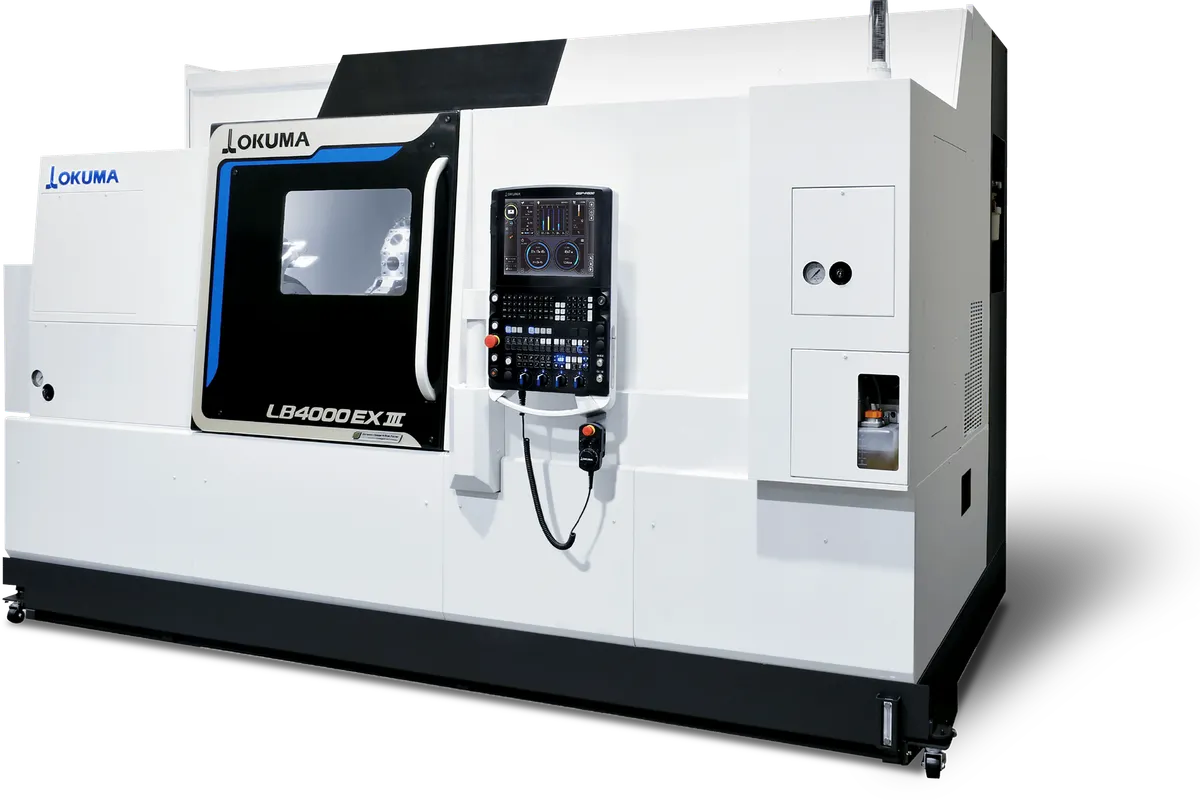
The Okuma LB4000 EX III is Okuma's large-capacity horizontal turning center, built for shops that routinely turn parts in the 400-500 mm diameter range. As the third generation of the LB4000 EX platform, it brings the same EX III refinements—upgraded spindle bearings, improved thermal compensation, and enhanced control software—to a larger frame designed for heavy-duty production.

Max turning diameter is 500 mm (19.7 in) with a generous swing over bed of 710 mm (28 in). Standard turning length is 500 mm (19.7 in), with 1,000 mm (39.4 in), 1,500 mm (59.1 in), and 2,000 mm (78.7 in) bed options for long shaft work. The main spindle delivers 30/22 kW (40/30 hp) at up to 3,500 RPM through an A2-11 spindle nose. The 12-inch or 15-inch hydraulic chuck handles workpieces that smaller Okuma lathes can't accommodate. Bar capacity is 104 mm (4.1 in) on the standard bore.

The LB4000 EX III uses heavy-duty box way construction on both axes. At approximately 7,500 kg (16,535 lb) on the standard bed, this machine has the mass to absorb vibration from aggressive roughing passes in steel, cast iron, and stainless. The 12-station turret with BMT mounting supports driven tools at up to 4,000 RPM on M/MY variants. Rapid traverse rates are 20 m/min on X and 24 m/min on Z.

Okuma's OSP-P300L control integrates Thermo-Friendly Concept, Collision Avoidance System III, and Machining Navi. The Thermo-Friendly system is especially valuable on a machine this size, where thermal growth from the spindle and bed can cause significant dimensional drift over multi-hour runs.

The LB4000 EX III competes with the Mazak Quick Turn 450, DMG Mori NLX 3000, Doosan Puma 4100, and Haas ST-40 in the large turning center segment. It's the go-to choice for shops running Okuma lathes that need to step up to 12-inch or 15-inch chuck capability while staying on the same OSP control platform. Specs sourced from Okuma published data.

03

Full Specifications

Parameter Value
Max Turning Diameter 480
Max Turning Length 750
Swing Over Bed 710 mm (28 in)
Max Spindle Speed 3,500 RPM
Spindle Motor Power 30/22 kW (40/30 hp)
Spindle Nose A2-11
Chuck Size 12 in (305 mm) / 15 in (381 mm)
Bar Capacity 104 mm (4.1 in)
Turret Stations 12 (BMT mounting)
X Axis Travel 280 mm (11 in)
Z Axis Travel 580 mm (22.8 in)
Rapid Traverse Rate 20 m/min X, 24 m/min Z
Positioning Accuracy ±0.005 mm
Repeatability ±0.003 mm
Machine Weight 7,500 kg (16,535 lb)
CNC Control Okuma OSP-P300L
Speed Range 42~4,200 [30~3,000, 12~1,400]
Rapid Traverse X Z 30/30
Standard Power 30/22 [37/30]
Okuma Global Repair Center Charlotte, North Carolina
Inches Metric
Spindle Nose Type JIS A2-8 [JIS A2-11, JIS A2-15]

Specifications sourced from okuma.com — verified 2026-03-28

04

Strengths & Limitations

Strengths

  • 500 mm turning diameter and 710 mm swing handle large workpieces that mid-size lathes can't touch
  • 30 kW (40 hp) spindle delivers serious roughing power for heavy stock removal in steel and cast iron
  • 104 mm bar capacity covers large-diameter production bar stock for pipe fittings and hydraulic components
  • Box way construction with 7,500 kg mass provides exceptional vibration damping for interrupted cuts
  • Bed length options up to 2,000 mm handle long shaft turning with tailstock support
  • Thermo-Friendly Concept compensates for thermal growth on a machine where dimensional drift would be most damaging
  • Third-generation EX III refinements improve on an already proven LB4000 platform

Limitations

  • 3,500 RPM max spindle speed limits high-speed finishing on smaller diameter parts
  • Starting at $165K, it's a significant investment with MYW configs pushing past $250K
  • At 7,500 kg, foundation requirements and rigging costs add to the total installation cost
  • Rapids at 20/24 m/min are slower than smaller lathes, increasing non-cutting time on multi-tool jobs
  • OSP control limits operator pool compared to Fanuc-based competitors
05

Best For

Heavy-industry production shops turning large flanges, housings, and pipe fittings in the 300-500 mm diameter range Oil and gas component manufacturers running large-bore bar stock in production volumes Shops turning cast iron and steel parts requiring maximum rigidity and vibration damping Facilities standardized on Okuma that need large-capacity turning alongside LB2000/LB3000 machines Aerospace landing gear and structural component manufacturers needing documented thermal compensation Contract manufacturers handling long shaft work requiring bed lengths up to 2,000 mm
06

Frequently Asked Questions

01 What does an Okuma LB4000 EX III cost?

New LB4000 EX III machines run $165,000-$260,000. Base turning configurations start around $165,000-$190,000. MY configurations with Y-axis and driven tools reach $220,000-$250,000. Full MYW setups push past $250,000. Used LB4000 EX II machines from 2017-2022 sell for $90,000-$140,000.

02 How does the LB4000 EX III compare to the Haas ST-40?

The Okuma has more spindle power (40 vs 30 hp), superior box way construction, Thermo-Friendly thermal compensation, and higher build quality. The Haas ST-40 costs roughly 40-50% less, has a larger service network, and uses a Fanuc-compatible control that most operators already know. For precision production, the Okuma is clearly superior; for budget-conscious shops or general-purpose work, the Haas delivers solid value.

03 Can the LB4000 EX III handle heavy interrupted cuts?

Yes. The combination of 7,500 kg mass, heavy-duty box ways, and 30 kW spindle makes this machine excellent for interrupted cutting in cast iron, forgings, and rough-turned blanks. The inherent damping of box ways absorbs chatter that would plague linear guide machines under similar cutting conditions.

04 What automation options are available?

The LB4000 EX III supports gantry loaders for chucking work, bar feeders for bar stock production, and collaborative robot loading. ARMROID in-machine robot integration is available for automated workpiece handling within the machine enclosure. The MYW sub-spindle variant enables complete part processing for lights-out production.

05 What's the difference between the LB4000 EX II and EX III?

The EX III brings upgraded spindle bearing preload, refined Thermo-Friendly algorithms, enhanced Machining Navi, Collision Avoidance System III, and updated OSP control software. The improvements focus on faster thermal stabilization, better surface finish consistency, and improved connectivity for smart factory integration.

07

Videos

EMO Hannover 2025 - The multifunctional  lathe: LB4000 EX III

EMO Hannover 2025 - The multifunctional lathe: LB4000 EX III

Okuma Europe GmbH

You Asked, and We Delivered: Okuma's New LB4000 EX III MYW

You Asked, and We Delivered: Okuma's New LB4000 EX III MYW

Okuma America Corporation

Okuma LB4000 EX III MYW Demo

Okuma LB4000 EX III MYW Demo

Morris

Okuma LB3000 EX II - Kremin CNC Machine Reviews

Okuma LB3000 EX II - Kremin CNC Machine Reviews

Kremin Inc. Manufacturing

Okuma (2013)  LB 4000 EX II MY 750

Okuma (2013) LB 4000 EX II MY 750

GINDUMAC GmbH

08

Community Discussions

09

Related Machines