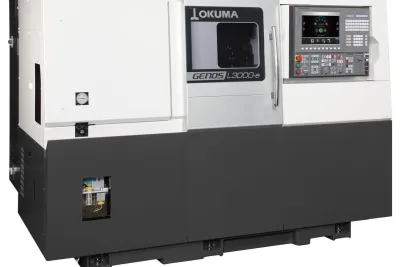
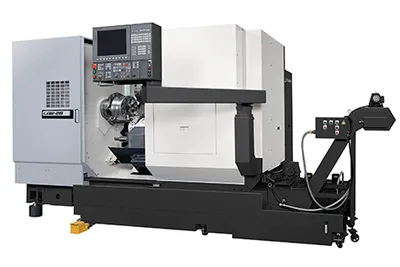
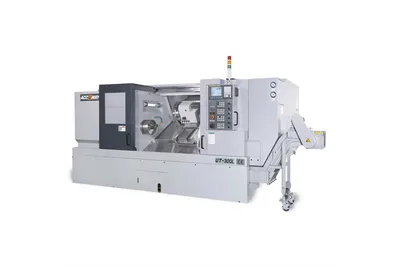
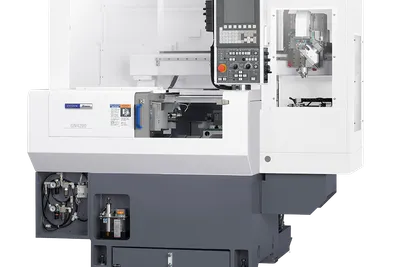
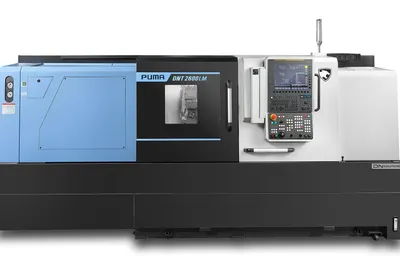
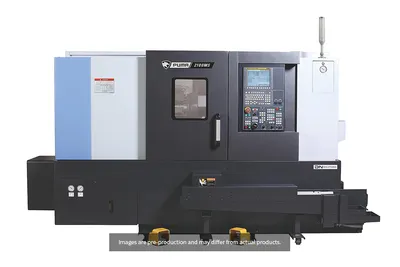
Okuma GENOS L250II
Key Specifications
Max Spindle
Rapid Traverse
Spindle Power
Max Turn Length
Accuracy
Repeatability
Overview
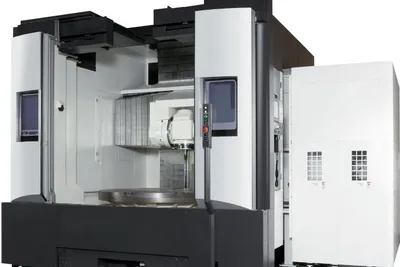
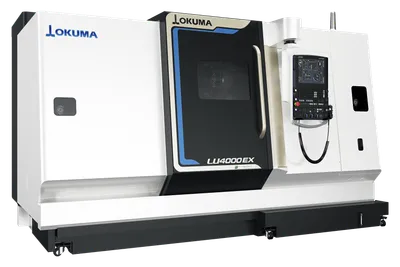
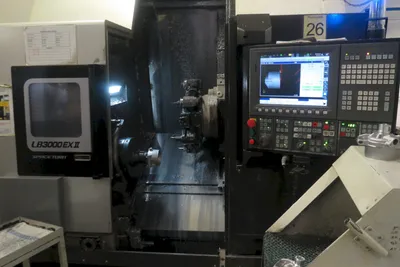
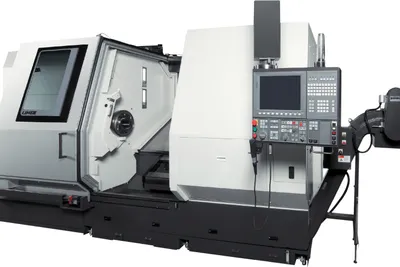
The Okuma GENOS L250II is Okuma's compact horizontal turning center designed for high-precision production of small to mid-size parts. Built at Okuma's Oguchi plant in Japan, the L250II shares the same integral spindle motor technology found in Okuma's larger lathes, eliminating belt-driven vibration for superior surface finishes on demanding materials. It targets shops that need Okuma-grade accuracy and thermal stability in a smaller, more affordable package.
Max turning diameter is 250 mm (9.8 in) with a swing over bed of 410 mm (16.1 in). Standard turning length is 250 mm (9.8 in), with a 500 mm (19.7 in) option for longer parts. The spindle delivers 11/7.5 kW (15/10 hp) at up to 6,000 RPM through a JIS A2-5 spindle nose. Bar capacity is 46 mm (1.8 in), covering common small-diameter production bar stock. The 6-inch hydraulic chuck keeps things compact and rigid for high-speed chucking work.
The 12-station turret accepts both OD and ID tools with quick indexing for minimal non-cutting time. Rapid traverse rates hit 20 m/min on X and 24 m/min on Z, which is competitive for a compact lathe in this class. The machine sits on a 30-degree slant bed casting with hardened and ground box ways for rigidity and long-term geometric accuracy.
Okuma's OSP-P300SA control runs the show, integrating Thermo-Friendly Concept thermal compensation and optional Collision Avoidance System. The control handles both G-code and Okuma's One Touch IGF conversational programming. At approximately 3,200 kg (7,055 lb), the L250II has a compact footprint that fits into cells and small shops where floor space is at a premium.
The GENOS L250II competes directly with the Haas ST-10Y, Doosan Lynx 2100, and DMG Mori CLX 350 in the compact lathe segment. It typically costs more than the Haas but delivers measurably better thermal stability and surface finish quality. For shops running tight-tolerance small parts across multiple shifts, the integral spindle and Thermo-Friendly Concept provide real production advantages. Specs sourced from Okuma published data.
Full Specifications
| Parameter | Value |
|---|---|
| Max Turning Diameter | Ø 280 |
| Max Turning Length | 290 |
| Swing Over Bed | 410 mm (16.1 in) |
| Max Spindle Speed | 6,000 RPM |
| Spindle Motor Power | 11/7.5 kW (15/10 hp) |
| Spindle Nose | JIS A2-5 |
| Chuck Size | 6 in (165 mm) |
| Bar Capacity | 46 mm (1.8 in) |
| Turret Stations | 12 |
| X Axis Travel | 155 mm (6.1 in) |
| Z Axis Travel | 310 mm (12.2 in) |
| Rapid Traverse Rate | 25/30 |
| Positioning Accuracy | ±0.005 mm |
| Repeatability | ±0.003 mm |
| Machine Weight | 3,200 kg (7,055 lb) |
| CNC Control | Okuma OSP-P300SA |
| Speed Range | 30~3,000 |
| Power 30 Min | 11 |
| Power Cont | 7.5 |
| Rapid Traverse X Z | 82/98 |
| Okuma Global Repair Center | Charlotte, North Carolina |
| Inches | Metric |
| Spindle Nose Type | JIS A2-6 |
Specifications sourced from okuma.com — verified 2026-03-28
Strengths & Limitations
Strengths
- Integral spindle motor eliminates belt vibration for excellent surface finishes on precision small parts
- 6,000 RPM spindle speed handles high-speed finishing on aluminum and brass better than most compact lathes in this class
- Compact footprint fits into tight shop layouts and automation cells without sacrificing rigidity
- Thermo-Friendly Concept maintains dimensional accuracy across full shifts without climate-controlled shop environments
- OSP-P300SA control with Collision Avoidance System protects against costly programming crashes
- Box way construction provides long-term geometric accuracy that linear guide compacts can't match
Limitations
- 46 mm bar capacity limits bar stock diameter; shops running larger stock need to step up to the GENOS L3000-e
- Starting around $80K, it costs 30-40% more than a Haas ST-10 with comparable turning specs
- OSP control requires operator retraining for shops standardized on Fanuc
- 250 mm standard turning length is short; the 500 mm option adds cost for longer parts
Best For
Frequently Asked Questions
01
New GENOS L250II machines typically run $80,000-$130,000 depending on configuration. Base turning-only models start around $80,000-$90,000. Adding milling capability and Y-axis pushes pricing toward $110,000-$130,000. Used machines from recent years sell for $50,000-$75,000 depending on hours and options.
02
The Okuma has an integral spindle motor (no belts), Thermo-Friendly thermal compensation, and generally delivers better surface finishes and tighter tolerance holding over long runs. The Haas ST-10 costs less, has a larger service network in North America, and uses a Fanuc-compatible control that most operators already know. For pure precision production, the Okuma wins; for value and operator availability, the Haas is compelling.
03
Yes, in the M (milling) and MY (milling + Y-axis) configurations. The M variant adds driven tool capability to the 12-station turret for cross-drilling, tapping, and light milling. The MY variant adds Y-axis travel for off-center milling work, reducing or eliminating secondary operations on a VMC.
04
The L250II pairs well with magazine bar feeders from LNS, Iemca, and Edge Technologies. The 46 mm bar capacity accommodates most common small-diameter bar stock. Okuma offers bar feeder prep as a factory option, which is significantly cheaper than retrofitting after delivery.
05
With a bar feeder, parts catcher, and chip conveyor, the L250II can run unattended for extended periods. The Collision Avoidance System adds a safety layer against crashes during unmanned operation. For full lights-out capability, the MYW variant with sub-spindle enables complete part processing without manual intervention.
Videos
Morris
Okuma America Corporation
Community Discussions
Community discussion — Okuma Genos L250II-e for sale - only 84 cut hours
Community discussion — Trouble finding working post processor for Okuma Genos L250II ...
Troubleshooting and problem-solving — New Okuma Genos L250 says needs 220 volts power question guys
Community discussion — Okuma L250 thru coolent
Owner experience and review — What are your experience with okuma machines? :
Troubleshooting and problem-solving — Question for Okuma lathe users : r/Machinists - Reddit
Capabilities and material handling — Okuma...Love or Hate? : r/Machinists - Reddit
Troubleshooting and problem-solving — Problem with compensation when milling on Okuma - RedditIf your shop had the money, what 5-axis mill and what lathe ...As promised. My shops 1985 Okuma. : r/Machinists - RedditHow do set tools and zero on Okuma sub side? :
Links to community discussions. Summaries are editorial — visit the original thread for full context.