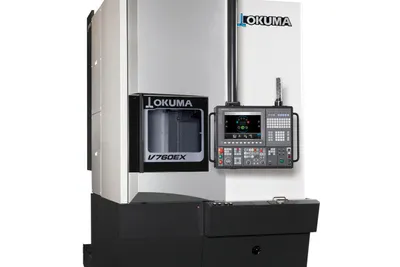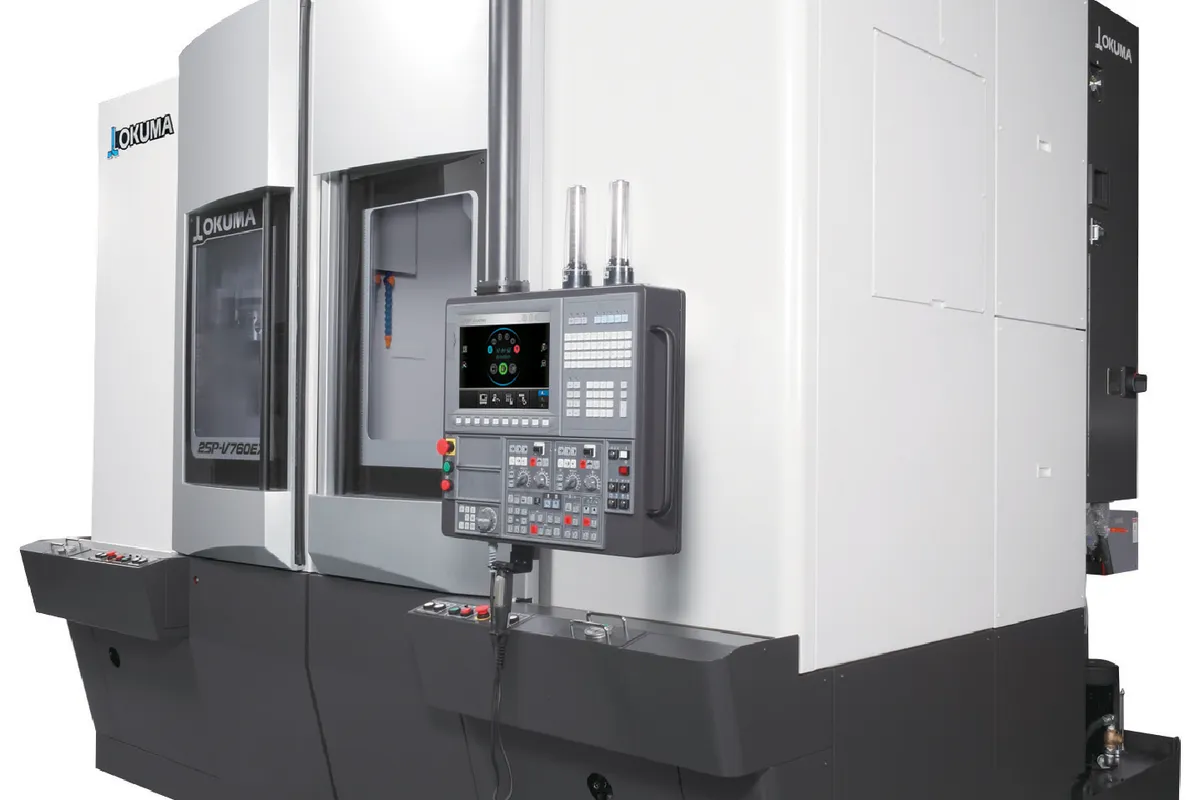
Okuma 2SP-V760EX
Key Specifications
Max Spindle
Rapid Traverse
Spindle Power
max turning diameter
max turning height
spindle torque
Overview
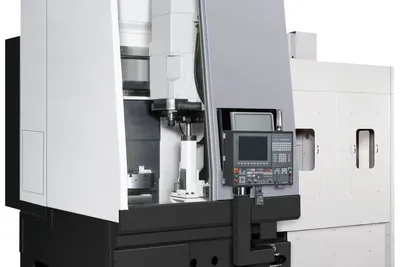
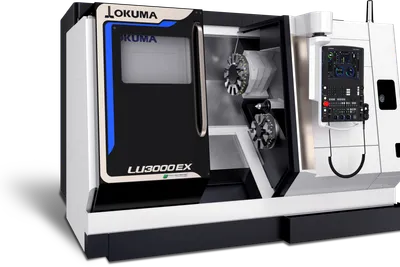
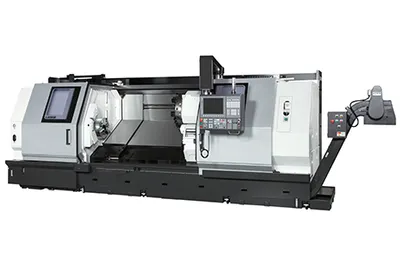
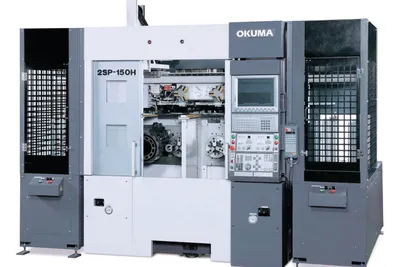
The Okuma 2SP-V760EX is a twin-spindle inverted vertical CNC lathe designed for high-volume production of disc-shaped and flanged parts. The machine uses two independent vertical spindles that pick up raw blanks, machine them at separate stations, and deposit finished parts, creating a continuous flow that dramatically reduces cycle times compared to single-spindle vertical lathes. Each spindle handles a maximum turning diameter of 300 mm (11.8 in) with a maximum turning height of 200 mm (7.9 in), targeting the sweet spot for automotive brake rotors, hubs, pulleys, gears, and bearing races.
Each spindle delivers 18.5/15 kW (25/20 hp) at a maximum speed of 3,000 RPM with 250 Nm of torque through a hydraulic chuck. The dual-spindle architecture means one spindle handles OP10 while the other runs OP20 simultaneously, effectively halving the floor-to-floor time compared to a single-spindle machine. The inverted spindle design lets gravity assist chip evacuation, keeping the cutting zone clean and reducing chip recutting that plagues horizontal lathe setups on disc parts.
The turret on each station carries 12 tools in a VDI 40 format with optional driven tools for cross-drilling and light milling operations. X-axis travel is 230 mm (9.1 in) and Z-axis travel is 300 mm (11.8 in) per station, with rapid traverse rates of 30 m/min on both axes. The gantry loader is integrated into the machine design, not bolted on as an afterthought, which keeps the footprint compact and the automation reliable.
Okuma's Thermo-Friendly Concept comes standard, maintaining dimensional accuracy across shifts without manual offset adjustments. The OSP-P300L control handles both spindles and the gantry loader from a single interface, simplifying programming for operators managing multiple stations. Collision Avoidance System protects the twin-spindle configuration from crashes during setup.
The 2SP-V760EX competes with the Emag VL 3 DUO, Fuji CSD-300II, and Doosan V8300M twin-spindle variants. At approximately $450,000-$650,000 depending on configuration, it targets Tier 1 and Tier 2 automotive suppliers running three-shift production. Shops producing 200,000+ parts per year see the strongest ROI from the twin-spindle architecture. Machine weight is approximately 11,500 kg (25,353 lb) and floor space runs 4,200 x 2,600 mm.
Full Specifications
| Parameter | Value |
|---|---|
| Max Turning Diameter | 300 mm (11.8 in) per spindle |
| Max Turning Height | 200 mm (7.9 in) |
| Max Spindle Speed | min⁻¹ |
| Spindle Motor Power | 30/22 |
| Spindle Torque | 250 Nm (184 ft-lb) per spindle |
| Number Of Spindles | 2 (inverted vertical) |
| Chuck Size | 250 mm (10 in) hydraulic |
| Turret Type | VDI 40, 12-station (per station) |
| X Axis Travel | 230 mm (9.1 in) |
| Z Axis Travel | 300 mm (11.8 in) |
| Rapid Traverse Rate | 24 |
| Gantry Loader | Integrated, built-in |
| Machine Weight | 11,500 kg (25,353 lb) |
| Floor Space | 4,200 x 2,600 mm (165 x 102 in) |
| CNC Control | Okuma OSP-P300L |
| Max Cutting Diameter | Ø760 |
| Max Cutting Length | 770 |
| Swing Over Bed | mm |
| Okuma Global Repair Center | Charlotte, North Carolina |
| Inches | Metric |
| Max Swing | Ø800 |
| Spindle Speed | 20~2,000 |
Specifications sourced from okuma.com — verified 2026-03-28
Strengths & Limitations
Strengths
- Twin-spindle architecture runs OP10 and OP20 simultaneously, effectively halving cycle time compared to single-spindle vertical lathes for disc-shaped parts
- Inverted spindle design uses gravity for chip evacuation, keeping the cutting zone clean and eliminating chip recutting common on horizontal lathes
- Integrated gantry loader provides reliable automation without the complexity and footprint of a bolt-on robot cell
- Thermo-Friendly Concept holds tolerances across three-shift production without manual offset adjustments between shifts
- Compact footprint relative to two separate vertical lathes plus a robot, saving floor space in automotive production lines
- Okuma OSP control manages both spindles and the gantry from a single interface, reducing programming and setup complexity
Limitations
- High capital cost of $450,000-$650,000 limits ROI to shops running 200,000+ parts per year in three-shift production
- OSP control is proprietary to Okuma with no Fanuc or Siemens option, requiring dedicated training for operators not already on Okuma platforms
- 300 mm max turning diameter restricts the machine to disc and flanged parts; larger components need the V920EX or standalone vertical lathes
- Twin-spindle configuration is optimized for high-volume repeat work and offers limited flexibility for job shop environments with frequent changeovers
Best For
Frequently Asked Questions
01
A new 2SP-V760EX typically runs $450,000-$650,000 depending on tooling configuration, driven tool options, and gantry loader specifications. The twin-spindle architecture commands a significant premium over single-spindle vertical lathes, but the per-part cost advantage at high volumes justifies the investment for shops running 200,000+ parts per year.
02
Both are twin-spindle inverted vertical lathes targeting automotive disc parts. The Emag VL 3 DUO uses a modular approach with separate VL 3 modules linked by a TrackMotion system, while the 2SP-V760EX integrates both spindles and the gantry in a single machine frame. Okuma's Thermo-Friendly Concept and Collision Avoidance System are advantages over the Emag. The Emag may offer slightly more flexibility in reconfiguring the line layout.
03
The machine excels at disc-shaped and flanged parts under 300 mm diameter and 200 mm height: brake rotors, brake drums, wheel hubs, pulleys, flywheels, bearing races, and gear blanks. Parts requiring both OP10 and OP20 turning operations see the greatest benefit from the twin-spindle architecture.
04
Yes, with optional driven tools in the VDI 40 turret. The machine can perform cross-drilling, tapping, and light milling on disc parts. However, for heavy milling or complex multi-axis work, a dedicated mill-turn machine like the Okuma MULTUS series is a better choice.
05
The 2SP-V760EX runs Okuma's OSP-P300L control, which manages both spindles and the integrated gantry loader from a single operator interface. The OSP-P300L includes Thermo-Friendly Concept for thermal compensation and Collision Avoidance System for crash protection during setup.
Videos
Okuma Europe GmbH
GreenBau Tehnologie
Automatics & Machinery
Okuma Europe GmbH
OKUMA CORPORATION JAPAN
Community Discussions
Options and configuration advice — 5 Axis machine evaluationOkumavs DMG Mori
Troubleshooting and problem-solving — OkumaOSP-200 ALARM 2715 "Wrong T Command" 15
Owner experience and review — practicalmachinist.com/forum/threads/okuma-2-spindle-axis.441839
Community discussion — How do you back up OKUMA OSP control? - CNCzone
Community discussion — Okuma - CNCzone
Troubleshooting and problem-solving — Problem Okuma System Variables - CNCzone
Community discussion — Need Help! Tool Wear Offset - Turn Milling - CNCzone
Pricing and buying discussion — What are your experience with okuma machines? :
Community discussion — Okuma...Love or Hate? : r/Machinists - Reddit
Community discussion — Asking advice for a fresh cut- switching from okuma multus to ...
Comparison and buying advice — Helping the boss spend money : r/Machinists - Reddit
Links to community discussions. Summaries are editorial — visit the original thread for full context.