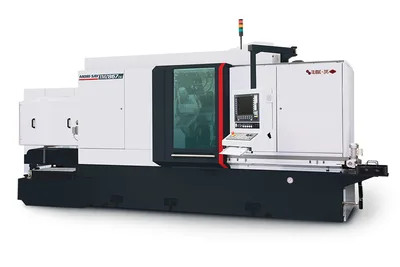
New Britain Machine Model 54
This model was not found in New Britain Machine's current lineup when we checked on 2026-10-03 . It may be a superseded or older model; the specifications below are as we last recorded them.
Key Specifications
number of spindles
max bar or chuck diameter
spindle speed range
main spindle drive
cross slides
end working slides
How much does the New Britain Machine Model 54 cost?
Estimated price range
Our best estimate for a multi-spindle automatic in this class — not a quote from New Britain Machine. Configuration moves it a long way.
Overview
Chucking work, not bar work, is what the New Britain Machine Model 54 is listed for: a 6-spindle multi-spindle automatic with 4 in (102 mm) chucking capacity and a weight of approximately 30,000 kg (66,000 lb). The model is not in New Britain Machine's current range and the table has not been confirmed against a maker's page, so these are the listed figures only.
The capacity row is the one to read closely. It is headed as bar or chuck diameter but the value is a chucking capacity, and the loading row gives manual or automated chucking depending on the application. That points at forgings, castings and sawn blanks loaded one at a time, where the six stations divide a long turning cycle into overlapping operations. How the parts get in and out, by hand or by automation, decides the real output and should be settled per machine.
In the CNC configuration the main spindle drive is an AC servo, the cross slides are CNC servo-driven per spindle position and the end-working slides are servo-driven. The control is a multi-channel CNC, Siemens or Fanuc depending on configuration. Spindle speed is described only as variable and appropriate to large-diameter chucking applications; there is no rpm figure, and no power figure either.
Coolant is listed as high-flow flood with chip management, which fits the chip volume of roughing 4 in (102 mm) blanks on six stations at once. Check the floor before anything else: approximately 30,000 kg (66,000 lb) is a foundation and rigging job.
Full Specifications
| Parameter | Value |
|---|---|
| Number of Spindles | 6 |
| Max Bar or Chuck Diameter | 4 in (102 mm) chucking capacity |
| Spindle Speed Range | Variable, appropriate to large-diameter chucking applications |
| Main Spindle Drive | AC servo (CNC configuration) |
| Cross Slides | CNC servo-driven per spindle position |
| End Working Slides | CNC servo-driven |
| Workpiece Loading | Manual or automated chucking (application-dependent) |
| CNC Control | Multi-channel CNC (Siemens or Fanuc, configuration-dependent) |
| Coolant System | High-flow flood coolant with chip management |
| Machine Weight | Approx. 30,000 kg (66,000 lb) |
Specifications compiled from manufacturer literature and industry references. Not independently verified against a published spec sheet — confirm with the manufacturer or an authorised dealer before making a purchasing decision.
Strengths & Limitations
Strengths
- 4 in (102 mm) chucking capacity across 6 spindles, per the listed figures
- Cross slides are CNC servo-driven per spindle position, with servo-driven end-working slides
- Loading is listed as manual or automated chucking, so the same machine can be fed by an operator or by a loader
- High-flow flood coolant with chip management is part of the listed equipment
Limitations
- No spindle speed in rpm and no spindle power are listed; speed is described only as variable
- Approximately 30,000 kg (66,000 lb), so foundation, rigging and floor space need planning
- The servo drive and CNC slides are tied to the CNC configuration, and the control make depends on configuration
- Not in the maker's current range, and the listed figures have not been confirmed against a maker's page
Best For
Frequently Asked Questions
01
The listed figures describe a chucker. The capacity is given as 4 in (102 mm) chucking capacity and workpiece loading as manual or automated chucking, depending on the application. No bar feed is listed in the table, so do not assume one is fitted.
02
Neither is stated as a figure. The speed row says variable, appropriate to large-diameter chucking applications, and the drive row says AC servo in the CNC configuration. There is no power row. Take both from the nameplate and documentation of the machine being considered.
03
The control row lists a multi-channel CNC, Siemens or Fanuc, configuration-dependent. Which of the two a given machine carries has to be checked on that machine, along with the control generation, before you plan programming and support.
04
The listed weight is approximately 30,000 kg (66,000 lb). That is a figure for planning rigging and the foundation, and it should be confirmed against the machine's own data plate because the table has not been checked against a maker's page.
More from New Britain Machine
New Britain Model 52 CNC Multi-Spindle Automatic Lathe
New Britain Model 42 CNC Multi-Spindle
New Britain Model 52
New Britain Machine CNCMatic
New Britain Machine Model 832
New Britain Model 60 CNC Multi-Spindle Automatic Lathe
Other Multi-Spindle Automatics
Tornos MultiDeco 26/6b
INDEX MS 16 Plus