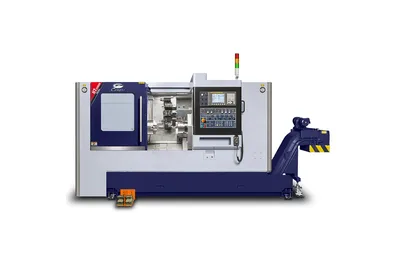
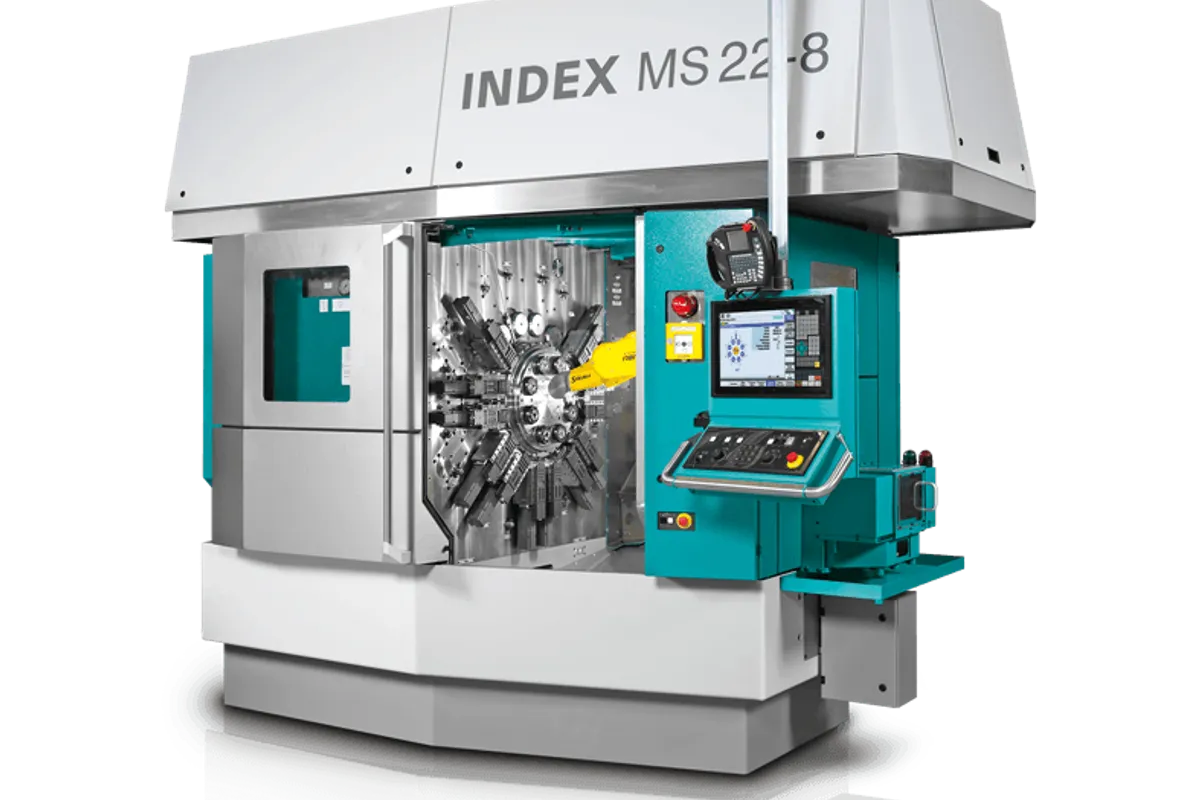
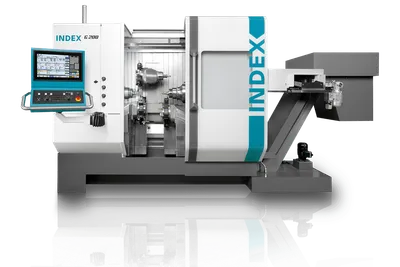
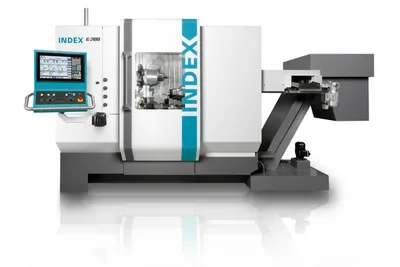
INDEX MS22C
Key Specifications
Max Spindle
Spindle Power
work spindles
max bar capacity
spindle torque
tool carriers
How much does the INDEX MS22C cost?
Estimated price range
Our best estimate for a cnc lathes / turning center in this class — not a quote from INDEX-Werke. Configuration moves it a long way.
Overview
The INDEX MS22C is a 6-spindle CNC multi-spindle automatic for bar up to 22 mm (0.86 in), with each work spindle running to 10,000 rpm. Machines of this type exist for one job: turning out large quantities of small precision parts, with every spindle position cutting at once so that a finished part drops every index.
Each spindle is rated 8.7 kW at 100% and 15 kW at 25% duty (11.6 / 20.1 hp), with 10 Nm continuous and 18 Nm at 25% duty (7.4 / 13.3 ft-lbf). The 10,000 rpm figure comes with a caveat in the listed figures: the speed limit depends on bar diameter, bar guide and part clamping, so long thin bar may not run at full speed. 11 tool carriers work across the spindle positions, with slide travel of 62 mm (2.4 in) in X, 85 mm (3.3 in) in Z and ±12 mm (±0.5 in) in Y.
The back end is what decides how complete the part is when it leaves the machine. The MS22C takes 1 or 2 synchronous spindles, each with a 22 mm clamping diameter, 10,000 rpm, 9.2 kW at 100% and 12 kW at 40% duty, 11 / 14 Nm, a pivoting angle of 132° (165°) and 120 mm (4.7 in) of Z travel. Each synchronous spindle has 3 backworking tools, of which a maximum of 2 are driven, and back-drilling slides are optional.
The control is listed as INDEX C200-SL, based on Siemens 840D solution line, with teleservice, spindle stop and C-axis as standard. Polygon turning, gear hobbing, tool monitoring, Y-axis and transmit function are options. The listed figures give a connected load of 62 kW, 75 kVA and 105 A at 400 V, 50/60 Hz, dimensions of 3,330 x 1,830 x 2,854 mm without bar guide or loading magazine, and a weight of approx. 5,700 kg (12,566 lb). The MS22C-8 sibling is listed at approx. 7,100 kg (15,653 lb) with the same spindle ratings.
Full Specifications
| Parameter | Value |
|---|---|
| Work Spindles | 6 |
| Max Bar Capacity | 22 mm (0.86 in) |
| Max Spindle Speed | 10,000 rpm (speed limits depend on bar diameter, bar guide and part clamping) |
| Spindle Motor Power | 8.7 kW at 100% / 15 kW at 25% duty (11.6 / 20.1 hp) |
| Spindle Torque | 10 Nm at 100% / 18 Nm at 25% duty (7.4 / 13.3 ft-lbf) |
| Tool Carriers | 11 |
| Slide Travel X | 62 mm (2.4 in) |
| Slide Travel Z | 85 mm (3.3 in) |
| Slide Travel Y | ±12 mm (±0.5 in) |
| Synchronous Spindles | 1 or 2; clamping diameter 22 mm; 10,000 rpm; 9.2 kW at 100% / 12 kW at 40% duty (12.3 / 16.1 hp); 11 / 14 Nm (8.1 / 10.3 ft-lbf); pivoting angle 132° (165°); Z travel 120 mm (4.7 in) |
| Backworking Tools | 3 per synchronous spindle, max. 2 driven; optional back-drilling slides 1+2 with X travel 62 mm (2.5 in) |
| CNC Control | INDEX C200-SL (based on Siemens 840D solution line) with teleservice, spindle stop and C-axis as standard |
| Connected Power | 62 kW, 75 kVA, 105 A; 400 V, 50/60 Hz |
| Dimensions Lxwxh | 3,330 x 1,830 x 2,854 mm (131.1 x 72 x 112.4 in), maximum configuration without bar guide or loading magazine |
| Machine Weight | approx. 5,700 kg (12,566 lb) |
Specifications sourced from static.machinetools.com — verified 2026-09-24
Strengths & Limitations
Strengths
- 6 work spindles, each to 10,000 rpm, for high-volume small parts
- 1 or 2 synchronous spindles with 3 backworking tools each, up to 2 driven
- 11 tool carriers with ±12 mm (±0.5 in) Y travel on the slides
- Teleservice, spindle stop and C-axis are standard on the INDEX C200-SL control
- Weighs approx. 5,700 kg (12,566 lb), against approx. 7,100 kg (15,653 lb) for the MS22C-8
Limitations
- Bar capacity is 22 mm (0.86 in), so only small-diameter parts
- Spindle torque is 10 Nm continuous and 18 Nm at 25% duty, light for heavy cuts
- Polygon turning, gear hobbing, tool monitoring, Y-axis and transmit are options
- Full 10,000 rpm depends on bar diameter, bar guide and clamping
Best For
Frequently Asked Questions
01
6 work spindles, each running to 10,000 rpm with 8.7 kW at 100% and 15 kW at 25% duty. On top of that it takes 1 or 2 synchronous spindles for back-end machining, each with a 22 mm clamping diameter.
02
Up to 22 mm (0.86 in). The listed figures note that the 10,000 rpm limit depends on bar diameter, bar guide and part clamping, so check the achievable speed for your bar size and length.
03
Each synchronous spindle has 3 backworking tools, of which up to 2 can be driven. The synchronous spindles run to 10,000 rpm, pivot through 132° (165°) and have 120 mm (4.7 in) of Z travel. Back-drilling slides are optional.
04
Polygon turning, gear hobbing, tool monitoring, Y-axis and transmit function are listed as options. Teleservice, spindle stop and C-axis come as standard with the INDEX C200-SL control, which is based on Siemens 840D solution line.
05
Connected load is 62 kW, 75 kVA and 105 A at 400 V, 50/60 Hz. The machine measures 3,330 x 1,830 x 2,854 mm in its maximum configuration without bar guide or loading magazine, and weighs approx. 5,700 kg (12,566 lb).
Videos

INDEX - better.parts.faster.

INDEX Corporation

MethodsEquipment

RDMO Second-Hand Machine Tools
More from INDEX-Werke
Other CNC Lathes / Turning Centers
Haas ST-55SY
Takamaz XT-6
Goodway GV-2000
Hyundai WIA SE2200YA Series
Johnford ST-130C