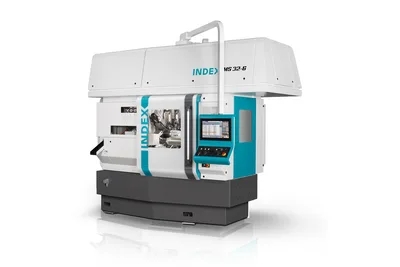
Index MS 40E
Key Specifications
Max Spindle
Spindle Power
Accuracy
number of spindles
max bar diameter
spindle speed independent
Overview
The Index MS 40E is a CNC multi-spindle automatic turning machine from Index-Werke GmbH & Co. KG, headquartered in Esslingen am Neckar, Germany. Index's MS series spans bar capacities from 16 mm (MS 16) to 40 mm (MS 40), with the MS 40E targeting the mid-range multi-spindle market for automotive, hydraulic fitting, and industrial component production requiring up to 40 mm bar stock.
The MS 40E handles bar stock up to 40 mm diameter across 6 spindles — a larger capacity than most competitor offerings in the 32–36 mm class (Tornos Sigma 32, Schütte SC 32). This larger capacity addresses hydraulic fittings, valve bodies, and shaft components that exceed 32 mm bar requirements. Independent spindle speed control allows each station to run at optimal cutting speed for its operation, and the Index C200-4D Siemens-based control provides the same programming environment used across the Index CNC turning product line.
With 6 spindles in parallel, the MS 40E produces parts at 4–6x the rate of a single-spindle turning center on the same part. For shops producing brass hydraulic fittings, automotive fuel system connectors, and precision steel shafts at 500,000+ parts/year, the MS 40E's cycle time advantage translates directly to lower cost per part and competitive pricing capability.
The MS 40E competes with the Tornos Sigma 32 (32 mm), the Schütte SC 32 (32 mm), and the Hydromat EPIC in the larger multi-spindle class. Index's advantages at 40 mm are the larger bar capacity that competitors' 32 mm machines cannot accommodate and the familiar C200-4D Siemens-based control. Pricing typically runs $600,000–$1,100,000.
Full Specifications
| Parameter | Value |
|---|---|
| Number Of Spindles | 6 |
| Max Bar Diameter | 40 mm (1.57 in) |
| Max Spindle Speed | 7,000 rpm |
| Spindle Speed Independent | Yes |
| Cross Slide Stroke | 80 mm (3.1 in) |
| Longitudinal Stroke | 155 mm (6.1 in) |
| Tool Stations | Up to 16 cross tools + 6 longitudinal tool posts |
| Live Tooling | Yes |
| Back Working | Yes (optional back-working unit) |
| Positioning Accuracy | ±0.005 mm |
| Machine Weight | 20,000 kg (44,092 lb) |
| CNC Control | Index C200-4D (Siemens 840D hardware) |
| Bar Feed | Magazine bar feeder interface (LNS, Iemca compatible) |
| Electrical | 400 VAC 3-phase 50 Hz |
| Guest Name | Dietary Restriction |
| David | None |
| Bob | None |
| Nancy | None |
| Mary | Vegetarian |
| Formula | Formula Output |
| Index | 3 |
| Goal | Formula |
| Find Marys Dietary Restriction | =INDEX(A1:D6, MATCH("Mary", A1:A6, 0), MATCH("Dietary Restriction", A1:D1, 0)) |
| Find Who Is At Table Number 2 | =INDEX(A1:D6, MATCH(2, D1:D6, 0), MATCH("Guest Name", A1:D1, 0)) |
| Bar Capacity | 40 mm |
| Spindle Motor Power | 24 kW |
| Spindle Torque Max | 57 Nm |
| Turret Stations | 8 |
Specifications sourced from index-group.com — verified 2026-03-28
Strengths & Limitations
Strengths
- 40 mm bar capacity is the largest in the standard multi-spindle class — accommodates hydraulic fittings, valve bodies, and larger shafts that 32 mm machines cannot process
- Siemens 840D-based control provides familiar programming environment for shops with existing Siemens machining center fleet
- 6 spindles at 40 mm bar capacity provide 4–6x the production rate of Swiss-type lathes on parts in the 32–40 mm range
- Independent spindle speed enables optimized cutting parameters for each station — critical for complex multi-material and multi-operation cycles
- Index VirtualLine offline programming enables part setup simulation without tying up the machine
Limitations
- Price of $600K–$1.1M requires sustained production volume of 1M+ parts/year to justify the capital investment
- 40 mm bar / 6-spindle configuration is the largest standard Index multi-spindle — shops needing larger bar capacity require custom or rotary transfer solutions
- Changeover complexity at 6 stations with large 40 mm tooling is time-consuming — best reserved for long production runs of 50,000+ parts
Best For
Frequently Asked Questions
01
For a mid-complexity hydraulic fitting in brass (6 operations, 3 drilling, 1 threading, 1 reaming, 1 parting): single-spindle Swiss-type lathe at 40 mm bar produces in approximately 18–30 seconds = 120–200 parts/hour. The MS 40E at 40 mm with the same part and cycle time per station: 8–15 second cycle = 240–450 parts/hour. Throughput advantage: 2–3x for this part complexity. On simpler parts (3 operations): Swiss-type 10–15 seconds = 240–360 parts/hour; MS 40E 4–8 seconds = 450–900 parts/hour. The MS 40E advantage is larger on simpler parts where the Swiss-type cycle is not constrained by complex operations. On very complex parts requiring 8+ operations, the MS 40E's parallel processing advantage grows further.
02
Parts in the 33–40 mm diameter range clearly require the MS 40E — a 32 mm machine literally cannot pass the bar. For parts in the 25–32 mm range that currently run on 32 mm machines, the MS 40E provides no additional capability (overkill in bar size). The MS 40E's value at 40 mm is for the specific component families: hydraulic fittings in 35–40 mm hex stock; automotive suspension components in 38–40 mm bar; valve stems and actuator shafts in 36–40 mm bar. These part families cannot use 32 mm multi-spindles and previously required single-spindle production — the MS 40E enables multi-spindle economics for these larger components.
03
The most significant difference is bar capacity: Tornos Sigma 32 handles up to 32 mm bar; Index MS 40E handles up to 40 mm bar. For fittings that fit in 32 mm bar, the Sigma 32 is a perfectly capable alternative and is preferred by many fitting manufacturers for its TISIS software's intuitive interface. For fittings requiring 33–40 mm bar (larger BSP and NPT fittings, larger hydraulic couplings), only the MS 40E accommodates the workpiece. In terms of spindle speed and precision: both machines achieve comparable accuracy and surface finish for brass. The choice is primarily driven by bar size requirements and existing control platform familiarity (TISIS/Tornos vs Siemens/Index).
04
For the Index MS 40E at 40 mm bar: LNS Challenge M 80 S (handles up to 80 mm bar, appropriate for 40 mm with 6-meter bar capacity); Iemca BOSS 542 (60 mm max, suitable for 40 mm); FMB Turbo 80 (80 mm max capacity). All three are magazine bar feeders that automatically load from a bar stock magazine and feed bars into the machine spindle without operator intervention. Capacity: typically 6 bars per magazine cycle = approximately 2–4 hours of production per fill. Bar straightness is important at 40 mm — bars with excessive bend cause vibration and premature collet wear. Index provides bar feeder interface specifications for each of these systems.
05
MS 40E setup process for a new part: (1) Program the part offline in Index VirtualLine — define all 6 station operations, tool geometries, and NC cycles; simulate for collisions and cycle balance; (2) Transfer program to machine; (3) Mount tooling at all 6 stations (toolholders, inserts, boring bars, threading tools) — approximately 2–3 hours for complete tooling change; (4) Set bar feed collet (change if bar diameter changes); (5) Set bar feeder guide bush diameter; (6) Run first-off parts for dimensional verification; (7) Adjust tools to print dimensions; (8) Release for production. Total setup time: 3–6 hours for a moderately complex changeover. Production runs of 10,000+ parts are economical; runs under 5,000 parts should be evaluated carefully against single-spindle cost.
Community Discussions
Owner experience and review — Have any of you ran an Index Traub 200.2? : r/Machinists - Reddit
Owner experience and review — Any experience with Index multi spindle machines ... - Reddit
Community discussion — Indexable endmill meltdown : r/machining - Reddit
Troubleshooting and problem-solving — Endmill Recommendations : r/Machinists - Reddit
Links to community discussions. Summaries are editorial — visit the original thread for full context.