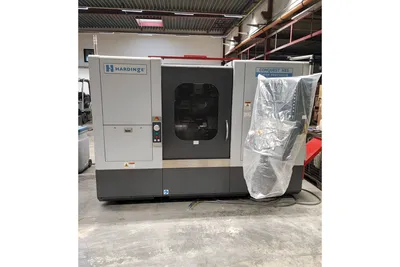
Hardinge GS-51
This model was not found in Hardinge's current lineup when we checked on 2026-10-03 . It may be a superseded or older model; the specifications below are as we last recorded them.
Key Specifications
X Travel
Z Travel
Max Spindle
Spindle Power
Max Turn Length
chuck size
How much does the Hardinge GS-51 cost?
Estimated price range
Our best estimate for a cnc lathes / turning center in this class — not a quote from Hardinge. Configuration moves it a long way.
Overview
The Hardinge GS-51 is a 51 mm (2 in) bar-capacity lathe with a hydraulic, programmable tailstock and 510 mm (20.08 in) of Z travel. It carries a 200 mm (8 in) hydraulic chuck and, in the listed figures, turns up to 356 mm (14 in) in diameter and 510 mm (20.08 in) in length.
The tailstock shapes the work. With the part held in the chuck or a 16C collet at one end and on a centre at the other, the whole 510 mm length becomes usable for shafts, pins and spindles that would chatter or deflect if left unsupported. Because the tailstock is programmable it can advance and retract inside the cycle, which matters when each part needs support only after the first cuts are done.
Cutting capacity comes from a 15 kW (20 HP) continuous spindle with 175 Nm (129 ft-lb) of torque and a 5,000 RPM top speed, on an A2-6 nose. Collet runout is listed as 3 microns (0.00012 in) or better.
Twelve tools fit the VDI turret. Box ways, hardened and ground, guide the axes; X moves 200 mm (7.87 in), and rapids are 20 m/min (787 IPM) in X and 24 m/min (945 IPM) in Z. The control in the listed figures is a Fanuc 0i-TF Plus and the machine weighs 3,800 kg (8,378 lb). Tailstock thrust and quill size are not given, so ask for them along with confirmation of the rest.
Full Specifications
| Parameter | Value |
|---|---|
| Chuck Size | 200 mm (8 in) hydraulic |
| Max Turning Diameter | 356 mm (14 in) |
| Max Turning Length | 510 mm (20.08 in) |
| Bar Capacity | 51 mm (2 in) |
| Spindle Nose | A2-6 |
| Max Spindle Speed | 5,000 RPM |
| Spindle Motor Power | 15 kW (20 HP) continuous |
| Spindle Torque | 175 Nm (129 ft-lb) |
| X-Axis Travel | 200 mm (7.87 in) |
| Z-Axis Travel | 510 mm (20.08 in) |
| Rapid Traverse X | 20 m/min (787 IPM) |
| Rapid Traverse Z | 24 m/min (945 IPM) |
| Turret | 12-station VDI |
| Guideway Type | Hardened and ground box ways |
| Collet System | 16C collet-ready |
| Collet Tir | 3 microns (0.00012 in) or better |
| Tailstock | Hydraulic, programmable |
| CNC Control | Fanuc 0i-TF Plus |
| Machine Weight | 3,800 kg (8,378 lb) |
Specifications compiled from manufacturer literature and industry references. Not independently verified against a published spec sheet — confirm with the manufacturer or an authorised dealer before making a purchasing decision.
Strengths & Limitations
Strengths
- Hydraulic, programmable tailstock for supported turning over 510 mm (20.08 in)
- 175 Nm (129 ft-lb) and 15 kW (20 HP) continuous at up to 5,000 RPM
- 16C collet-ready, with 3 microns (0.00012 in) or better collet runout
- 200 mm (8 in) hydraulic chuck and 51 mm (2 in) bar capacity on one A2-6 spindle
Limitations
- Tailstock thrust and quill dimensions are missing from the listed figures
- No live tooling, C-axis or sub-spindle row appears, so milled features and back-end work need another setup unless a machine proves otherwise
- X travel of 200 mm (7.87 in) and bar capacity of 51 mm (2 in) set the upper limits on part size
- Rapids of 20 m/min (787 IPM) in X and 24 m/min (945 IPM) in Z are unhurried
Best For
Frequently Asked Questions
01
The tailstock is listed as hydraulic and programmable, meaning it is moved by the control and not cranked by hand. The listed figures stop there: thrust, quill travel and centre taper are not given, and they decide how heavy a shaft can be supported.
02
The listed envelope is 356 mm (14 in) maximum turning diameter and 510 mm (20.08 in) maximum turning length, with X travel of 200 mm (7.87 in) and Z travel of 510 mm (20.08 in). Bar through the spindle is limited to 51 mm (2 in).
03
Yes. The spindle is listed as 16C collet-ready, with collet runout of 3 microns (0.00012 in) or better, and a 200 mm (8 in) hydraulic chuck is listed as well. The spindle nose is A2-6.
04
15 kW (20 HP) continuous, with 175 Nm (129 ft-lb) of torque and a maximum speed of 5,000 RPM. Supported between chuck and tailstock, a stiff part can take cuts that use that torque; a slender one will be limited by deflection first.
Videos

Mark Conway

MachineryNetwork

Bullseye Industrial Sales LLC

Revelation Machinery
Community Discussions
Troubleshooting and problem-solving
Troubleshooting and problem-solving
Troubleshooting and problem-solving
Links to community discussions. Summaries are editorial — visit the original thread for full context.
More from Hardinge
Other CNC Lathes / Turning Centers
DN Solutions PUMA 5100 XLYB
Danobat MTG XLD
HNK VTC-12/16F
Dainichi TL132/152
Haas ST-45LY